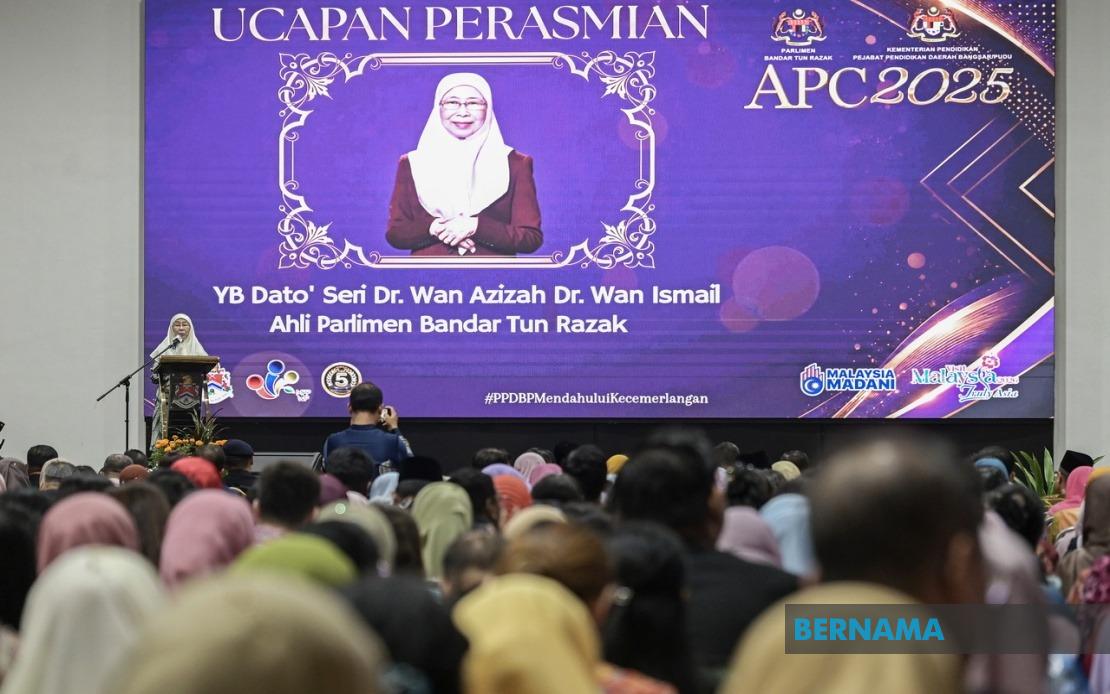
A nation's true measure of strength extends far beyond economic metrics, technological prowess or infrastructure development—it fundamentally rests on the calibre of citizens it cultivates, according to Prime Minister's wife Datuk Seri Dr Wan Azizah Wan Ismail. Speaking at the 2025 Excellent Service Award ceremony in Kuala Lumpur, the Bandar Tun Razak Member of Parliament articulated a vision of education that transcends traditional knowledge transfer, emphasising instead the development of individuals grounded in ethical principles, integrity and genuine compassion for others. Her remarks underscore a growing recognition among policymakers that Malaysia's future competitiveness hinges not merely on quantifiable outputs but on the moral and intellectual foundation of its workforce.
Dr Wan Azizah positioned educators as the architects of national character, noting that teachers occupy a uniquely influential position in shaping young minds during formative years. This observation carries particular weight in Malaysia's urban landscape, where both parents frequently engage in full-time employment and schools become de facto custodians of childhood development. The extended time children spend within educational institutions means teachers often become primary role models and moral guides, second only to family in their developmental influence. Recognising this reality, Dr Wan Azizah framed teaching not as a technical profession but as a calling that demands profound responsibility for nation-building at the individual level.
The Prime Minister's wife articulated a comprehensive vision of education that recalibrates its fundamental purpose. Rather than viewing schools primarily as knowledge-delivery systems, she advocated for a holistic approach encompassing character formation, behavioural cultivation and emotional development. This perspective resonates with contemporary educational theory that emphasises social-emotional learning alongside academic achievement. In the Malaysian context, where concerns about social cohesion and values decline periodically surface in public discourse, her emphasis on "noble character, good manners and compassionate hearts" addresses anxieties about whether traditional values are adequately transmitted to younger generations. The framing positions education as a moral endeavour with consequences extending beyond individual prosperity to collective societal wellbeing.
The technological revolution presents unprecedented challenges to traditional educational models, a concern Dr Wan Azizah explicitly addressed by invoking the artificial intelligence era. As AI systems increasingly commodify information access and automate routine cognitive tasks, the comparative advantage of human capital shifts toward attributes machines cannot replicate: ethical reasoning, creative synthesis, and values-based decision-making. Dr Wan Azizah's call for prioritising values-based education and critical thinking skills reflects sophisticated understanding that future workforce readiness demands cultivating distinctly human capabilities. The ability to discern truth from falsehood becomes increasingly valuable in an information-saturated environment where misinformation propagates with unprecedented velocity. Malaysian educators thus face mounting pressure to equip students not with rote knowledge but with intellectual tools for navigating epistemic complexity.
The 2025 Excellent Service Award ceremony itself demonstrated institutional commitment to recognising educator excellence. The event honoured 746 teachers and school administrators from 143 schools across the Bangsar/Pudu district, with approximately 1,000 attendees witnessing the recognition. This substantial scale of acknowledgment—nearly three-quarters of a thousand educators receiving formal recognition—underscores the Malaysian education system's attempt to incentivise and celebrate exemplary performance. The involvement of senior officials, including the Prime Minister's Political Secretary Datuk Azman Abidin and Kuala Lumpur Federal Territory Education Department director Megat Affandi Ismail, reflected institutional gravitas accorded to the proceedings. Such high-level participation signals that educator recognition forms part of broader policy objectives rather than representing merely ceremonial appreciation.
Dr Wan Azizah explicitly connected award recognition to broader motivational objectives, hoping recipients would feel inspired to sustain excellence while peers witnessed the institutional valuation of such performance. This dual motivation strategy—honouring outstanding practitioners while inspiring peers—reflects contemporary human resources thinking that emphasises both celebration of achievement and aspirational benchmarking. In the Malaysian education context, where teacher morale and retention present persistent challenges, public recognition by high-ranking officials provides symbolic validation of professional worth. The ceremony thus functioned as both celebration and catalyst, attempting to create cultural momentum around educational excellence.
The geographic specificity of the award—honouring contributions to organisational excellence specifically within the Bangsar/Pudu district—reflects Malaysia's federal and administrative structure while maintaining localised focus. This district-level recognition acknowledges that educational outcomes materially differ across geographic areas, with urban districts like Bangsar/Pudu potentially facing distinct challenges including resource concentration, demographic diversity and socioeconomic heterogeneity. By organisationally recognising district-specific educator excellence, authorities implicitly acknowledge that sustainable improvement emerges through distributed leadership and locally-contextualised implementation rather than purely centralised mandates. The 143 schools encompassed in the award ceremony represent substantial institutional diversity requiring differentiated leadership approaches.
The emphasis on "exemplary performance and dedication throughout 2025" embedded temporal accountability into the recognition framework. By explicitly referencing the preceding calendar year, the awards programme established clear performance periods and measurable timelines. This structured approach contrasts with perpetual or vague recognition systems, creating definitive benchmarks and accountability windows. For Malaysian educators working within bureaucratic systems often characterised by ambiguous performance expectations, such temporal clarity potentially clarifies what institutional excellence demands. The annual rhythm of recognition also creates regular touchpoints for reflecting on educational practice and identifying improvement opportunities.
Dr Wan Azizah's intervention into education policy discourse positions her as substantively engaged with pedagogy beyond ceremonial first-ladyship. Her articulation of education's purpose—developing ethical, knowledgeable, compassionate citizens rather than merely economically productive units—represents a values-inflected perspective that subtly challenges purely instrumentalist approaches to education. As Malaysia navigates rapid technological change and globalised economic competition, policymakers must balance immediate workforce development imperatives with longer-term nation-building objectives. The Prime Minister's wife's emphasis on values suggests policy receptiveness to holistic educational objectives transcending narrow economic metrics. This philosophical positioning, when integrated with institutional recognition of educator excellence, potentially influences how education policy conceptualises success and teacher performance evaluation.
The intersection of values-based education, critical thinking, and character formation that Dr Wan Azizah emphasised reflects growing international recognition that sustainable development requires cultivating citizens capable of ethical reasoning amid complexity. For Malaysia specifically, managing multicultural integration, technological disruption and regional competition simultaneously demands educational approaches nurturing both intellectual rigour and moral grounding. The national education system's capacity to prepare citizens for these interconnected challenges substantially determines Malaysia's medium-to-long-term trajectory. By elevating educator excellence recognition and explicitly connecting it to character formation and values cultivation, authorities signal that sustainable national competitiveness emerges through investments in human development transcending narrow technical skill acquisition. The 2025 Excellent Service Award ceremony thus embodied and operationalised a comprehensive vision of education's purpose in nation-building.

