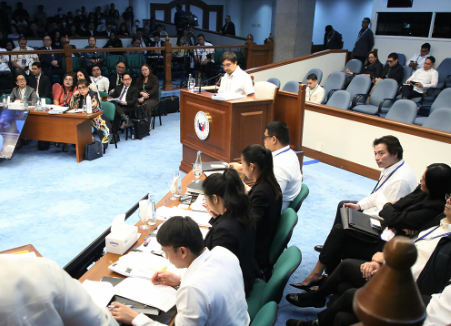
The Senate impeachment trial of Vice President Sara Duterte entered a critical phase on Tuesday when National Bureau of Investigation regional director Jeremy Lotoc testified that Duterte was fully capable of executing her threats against President Ferdinand Marcos, first lady Liza Araneta-Marcos and former Speaker Martin Romualdez. Speaking on the fifth day of proceedings, Lotoc presented the NBI's position that her controversial public statements satisfied the legal elements of grave threats and constituted a betrayal of public trust, the core allegations underpinning her impeachment.
The testimony centred on whether Duterte possessed not merely the intent but the actual means to carry out her remarks made during online forums in late November 2024. When Senate President Sherwin Gatchalian directly asked Lotoc whether the Vice President had the capability to execute such threats, the NBI official responded affirmatively without hesitation. His reasoning illuminated a crucial dimension of the prosecution's argument: that Duterte's constitutional position as second-highest official of the state, combined with her prominent political lineage and extensive networks, provided her with access to resources and mechanisms unavailable to ordinary citizens making similar threats.
Lotoc elaborated on this foundation by referencing Duterte's family history, particularly noting that her father, Rodrigo Duterte, had served as President of the Philippines. The implication was that such familial connections within political circles, coupled with her current vice-presidential authority, endowed her with practical capacity to hire or contract someone to commit violence. This argument extended beyond mere position to encompass the tangible advantages of political power, wealth, and institutional access that accompanied her office. The prosecution sought to establish that capability was not theoretical but grounded in observable, material circumstances.
A central point of contention emerged around whether the NBI had identified the alleged intermediary or assassin whom Duterte claimed to have contacted. Lotoc acknowledged candidly that investigators possessed no independent evidence proving such a person existed or had been contracted. Instead, the NBI's conclusion rested entirely on Duterte's own public statements, particularly her November 23 online press conference and a subsequent November 26 interview in which she reiterated having spoken to someone who would exact revenge should she be killed. The prosecution framed this reliance on her words as reasonable, arguing that Duterte herself had provided the most damaging evidence against her own case through repeated public declarations rather than isolated remarks.
The question of whether Duterte's words constituted joking hyperbole or genuine threat formed a battleground during testimony. Lotoc emphasised that Duterte never retracted her controversial statements, only denied having actually hired an assassin. Her November 26 interview, he noted, represented a reinforcement rather than a clarification of her earlier remarks, suggesting deliberate repetition rather than off-hand comment. This distinction proved significant to the prosecution's narrative: they portrayed Duterte as someone who consciously chose to restate threats rather than walk them back when given subsequent opportunities to do so. The pattern of reiteration, from this perspective, demonstrated seriousness of intent.
When pressed about the lack of direct evidence linking Duterte to a specific individual, Lotoc explained that investigators wanted to question her personally to clarify whether she had genuinely contracted someone. Duterte never appeared before the NBI for such questioning, instead providing only a written denial. Lotoc characterised this denial as insufficient to overcome the weight of her own public statements. For the prosecution, her absence from investigative interviews itself suggested consciousness of guilt or unwillingness to subject her claims to scrutiny, while her written rebuttal, lacking elaboration or context, carried minimal evidentiary weight.
The concept of "Operation Romanov," which Duterte had invoked as justification for believing her own life faced threats, underwent critical examination during testimony. Duterte had referenced this supposed plot to contextualise why she believed drastic measures necessary. Lotoc testified that NBI investigation traced the term to Davao City Mayor Sebastian "Baste" Duterte during a January 2024 rally, where it was directed at President Marcos and his family rather than at the Vice President herself. This reframing essentially removed a pillar from Duterte's self-defence argument, suggesting she had mischaracterised the threat landscape to justify her own inflammatory rhetoric.
The vlogger Princess Maui, who had raised the Romanov operation during Duterte's November 23 briefing, proved unhelpful to the Vice President's case. Lotoc reported that investigators deemed Princess Maui's information unreliable after she declined to appear before the NBI to substantiate her allegations. The prosecution thus highlighted how Duterte's own sources of justification either evaporated under scrutiny or failed to materialise upon investigation. This pattern reinforced the prosecution's central claim that Duterte had publicly issued threats without credible basis for believing her life faced comparable danger.
Lotoc's testimony revealed significant cooperation challenges between the Vice President's office and investigating authorities. The NBI director stated that his bureau's inquiry had stalled because neither Duterte nor her representatives provided actionable intelligence or cooperated meaningfully with investigators. This lack of engagement contrasted sharply with the prosecution's argument that transparency and cooperation would strengthen her position if her claims held merit. Instead, the absence of such cooperation implied defensive rather than exculpatory motivation.
The defence strategy during cross-examination focused on what prosecution adviser Robert Ace Barbers characterised as minor technical deficiencies. The defence highlighted typographical and clerical errors in NBI documents, seeking to undermine the credibility of investigative findings through documentation flaws. Lotoc dismissed these criticisms, maintaining that such errors did not alter the substance of the bureau's conclusions or the factual basis supporting them. This tactical divergence—prosecution concentrating on material facts and statements, defence emphasising administrative imperfections—illustrated broader tensions in how both sides constructed their narratives.
The impeachment proceedings have taken on heightened significance for Philippine governance beyond the individual Vice President. Prosecutors contend that Duterte's conduct demonstrated unfitness for the presidency, given that the Constitution establishes the Vice President as constitutional successor in case of death, incapacity or removal of the sitting President. Her publicly stated willingness to contract assassination against those currently in office thus raised fundamental questions about whether someone contemplating violence against the sitting chief executive should retain proximity to supreme power. This institutional dimension transformed the case from personal misconduct to a matter affecting constitutional stability.
Lotoc's testimony, delivered with apparent confidence in NBI findings, provided the prosecution with authoritative investigative backing for their core allegations. By establishing both intent through Duterte's own words and capability through her political position, the NBI official constructed a foundation upon which prosecutors could argue that her impeachment served not merely political interest but constitutional necessity. The Vice President's legal team faced the challenge of rebutting conclusions rooted in her own public statements while demonstrating that capability and position alone, absent proven conspiracy, failed to satisfy legal standards for grave threats.

