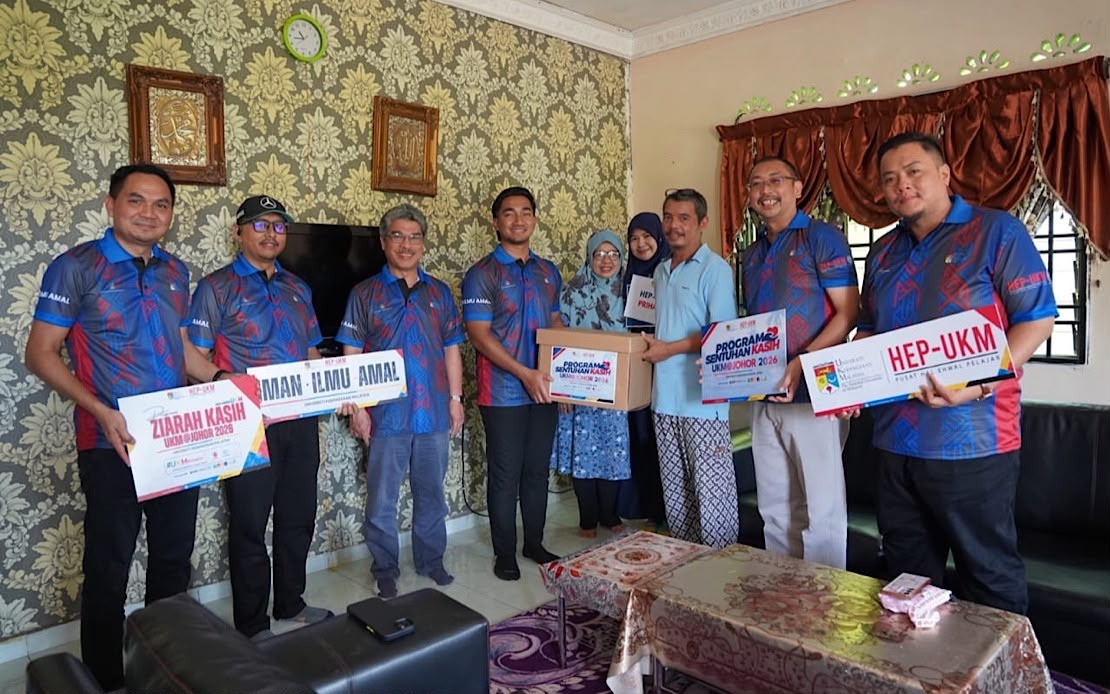
Universiti Kebangsaan Malaysia (UKM) has brought together nearly 1,000 members of the Johor community for the Sentuhan Kasih outreach initiative, a programme designed to deepen institutional ties and foster direct engagement between the university and residents beyond traditional campus boundaries. Coordinated through the institution's Student Affairs Centre, the weekend activities spanned four distinct localities including Kota Masai in Pasir Gudang, Kampung Baru Sri Aman, and two zones within Skudai, with participation from 78 UKM student volunteers and community members.
The Sentuhan Kasih UKM@Johor programme operates under the banner "Dari Kampus ke Komuniti, Menyebar Kasih dan Bakti," a philosophy that translates the university's commitment to spreading compassion and service from academic settings into residential areas. Rather than confining institutional resources and expertise within university grounds, the initiative reflects a deliberate shift towards embedding student learning within authentic community contexts where young people can apply classroom knowledge to address real neighbourhood needs and challenges.
Activities undertaken during the outreach weekend encompassed a diverse range of interventions tailored to community wellness. Beyond traditional gotong-royong collective service efforts, UKM volunteers organised mental health screening sessions—an increasingly vital service in economically transient areas—alongside recreational sports activities designed to strengthen social cohesion among residents. The programme also included ziarah kasih courtesy visits, allowing students to establish direct relationships with families and understand lived experiences within working-class neighbourhoods.
Higher Education Minister Datuk Seri Dr Zambry Abd Kadir's attendance underscored governmental recognition of university-led community engagement as aligned with broader development objectives. His presence signalled policy endorsement for institutional models that position universities as civic actors rather than purely credentialing bodies, a positioning increasingly relevant as Malaysian higher education evolves to address contemporary social priorities alongside traditional academic functions.
Associate Professor Dr Darfizzi Derawi, who directs the Student Affairs Centre and chairs the Sentuhan Kasih initiative, articulated a pedagogical argument for student participation in such programmes. According to his assessment, exposure to direct community interaction equips undergraduates with soft skills—including adaptive communication and practical problem-solving—that conventional classroom instruction cannot adequately develop. This reflects growing recognition within higher education globally that experiential learning anchored in genuine community contexts produces graduates better equipped for complex professional and civic responsibilities.
The expansion strategy outlined by HEP-UKM leadership indicates that Sentuhan Kasih represents not a one-off initiative but rather a template for systematic nationwide community engagement. By scaling the model across Malaysian states periodically, UKM signals commitment to establishing permanent institutional infrastructure for university-community partnerships rather than treating outreach as supplementary activity. This approach positions the university as a distributed social asset rather than a geographically confined facility.
Local community perspective, articulated by Herman Ismadi Ismail representing the Kota Delima Zone, highlighted mutual benefits of the engagement. For residents in predominantly industrial areas where weekend economic pressures constrain civic participation, the programme provided accessible exposure to university opportunities and initiatives. Despite approximately 80 percent of local workers engaged in industrial sector employment—typically involving weekend availability constraints—community turnout remained substantial, indicating genuine appetite for institutional partnership among working-class neighbourhoods often peripheral to university engagement efforts.
The programme's extension to direct visits with seven families of university students within Tiram and Puteri Wangsa areas represented a complementary welfare dimension, addressing student hardship through family-level assessment rather than purely institutional support channels. This approach acknowledges that student welfare extends beyond campus boundaries and recognises that socioeconomic pressures within student families can significantly impede academic focus and competitiveness.
UKM Vice-Chancellor Prof Datuk Dr Sufian Jusoh contextualised the initiative within broader institutional philosophy emphasising holistic human capital development. His framing positioned student welfare investment as extending beyond conventional financial assistance towards comprehensive environmental support that enables sustained academic engagement. This perspective reflects contemporary understanding that educational excellence depends not merely on intellectual capability but on addressing material, psychological and social conditions that either enable or obstruct academic pursuit.
The Sentuhan Kasih programme encapsulates broader institutional evolution within Malaysian higher education, where universities increasingly recognise that societal value extends beyond graduate employment preparation towards direct civic participation and community stabilisation. For Johor residents, particularly within working-class neighbourhoods often overlooked by elite institutions, such engagement represents tangible recognition that universities function as public assets whose expertise and human resources carry obligations beyond credentialing. As UKM systematises this model across regions, the initiative may establish benchmarks for university-community relations throughout Southeast Asia, where similar tensions between institutional insularity and social responsibility remain unresolved.

