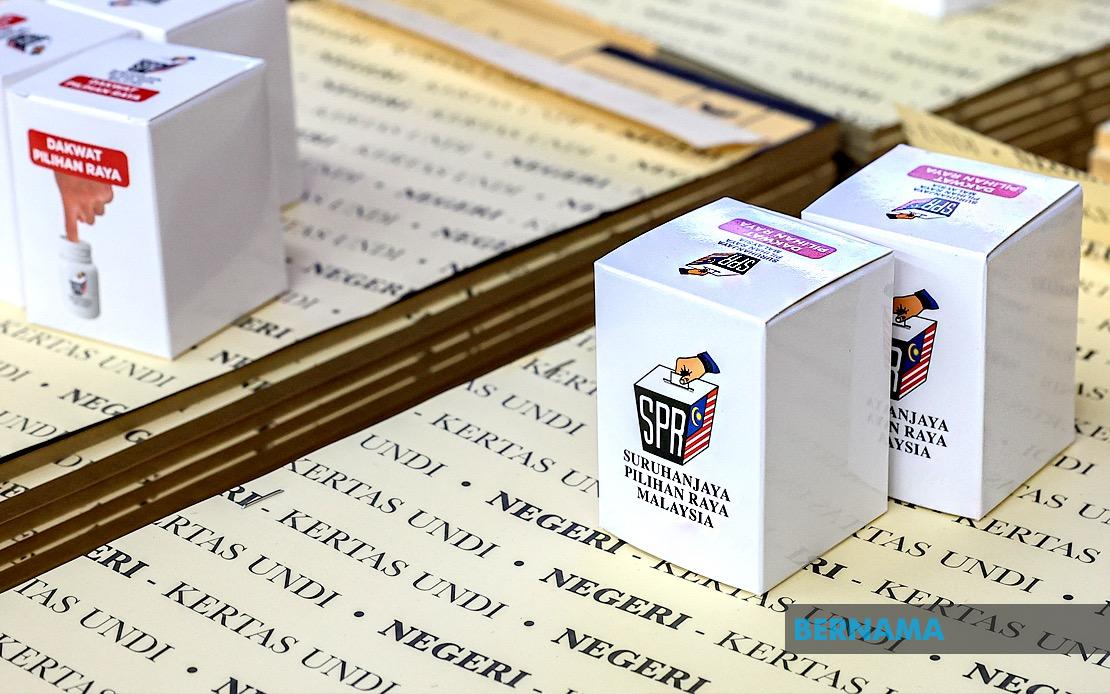
Johor is preparing for an extensive early voting exercise ahead of the 16th State Election, with nearly 25,000 eligible voters from the armed forces and law enforcement agencies scheduled to cast their ballots tomorrow. The exercise reflects standard electoral procedures that allow uniformed personnel to vote before the main polling day, which falls on Saturday, July 11. This staggered approach acknowledges the operational demands placed on security services during election periods, when they are typically required to maintain order and protect the integrity of the voting process.
The early voting contingent comprises two roughly equal halves: 12,041 military personnel and their spouses will participate through 11 dedicated polling centres, whilst 12,710 police officers and their families will vote across 53 centres. The split between active security personnel and their families underscores how election preparations ripple beyond the immediate workforce, affecting household schedules and requiring expanded electoral infrastructure. Across Johor's geography, these 64 early polling stations will open synchronously at 8 am, ensuring coordinated management and consistent treatment of voters statewide.
Within the police contingent, voting patterns reveal practical considerations in electoral logistics. Of the 12,067 police voters expected to cast ballots in person at designated centres tomorrow, a smaller group of 643 has opted for postal voting—a mechanism that accommodates those who may be unable to attend physical voting locations due to operational duties or posting elsewhere. This flexibility, while representing only about 5 per cent of police early voters, demonstrates how electoral commissions adapt to the realities of a mobile workforce spread across the peninsula.
Managing this process demands substantial security resources, creating a self-referential dynamic where law enforcement secures an election in which law enforcement votes. The deployment reaches 3,565 police personnel across multiple functional roles: 647 officers will supervise overall operations, whilst 2,806 rank-and-file officers manage polling-centre security and voter flow. An additional 112 civilian staff provide administrative support. Beyond the centres themselves, responsibilities extend to escorting ballot boxes, controlling traffic at voting locations, maintaining crime-prevention patrols, staffing operations rooms, and ensuring law enforcement presence across affected areas. This comprehensive approach reflects the premium placed on election security in Malaysia's democratic framework.
The physical organisation of early voting reveals how electoral administration accommodates uneven distributions of voters across the state. Closing times for polling centres will vary between noon and 6 pm, calibrated to the number of registered voters at each location. Smaller outposts—such as Buloh Kasap Police Station in Segamat, Tenang Police Station in Labis, and Bandar Penawar Police Station, each serving between six and 28 eligible voters—will close early after completing their rolls. Conversely, major polling hubs demonstrate significant concentration: the Federal Reserve Unit Hall No 2 at Johor Police Headquarters will accommodate 1,338 voters for the Stulang state constituency, making it the largest police early voting centre. The KEMAS Preschool at the 6th General Operations Force Battalion in Bakri ranks second, serving 927 voters for Bukit Naning constituency. These disparities underscore how electoral geography shapes administrative demands.
Weather considerations add another layer to election planning in tropical Malaysia. The Malaysian Meteorological Department has forecast morning rain for the districts of Batu Pahat, Muar, Pontian and Tangkak, whilst fair conditions are anticipated elsewhere across the state. Although precipitation typically does not significantly impede voting, weather forecasts inform contingency planning, particularly regarding ballot security and the movement of materials between centres. Such attention to meteorological detail exemplifies the methodical approach to ensuring that external factors do not compromise electoral processes.
The broader context shows Johor's election involves substantial electoral competition, with 172 candidates contesting 56 state seats. This candidate-to-seat ratio of roughly 3 per candidate indicates genuine multi-cornered contests across much of the state, suggesting that Johor voters face meaningful choices rather than predetermined outcomes. The concentration of candidates in relatively few seats reflects both population distribution and the appeal of certain constituencies to rival parties. Early voting by uniformed personnel, therefore, represents only one component of a larger electoral machinery mobilising across the state.
For Malaysian readers and Southeast Asian observers, Johor's election carries significance beyond the state itself. As Malaysia's southernmost peninsula state, directly adjacent to Singapore and serving as a major economic and commercial hub, electoral developments in Johor often possess national ramifications. The exercise of managing 25,000 early voters across 64 centres, whilst simultaneously preparing for Saturday's main polling day, demonstrates the scale of coordination required to conduct democratic elections across multi-ethnic Malaysia. The success or challenges of this early voting phase may set the tone for the broader electoral period, influencing confidence in the electoral commission's capacity to manage the final count fairly and transparently.

