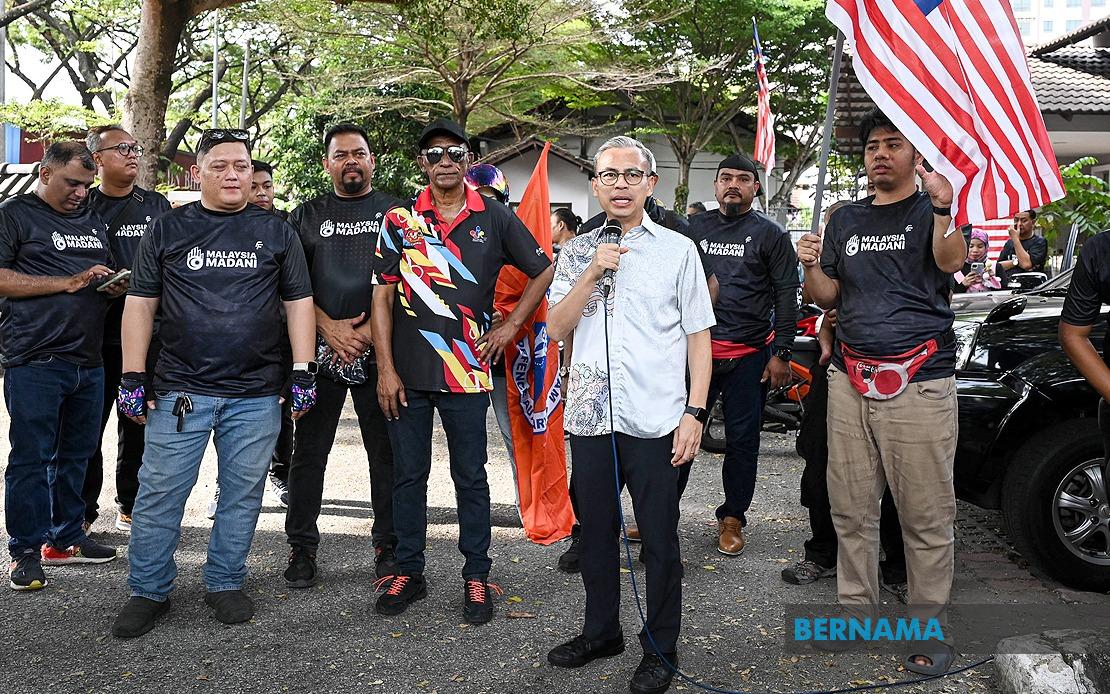
Nearly 300 motorcyclists converged on Lembah Pantai on Monday to participate in a patriotic convoy marking Malaysia's Merdeka eve celebrations, with organisers emphasising the importance of interfaith and intercommunal solidarity in strengthening the nation. The initiative, known as the Kembara Merdeka Convoy, drew riders from across the diverse urban constituency, reflecting the area's multicultural composition and serving as a symbolic affirmation of national cohesion at a significant moment in the country's calendar.
Communications Minister Datuk Seri Fahmi Fadzil, who represents the Lembah Pantai parliamentary constituency, positioned the convoy as a platform for demonstrating the lived reality of Malaysian plurality and shared national identity. In remarks delivered during the event, Fahmi stressed that participants had gathered specifically to showcase what it means to be Malaysian—a identity transcending ethnic and religious boundaries and rooted instead in common aspirations and mutual respect. This framing proved significant in a political context where questions of national identity and social cohesion frequently dominate discourse, positioning the convoy as a practical demonstration of principles rather than merely rhetorical assertion.
The minister's emphasis on the diversity within his own constituency underscored a deliberate strategic narrative. By highlighting the friendships and cross-community bonds that characterise daily life in Lembah Pantai, Fahmi articulated a vision of Malaysian unity grounded in tangible local relationships rather than abstract appeals. This rhetorical approach carries weight in an urban, cosmopolitan constituency where residents regularly navigate multicultural spaces and interactions, making such community-focused messaging particularly resonant for this demographic.
Fahmi articulated an optimistic outlook regarding the durability of community bonds forged through such initiatives, expressing determination to translate the symbolic goodwill generated by the convoy into sustained programmatic engagement. He called for continued participation from residents in future community ventures, ranging from social assistance schemes to subsequent patriotic observances and developmental initiatives. This emphasis on continuity reflected recognition that single events, however well-attended, require institutional follow-through to translate public participation into lasting social capital and organised community action.
The convoy's routing encompassed five distinct waypoints, beginning its journey at Taman Seri Sentosa and progressing through several strategically selected locations representing different facets of the Lembah Pantai community. Participants travelled through Kampung Pasir, visited the IWK Eco Park, proceeded to Vista Angkasa in Kampung Kerinchi, and concluded their ride at Bangsar LRT station. This deliberately choreographed geographic progression ensured that the convoy's patriotic messaging reached multiple residential pockets and community centres within the constituency, maximising both visibility and local engagement.
At each designated stop along the route, organisers orchestrated a symbolic gesture that carried particular significance for reinforcing the patriotic theme underpinning the entire exercise. Participants distributed Malaysian flags—Jalur Gemilang—to representatives of local Resident Representative Councils and community organisations, institutionalising the passing of patriotic responsibility from the cyclists to established community structures. This methodical transfer of flags functioned both as literal symbol and practical mechanism for embedding the convoy's message within permanent local institutional frameworks, ensuring that patriotic sentiment would remain anchored within community organisations beyond the single day's events.
The choice to utilise motorcycles as the primary vehicle for this patriotic procession possessed its own communicative dimension, distinguishing this convoy from traditional motorised celebrations. Motorcycles provided enhanced visibility, accessibility, and a more intimate connection to the urban landscape being traversed, allowing participating riders to engage more directly with spectators and local residents. The motorcycle community's participation also reflected deliberate outreach to a demographic segment that might not typically constitute the primary audience for formal government-organised patriotic events, suggesting an inclusionary approach to how national celebrations are conceived and executed.
Lembah Pantai's status as an urban constituency with significant demographic complexity made it a particularly apt location for staging such an initiative, given the ongoing necessity within Malaysian political discourse to demonstrate functional unity across different communities and ethnic backgrounds. The constituency encompasses affluent urban areas, traditional villages, planned neighbourhoods, and informal settlements, creating a microcosm of Malaysian society that challenges simplistic narratives about communal separation. The convoy's deliberate routing through this varied topography thus carried implicit political messaging about the constituency's integrated character.
The timing of the convoy on Merdeka eve possessed additional significance, positioning the initiative as a bridge between Malaysia's independence narrative and contemporary expressions of national identity. By staging this community-based patriotic exercise immediately preceding the national holiday, organisers sought to refresh and localise the meaning of Merdeka, moving beyond ceremonial commemoration toward active community participation and demonstration. This approach reflects evolving thinking within Malaysian politics about how national identity can be actively constructed and maintained through grassroots engagement rather than top-down messaging alone.
Fahmi's repeated emphasis on future collaboration and sustained engagement suggested recognition that the Lembah Pantai constituency presents particular challenges and opportunities for community cohesion work. Urban constituencies with diverse populations, while offering tremendous potential for demonstrating successful integration, simultaneously require continuous investment in relationship-building and shared purpose. The minister's call for ongoing participation in community service initiatives, patriotic celebrations, and development programmes implied commitment to transforming symbolic gestures into habitual collaborative practice, institutionalising the unity demonstrated during the convoy into normalised community behaviour.
The involvement of Resident Representative Councils—the formal bodies representing residential communities at the local level—added an institutional dimension to what might otherwise have remained a spontaneous grassroots celebration. By connecting the convoy to these established governance structures, organisers ensured documentation and continuity, creating potential pathways for transforming this Merdeka eve initiative into a recurring annual tradition within Lembah Pantai. Such institutional embedding frequently determines whether community events generate lasting social capital or remain isolated incidents.

