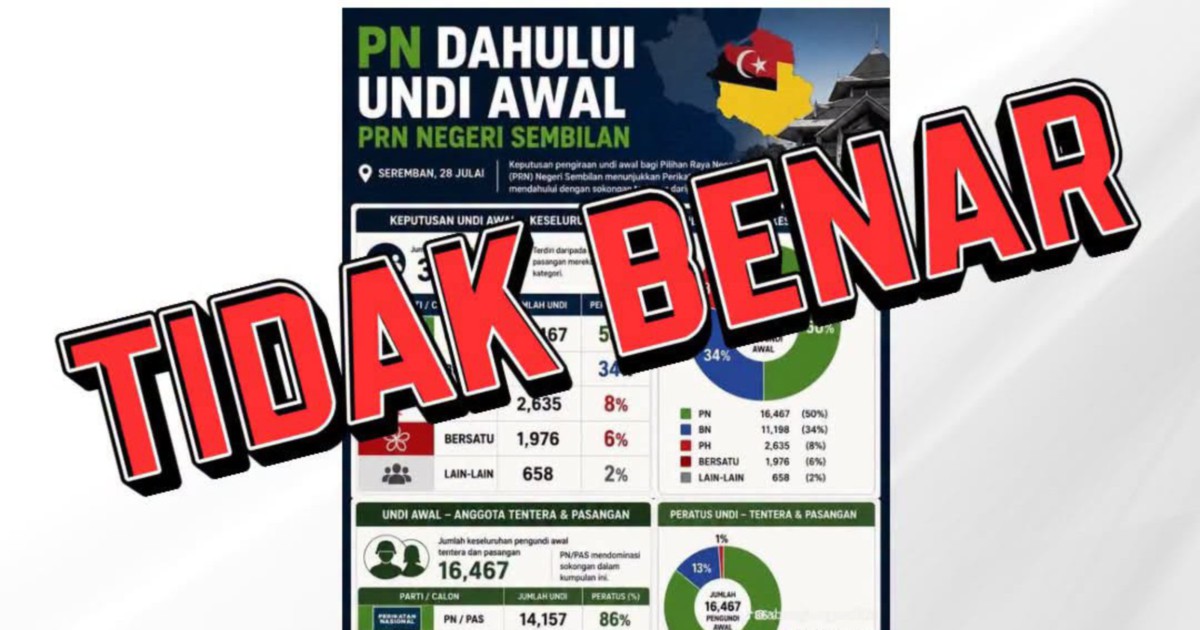
Voters in Negeri Sembilan will see the results of early voting tallied on Saturday evening when the state goes to the polls, the Election Commission announced from its headquarters in Seremban. The commission has scheduled the commencement of counting for the early votes at 5pm sharp, establishing a clear timeline for when the first batch of results will become public knowledge. This disclosure comes at a critical juncture in the campaign season, with various political coalitions mobilising supporters and speculation mounting about electoral momentum heading into polling day.
The decision to conduct the early count on Saturday rather than spreading the process across multiple days reflects the Election Commission's commitment to maintaining an efficient and transparent electoral system. Early voting has become an increasingly significant component of Malaysia's electoral process, with voters unable to attend polling stations on the official election day—including those overseas, military personnel, and essential service workers—exercising their franchise in advance. The concentration of counting at a designated time ensures that observers, party representatives, and media can monitor the process simultaneously and verify results against their own records.
The Malaysian electoral landscape has increasingly experienced the spread of unverified claims and false information through social media platforms, particularly during volatile periods like election campaigns. In recent months, claims have circulated online suggesting that one coalition or another has already obtained a decisive advantage before voting has taken place, creating confusion and potentially influencing voter behaviour. Such narratives, whether originating from partisan sources or amplified by misinformation networks, undermine public confidence in the democratic process and cloud rational discussion about substantive policy differences between contending parties.
The Election Commission's explicit dismissal of these viral claims represents a necessary institutional response to widespread digital disinformation. By publicly stating that such assertions are baseless, the commission attempts to restore clarity and encourage voters to await official results rather than acting on rumour or speculation. The credibility of electoral authorities rests partly on their ability to provide factual information that counters false narratives, particularly in societies where social media has become a primary information source for many citizens. In Malaysia's competitive political environment, such clarifications serve a crucial stabilising function.
Negeri Sembilan, with its thirteen state assembly seats, represents a significant prize in Malaysia's intricate federal system where state governments control education, land, and local administration. The state's electoral dynamics have shifted considerably over recent years, reflecting broader realignments in Malaysian politics. Several seats remain genuinely competitive, and the outcome could influence subsequent efforts to form coalition governments at both state and federal levels, depending on which parties can secure sufficient representation to establish working majorities.
Early voting in this election will encompass multiple categories of voters whose circumstances prevent them from accessing polling stations on the designated day. Military personnel stationed across Malaysia will have already cast their votes, as will civil servants unable to be away from their posts. Overseas Malaysians who registered for early voting at specific locations will have participated in the process during the designated period. The aggregation of these early votes at 5pm Saturday will thus represent the preferences of a diverse demographic cross-section of the electorate, potentially offering insights into voting patterns before the main polling day results arrive.
The timing of the early count has implications for media coverage and public reaction. A 5pm Saturday start means that results will emerge during evening hours, when many Malaysians are likely to be available to follow developments through news outlets and social platforms. This timing contrasts with some previous elections where early counts have occurred at times with lower viewership potential. The Election Commission appears to have considered accessibility and transparency in setting this schedule, allowing citizens to engage with emerging information relatively contemporaneously.
For political parties, the early vote count provides preliminary data about their performance and voter enthusiasm. While early voters represent a specific demographic rather than a perfect microcosm of the entire electorate, the direction and magnitude of results can inform campaign strategies for the final push before main polling day. Parties often use early vote outcomes to adjust their messaging, deployment of campaign resources, and ground-level activities in the final hours of campaigning. However, they must be cautious about over-interpreting early results, as different voter groups participate in early voting compared to those who vote on the official day.
The Election Commission's role as a neutral arbiter has become increasingly important as electoral competition has intensified. Beyond managing the mechanics of voting and counting, the commission must also function as a bulwark against electoral myths and misinformation. By proactively addressing false claims, the institution demonstrates that Malaysia possesses mechanisms for countering disinformation and maintaining factual grounding in public discourse. This institutional function extends beyond the commission itself to encompass media literacy and critical evaluation of claims circulating online, areas where civil society and educational institutions also bear responsibility.
The Negeri Sembilan state election represents one instance within Malaysia's broader electoral cycle, which has seen multiple polls across various states and at federal level over recent years. The cumulative impact of these elections has reshaped political alignments, introduced new leadership, and demonstrated both the resilience and vulnerabilities of democratic institutions. As voter behaviour continues to evolve and digital communication transforms how campaigns operate, election authorities face ongoing challenges in ensuring integrity, transparency, and public confidence. The clear scheduling of the early vote count and the explicit dismissal of false claims exemplify the type of straightforward institutional communication that helps maintain democratic legitimacy.

