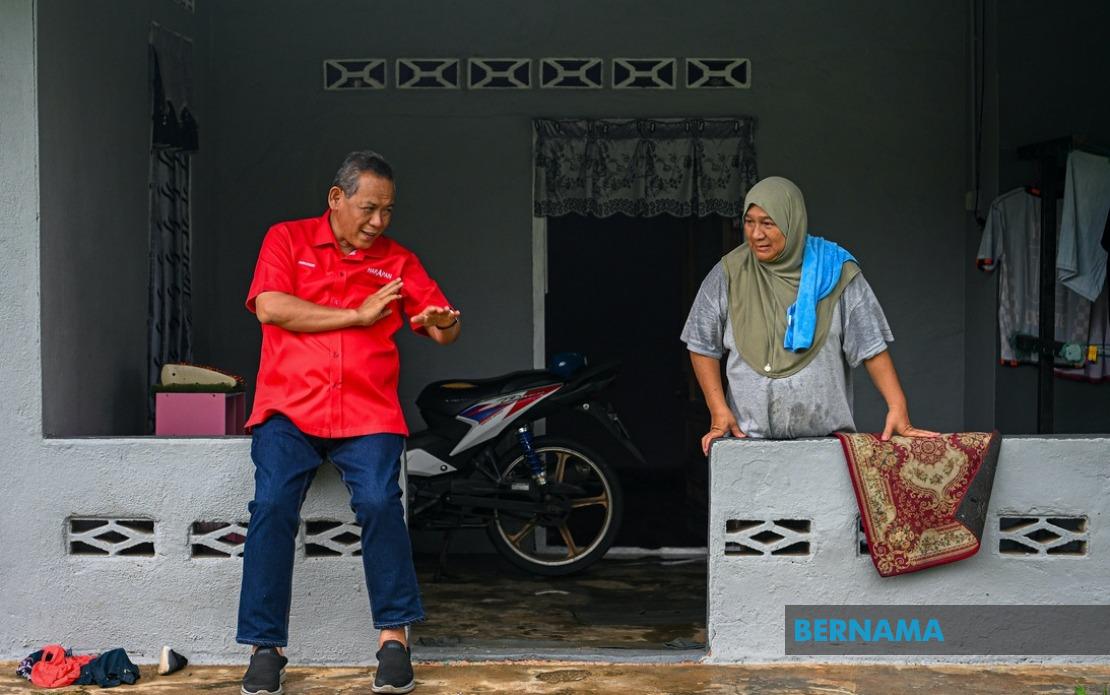
Pakatan Harapan enters the Negeri Sembilan state election campaign with a strategy centred on the political durability and administrative credentials of incumbent Menteri Besar Datuk Seri Aminuddin Harun, whose tenure spanning nearly two full terms has been marked by an absence of major corruption allegations or governance scandals. The coalition's confidence reflects a calculated bet that voters in the state will reward stable, clean administration over partisan appeals or dramatic policy shifts, a calculation that takes on particular significance given the turbulent political terrain of Malaysian state and federal politics over the past decade.
Amirudin Shari, the PKR vice-president serving as PH's chief strategist for the election and simultaneously holding the Selangor menteri besar portfolio, articulated this positioning clearly during campaigning. Amirudin highlighted that early feedback from grassroots party workers suggested Aminuddin's approach to governance had struck a chord with ordinary voters, who appeared to prioritise stability and predictability over more ambitious or transformative agendas. The emphasis on avoiding major scandals and maintaining administrative discipline represents a deliberate pivot away from the contentious identity and religious politics that often dominate Malaysian electoral discourse, instead positioning PH as the custodian of competent, transparent governance.
The campaign's foundation rests partly on Aminuddin's dual credibility as both menteri besar and Port Dickson MP, a combination that allows PH to present him as a figure with relevant legislative experience and constituency-level accountability. This layering of roles and responsibilities serves multiple strategic purposes: it demonstrates continuity in leadership while simultaneously allowing the coalition to claim that voters have already endorsed Aminuddin at the federal level through his parliamentary seat. For Malaysian and Southeast Asian observers tracking governance trends in the region, this emphasis on incumbency and absence of scandal reflects a broader pattern where clean administration has become a competitive differentiator in electoral contests, particularly when major corruption cases have dominated headlines during previous electoral cycles.
Amirudin also pointed to Prime Minister Datuk Seri Anwar Ibrahim's leadership at the federal level as an asset for PH's campaign machinery, noting that public confidence in the premier translates into electoral support for candidates bearing the coalition's colours. This connection between federal and state-level politics is particularly relevant in Malaysia's federal system, where voter sentiment about national leadership regularly influences outcomes in state and local contests. The reference to PH's successful campaign in Johor, where Anwar's intervention reportedly bolstered candidate support, suggests that the coalition views the prime minister's personal popularity and policy achievements as transferable capital that can be deployed in other state contests.
The organisational strength of PH's ground machinery in Negeri Sembilan forms another pillar of the campaign strategy. Amirudin's confidence in the party's ability to mobilise supporters rests not merely on public rallies or formal campaign events, where turnout can be difficult to predict and media coverage unreliable, but rather on quieter, systematic grassroots work. This approach acknowledges a reality familiar to Malaysian political operators: well-organised constituency-level party structures, volunteer networks, and community relationships often prove more consequential than headline-grabbing campaign moments in determining electoral outcomes.
The manifesto that PH planned to launch represented an attempt to balance continuity with new commitments, combining ongoing development initiatives with fresh policy proposals intended to address voter priorities in areas such as economic opportunity and quality of life. This balancing act reflects the strategic dilemma facing an incumbent coalition: presenting itself as a force for progressive change while simultaneously asking voters to renew their mandate based on past performance. For a state like Negeri Sembilan with a relatively diverse economic base spanning manufacturing, agriculture, and services, such manifestos must address both urban and rural voter interests.
The 2023 election results provide important context for understanding the current campaign dynamics. PH's 17-seat victory then gave the coalition a clear majority in the 36-member state assembly, with Barisan Nasional securing 14 seats and Perikatan Nasional capturing five. This configuration meant that PH governed with a relatively comfortable buffer, though not so overwhelming as to generate complacency among party officials. The question facing the coalition in the current contest is whether it can consolidate and potentially expand that majority, or whether voter sentiment has shifted in response to national and state developments over the intervening period.
The electoral landscape comprises 889,490 registered voters across Negeri Sembilan, a substantial electorate that spans both urban centres and rural communities. The composition of this electorate includes 867,151 ordinary voters alongside 16,884 military personnel and spouses and 5,455 police personnel eligible for early voting. This breakdown carries significance for campaign strategy, as military and police voters have historically demonstrated distinctive political preferences, and early voting procedures may influence overall turnout patterns and the sequence in which results become clear on polling night.
The election calendar—with the Negeri Sembilan State Legislative Assembly having been dissolved on June 5, early voting scheduled for July 28, and general polling on August 1—provides a compressed campaign window of roughly five weeks. Within this timeframe, all major political players must communicate their messages, mobilise supporters, and attempt to shift voter sentiment or consolidate existing support. For PH, the strategy of emphasising Aminuddin's clean record and the coalition's administrative performance represents a relatively conservative approach, betting that voters will respond to governance competence and the absence of scandal rather than being swayed by more radical policy departures or appeals to partisan identity.
The emphasis on clean governance and administrative stability also carries implications for how Negeri Sembilan voters may be positioning themselves relative to broader Malaysian political debates. A decision to retain PH would represent validation of the coalition's approach to politics following its return to federal power in 2022, while potentially reflecting voter views that the state benefits from alignment between state and federal government. Conversely, any significant erosion of PH support would signal that voters have concerns about either the coalition's performance at state level or its handling of national affairs that override considerations of administrative cleanliness and stability.
For observers in Malaysia and Southeast Asia more broadly, the Negeri Sembilan election serves as a barometer of voter sentiment regarding governance standards, anti-corruption priorities, and the sustainability of coalition politics in an environment where political realignments remain frequent. The outcome will provide insight into whether Malaysian voters continue to prioritise clean, stable administration or whether other considerations—including economic grievances, communal concerns, or frustration with incumbent governments—have moved to the forefront of electoral decision-making. PH's strategy suggests confidence that cleanliness and competence remain competitive advantages, but the August 1 results will test that assumption.

