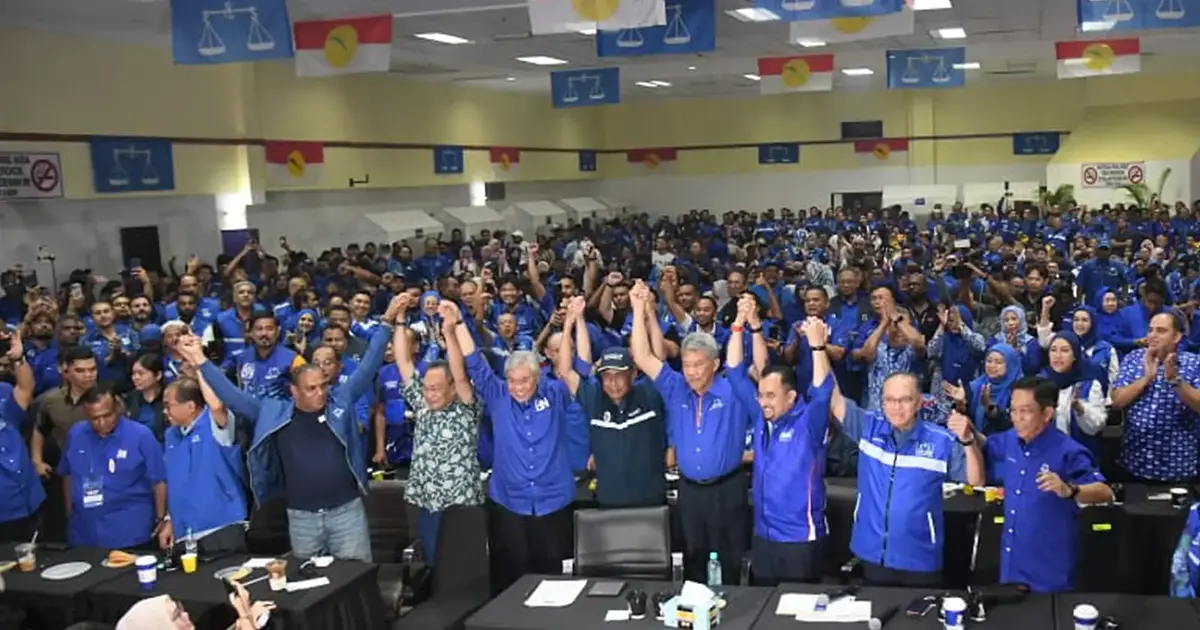
The Negeri Sembilan state election delivered a decisive outcome that has redrawn the immediate contours of Malaysian politics, with Barisan Nasional solidifying its parliamentary backbone while probing questions mount about the capacity of its challengers to mount an effective alternative. The results represent more than a local contest over control of a mid-sized state government; they carry implications for national political trajectories as the country heads toward eventual general elections and as coalition partners reassess their strategic alliances.
For Barisan Nasional, the election functioned as a confidence booster at a moment when the coalition has worked systematically to restore its electoral standing after the 2018 defeat. The victory extends BN's track record of recent state-level successes and provides the governing machinery with further territorial consolidation. This strengthening is consequential because state administrations offer platforms for resource deployment, patronage networks, and administrative visibility that can translate into federal-level support. Negeri Sembilan's results therefore feed into a broader narrative of BN recovery that has gathered momentum across multiple electoral cycles.
Pakatan Harapan's performance in Negeri Sembilan, by contrast, underscores a deteriorating political position that extends beyond a single state contest. The coalition that swept to historic victory in 2018 has struggled consistently in subsequent state elections and by-elections, suggesting that its initial appeal—rooted in anti-corruption sentiment and promises of reform—has failed to sustain electoral momentum or translate into durable voter attachment. The decline raises fundamental questions about whether PH can effectively prosecute a competitive general election campaign or whether it has become institutionally weakened by internal divisions, leadership uncertainties, and inability to deliver on transformational promises.
The Malaysian electorate's shifting preferences appear driven by multiple converging factors. Economic pressures, living cost concerns, and the effectiveness of BN's administrative messaging have evidently resonated more powerfully than PH's reform narrative in recent contests. Additionally, some voters may have concluded that BN's return to office was inevitable, producing a bandwagon effect that undermines opposition momentum. For Malaysian observers, these patterns raise questions about whether the political realignment of 2018 was genuinely transformative or merely cyclical, with voters returning to traditional patterns of support once the initial shock wore off.
Within Perikatan Nasional, Negeri Sembilan's outcome has exposed underlying tensions that threaten the stability of this relative newcomer to Malaysia's coalition landscape. Bersatu's positioning within PN has always been architecturally unstable, dependent on managing relationships with PAS while maintaining relevance in federal governance contexts. Election results that disappoint PN's electoral expectations inevitably intensify internal recriminations and strategic reassessments among the constituent parties. For Bersatu specifically, the challenge intensifies as the party must justify its existence as a distinct political entity capable of delivering electoral value, rather than appearing as a vehicle for particular personalities or transactional arrangements.
The broader question animating Malaysian politics concerns whether PN can establish itself as a credible alternative pole of attraction for voters, or whether it remains fundamentally subordinate to the BN-PH binary that has dominated post-2018 politics. Negeri Sembilan suggests that PN has not yet achieved the organizational depth, messaging coherence, or voter recognition necessary to break through as an independent force at the state level. This limitation carries implications for federal politics, where PN's parliamentary presence depends substantially on opportunistic alliances rather than organic electoral support.
For Pakatan Harapan, Negeri Sembilan crystallizes the existential problem that the coalition faces heading toward the next general election. The party must fundamentally revitalise its political narrative and internal cohesion, or accept that its 2018 surge represented a peak rather than an inflection point. This necessitates either restoring voter confidence in the coalition's capacity to execute reform or developing new policy frameworks that resonate with contemporary Malaysian concerns—particularly around economic management, inequality, and social provision. Without such repositioning, PH risks further electoral erosion that could render it incapable of mounting serious federal competition.
Barisan Nasional's consolidation should not obscure challenges inherent to its own coalition management. The internal dynamics between UMNO, MIC, and MCA demand continual calibration, and recent elections have demonstrated variable performance across different demographic and geographic constituencies. Maintaining voter support requires sustained administrative competence, delivery of tangible benefits, and management of internal faction tensions. That said, BN's structural advantages—control of federal apparatus, administrative resources, and organizational machinery—position it as the electorally dominant force in contemporary Malaysian politics.
Regionally, Malaysia's political evolution carries implications beyond its borders, as Southeast Asian observers monitor whether democratic competition can function effectively or whether electoral dominance by a single coalition eventually constrains political contestation. The Negeri Sembilan results reflect patterns visible across the region, where opposition parties struggle against incumbent advantages and where coalition management becomes increasingly complex. For Malaysian readers, this suggests that coming years will be defined by incremental shifts in relative party positioning rather than dramatic realignments, unless major exogenous shocks alter voter calculations.
Looking ahead, Negeri Sembilan should prompt all major political actors to conduct serious strategic audits. Barisan Nasional must assess whether recent electoral success can be consolidated into durable governance achievements that sustain voter satisfaction. Pakatan Harapan faces a more urgent imperative: determining whether the coalition can reverse apparent electoral decline through leadership renewal, policy innovation, and organizational reform. Perikatan Nasional, meanwhile, must clarify its strategic purpose and voter proposition beyond existing coalition configurations. The state election thus functions as a political mirror, reflecting the underlying shifts reshaping Malaysian electoral competition and forcing parties to reckon with uncomfortable truths about their current positions and future prospects.

