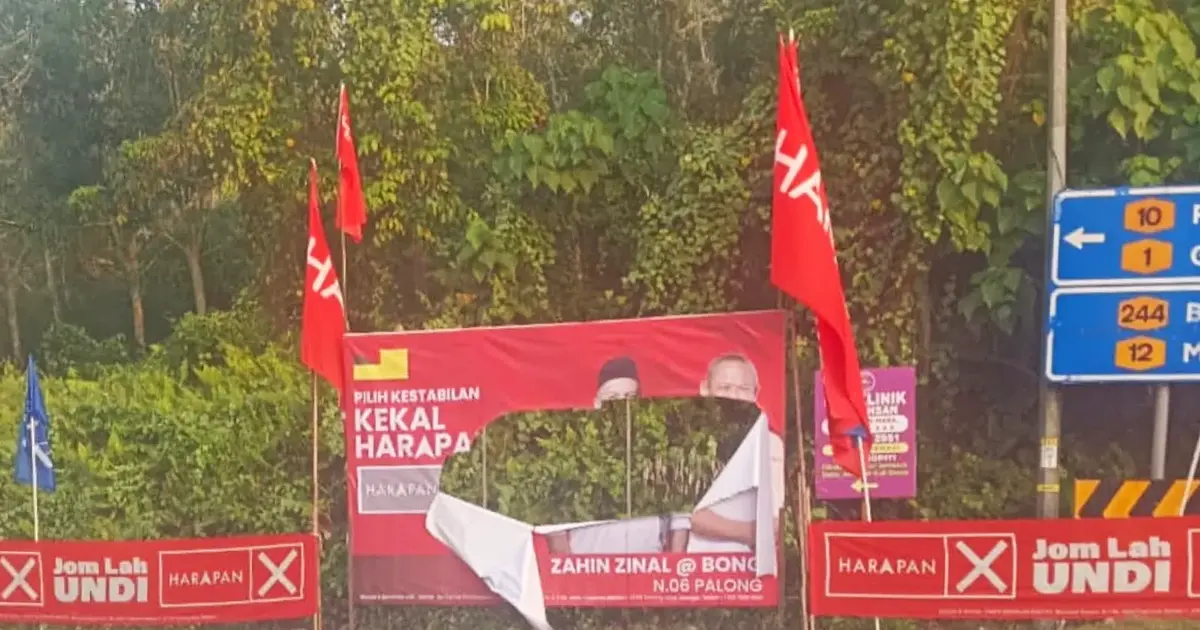
Police in Negeri Sembilan have opened investigation files on 14 separate incidents classified as election-related offences, revealing a concerning pattern of vandalism and destruction targeting political campaign materials across the state. The cases, which remain under active investigation, reflect growing tensions in the lead-up to elections and underscore the challenge authorities face in maintaining campaign-related civility and order.
Among the documented incidents are cases involving the deliberate burning of political party flags, a particularly inflammatory act that carries symbolic weight beyond simple property damage. The torching of such symbols represents an escalation in the tensions between competing political camps and signals the depth of passion—and occasionally hostility—that characterises electoral competitions in Malaysia. Flag burning in particular has historically drawn strong reactions from supporters and raised concerns about the potential for escalating tensions during campaign periods.
Beyond the flag-burning cases, police have documented numerous instances of campaign material vandalism. These incidents include the defacement and destruction of campaign banners erected throughout various constituencies and municipalities in Negeri Sembilan. Campaign banners serve as crucial tools for political parties to maintain visibility and reach voters, and their systematic destruction represents both a financial loss to the parties involved and an attempt to suppress their political messaging. The targeting of such materials indicates a deliberate effort by rival camps to undermine each other's visibility in public spaces.
Billboards displaying campaign advertisements and political messaging have similarly fallen victim to vandalism, with authorities recording damage to structures that cost significant resources to produce, install, and maintain. The repeated targeting of these advertisement platforms suggests a coordinated approach by certain groups determined to disrupt the electoral landscape. Such acts go beyond mere political rivalry and venture into territory that law enforcement views as criminal conduct.
The geographic spread of these incidents across Negeri Sembilan indicates that the problem is not localised to a single constituency or area but rather represents a state-wide phenomenon. This widespread nature complicates police response efforts and suggests that multiple groups or individuals are engaging in similar conduct, whether independently or in a coordinated manner. The distributed nature of the incidents also makes pattern recognition and targeted intervention more challenging for law enforcement agencies.
Election-related offences encompass a broad category of legal violations defined under Malaysian electoral law, which aims to ensure fair, orderly, and peaceful campaigns. These provisions exist to protect democratic processes from disruption and to safeguard the rights of candidates and voters alike. When violations occur, they undermine public confidence in the electoral system and can create a climate of fear or intimidation among political participants and the general public.
For Malaysian and Southeast Asian observers, the emergence of such incidents raises questions about the health of electoral discourse and the effectiveness of existing enforcement mechanisms. While election-related violations occur in democracies worldwide, their frequency and nature often serve as indicators of underlying political tensions and the degree to which competing parties are willing to operate within established legal and ethical boundaries. In the Malaysian context, where elections have historically been relatively orderly affairs, any escalation in vandalism or destruction warrants close attention.
The role of police in investigating these matters places them in a sensitive position. Authorities must pursue investigations rigorously to demonstrate that electoral rules apply equally to all parties, thereby maintaining public trust in impartiality. At the same time, police operations must avoid any perception of partisan bias, which could exacerbate tensions during campaigns. The need to balance robust enforcement with fairness represents a constant challenge for law enforcement agencies managing election-related matters.
These incidents also carry implications for campaign finance and resource allocation. Political parties must budget not only for standard campaign materials but also for replacement of vandalised items, representing a hidden cost imposed by misconduct. Smaller parties or those with limited resources may be disproportionately affected, as they lack the financial capacity to rapidly replace destroyed materials. This dynamic can inadvertently influence the competitive landscape by draining resources from campaigns and placing additional burdens on parties unable to absorb such costs.
The opening of investigation files into these 14 cases demonstrates that police are taking the matter seriously and treating each incident as a separate criminal matter worthy of formal investigation. The documentation and tracking of such cases also creates an evidentiary foundation that may support prosecution if adequate evidence emerges and suspected perpetrators are identified. Success in prosecuting these cases would likely serve as a deterrent to others contemplating similar actions during future electoral cycles.
Going forward, the outcomes of these investigations will be closely watched by political parties, civil society organisations, and the general public. Successful prosecutions would reinforce the message that election-related vandalism and destruction carry real legal consequences. Conversely, if investigations stall or fail to result in charges, it may embolden others to engage in similar conduct. The handling of these cases will therefore have implications that extend beyond Negeri Sembilan, potentially influencing the conduct of elections throughout Malaysia in the coming months and years.

