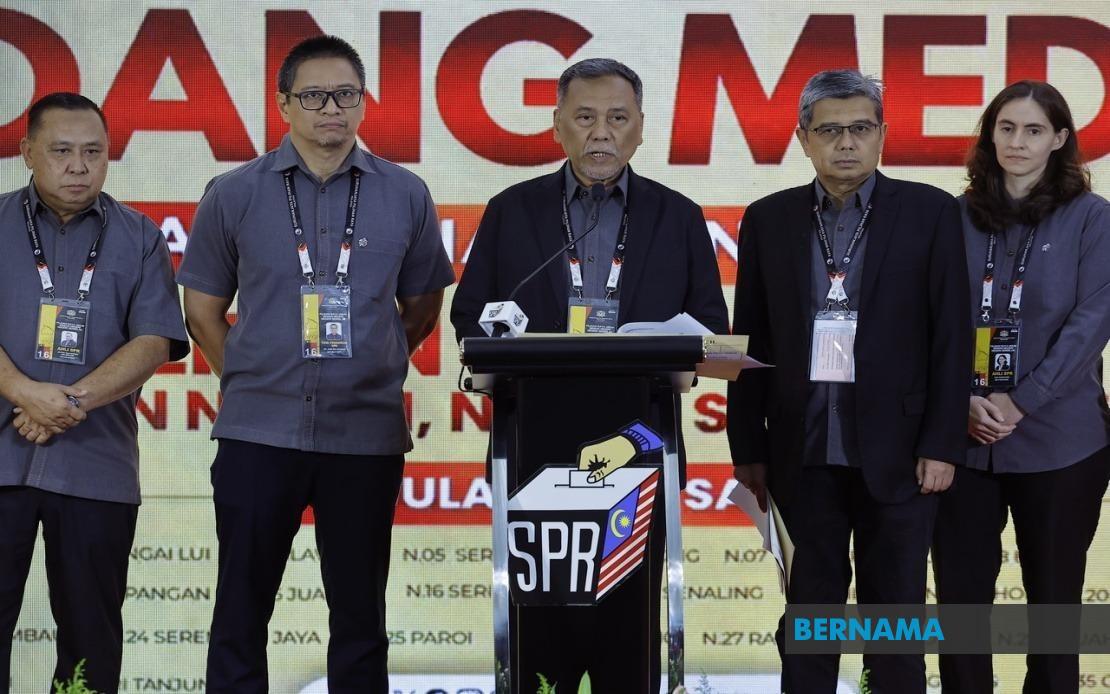
The Election Commission has formally verified all candidates for the Negeri Sembilan state election, confirming that 103 hopefuls will compete across the 36 available seats when voters go to the polls on August 1. The verification process concluded on July 18 after nomination submissions closed at eight designated centres throughout the state, with EC chairman Datuk Seri Ramlan Harun announcing the final tally at a press briefing in Seremban. The confirmation marks a critical milestone in the campaign cycle, as political parties and independent candidates now formally enter the race to shape the state's governance over the coming five years.
Pakatan Harapan has emerged as the dominant force in terms of candidate deployment, fielding 36 contenders across the state assembly districts. This represents a substantial show of force that underscores the coalition's confidence in its electoral prospects following its earlier federal government experience. Barisan Nasional, the traditional ruling coalition, has positioned 25 candidates, signalling a measured but determined campaign. Bersatu, which has undergone significant political transitions in recent years, has committed 24 candidates to the contest, reflecting its continuing efforts to establish relevance at the state level. Perikatan Nasional, operating as a broader vehicle for opposition politics, has nominated 11 candidates. These figures reveal the relative strength and strategic priorities of Malaysia's major political blocs heading into the election.
Beyond the three primary coalitions, smaller parties and independent voices are contributing to the electoral landscape. Berjasa, ASLI, and the Socialist Party of Malaysia have each fielded a single candidate, while four independent contenders are running without party affiliation. Though numerically modest, these candidacies reflect the democratic principle of open competition and provide alternatives for voters dissatisfied with the major coalitions. The presence of these fringe options, combined with the larger party fieldings, demonstrates the breadth of political choice available to Negeri Sembilan's electorate.
The contest configuration across the 36 seats reveals an election landscape characterised by intense, multi-sided competition in numerous districts. Twenty-one seats—nearly 60 percent of the total—will witness three-cornered fights, meaning voters will choose among candidates from three different parties or groupings. This proportion of multi-candidate contests substantially elevates the unpredictability of the outcome compared to traditional two-candidate races, as vote splitting becomes a critical factor. Two additional seats, Nilai and Sri Tanjung, face even more complex scenarios with five candidates competing, while Jeram Padang and Rahang will host four-way battles. Only eleven seats will feature the simpler dynamics of direct head-to-head contests between two candidates. This fragmented contest structure across much of the state suggests that victory margins could be tighter than in previous elections, and that smaller parties or independent candidates might play decisive roles in determining winners.
Demographic analysis of the candidate pool reveals a significant gender imbalance, with 94 male candidates vastly outnumbering 9 female contenders across all parties and independent categories. This disparity reflects broader challenges within Malaysian political structures regarding women's representation and advancement through party hierarchies. The age range of contenders spans from a 23-year-old Bersatu representative in Sri Tanjung to a 70-year-old Pakatan Harapan candidate in Gemencheh, demonstrating both generational renewal efforts and retention of experienced political figures. These demographic patterns offer insight into how different political organisations approach candidate selection and succession planning.
The electorate that will determine the outcome comprises nearly 890,000 registered voters across Negeri Sembilan. This total encompasses 867,151 ordinary civilian voters, supplemented by 16,884 military personnel and their spouses, and 5,455 police officers. The inclusion of military and police voters, who typically vote at designated early polling stations, represents a notable bloc whose preferences could influence tight contests, particularly in districts where the broader civilian vote is closely divided. The overall voter population provides a substantial democratic mandate, and the election commission's preparation of logistics for nearly 890,000 ballots represents a significant administrative undertaking.
The electoral timeline remains compressed but manageable. Early voting has been scheduled for July 28, allowing military personnel, police officers, and other eligible early voters to cast ballots several days before the general polling on August 1. This staggered approach, standard across Malaysian state elections, requires careful coordination to ensure vote security and accurate tallying. The brief interval between nomination closure and early voting allows limited campaigning time for candidates, placing a premium on pre-existing party machinery, candidate recognition, and messaging efficiency. The August 1 polling day itself will determine which candidates successfully navigate the competitive landscape to claim seats in the 36-member state assembly.
Negeri Sembilan's dissolution on June 5 triggered the sequence of events leading to this election, as the state executive determined that fresh electoral validation was necessary. The state assembly's 36 seats represent the primary mechanism through which citizens exercise direct democratic choice in state-level governance, selecting representatives who will appoint the menteri besar and establish policy direction for the state government. The concentration of candidate competition into roughly two months reflects Malaysia's constitutional framework, which requires elections to be conducted within specific timeframes following assembly dissolution.
The competitive configuration—with substantial party competition, significant three-cornered contests, and nearly 890,000 eligible voters—positions the Negeri Sembilan election as a meaningful test of political sentiment in the state. Results may carry implications beyond the state boundaries, offering signals regarding electoral trends in Malaysia's broader political landscape. For parties, the election represents an opportunity to strengthen state-level footholds or mount comebacks. For voters, the array of 103 candidates and the multi-candidate dynamics in numerous seats provide genuine choices and potentially greater scope for electoral surprise compared to contests dominated by simple two-way races.

