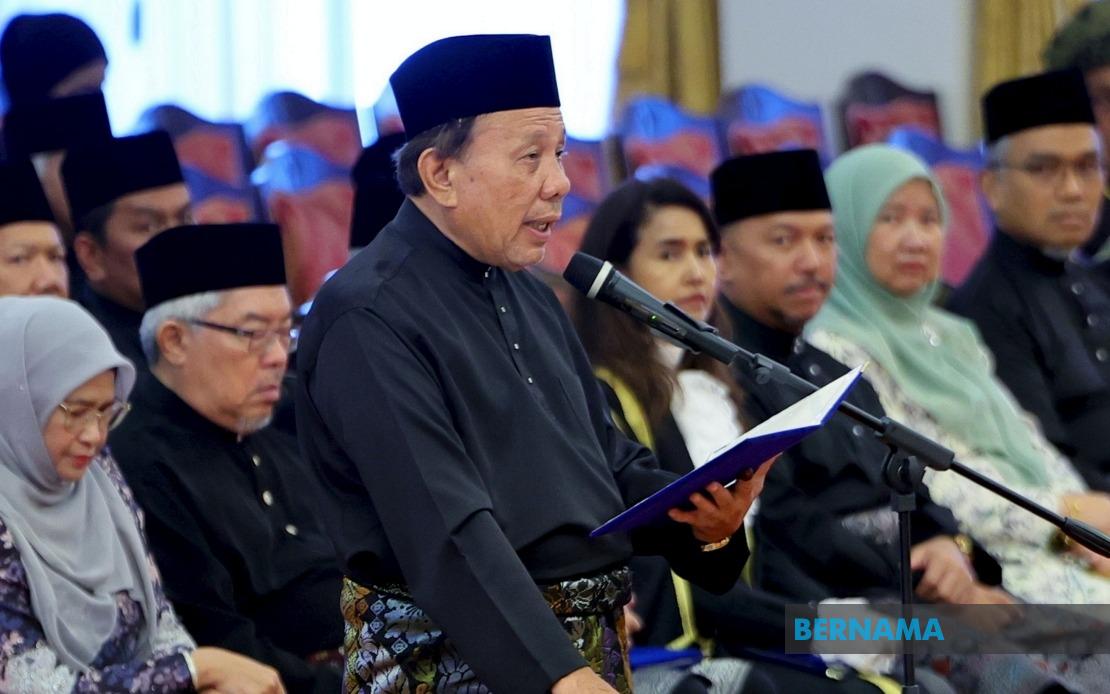
Datuk Ismail Lasim commenced his tenure as Negeri Sembilan's Menteri Besar by taking his oath before Yang Dipertuan Besar Tuanku Muhriz Tuanku Munawir at Istana Besar Seri Menanti in Kuala Pilah on August 2, setting the tone for what he characterized as a mandate demanding humility and rigorous accountability. The swearing-in ceremony marked the formal transition of leadership following the state's 16th election, with Ismail emphasizing that the electoral verdict represented far more than a ceremonial validation but rather a profound obligation to deliver tangible improvements across the state's administrative and developmental landscape.
Central to Ismail's inaugural address was his articulation of governance rooted in accessibility and answerability to the electorate. He stressed that wielding the public's confidence demands demonstrable commitment to fairness in decision-making, clarity in operations and effectiveness in service delivery—principles he positioned as non-negotiable pillars of his administration. This framing reflects broader regional trends toward heightened citizen expectations for government accountability, particularly in the aftermath of electoral campaigns that emphasise reform and renewal across Malaysia's various state governments.
The new Menteri Besar placed considerable emphasis on preserving Negeri Sembilan's constitutional and customary distinctiveness, notably its reliance on Adat Perpatih—a matrilineal customary law system distinct from other Malaysian states. Ismail committed to ensuring that policies throughout his tenure would remain grounded in this tradition's foundational values of consensus-building, equitable treatment, social cohesion and practical wisdom. This commitment carries substantial implications for how the state government will approach everything from land administration to family law matters, signalling continuity with historical governance frameworks rather than wholesale transformation.
Development strategy featured prominently in Ismail's vision, though he explicitly rejected a narrow conception of progress anchored solely to infrastructure projects and economic statistics. Instead, he articulated a holistic development model encompassing employment generation, educational advancement, healthcare improvements, housing accessibility and agricultural sustainability alongside conventional economic metrics. This multidimensional approach addresses mounting public concern across Southeast Asia regarding equitable growth distribution, particularly between urban centres and peripheral regions that often experience marginalization in development prioritisation.
Ismail specifically pledged that his administration would pursue balanced development benefiting both urban and rural constituencies, recognizing a persistent policy challenge across Malaysia's federal structure. Rural Negeri Sembilan communities, particularly those dependent on agriculture and traditional livelihoods, have historically witnessed slower developmental progress compared to urban hubs like Seremban. His explicit commitment to inclusive progress across geographic divides suggests an intention to redirect state resources toward addressing regional disparities that frequently generate political discontent.
Economic revitalization emerged as another cornerstone of the incoming administration's agenda, with Ismail committing to aggressive investment promotion, job creation initiatives and enhancement of living standards across the state. These pledges carry significance for Negeri Sembilan's competitive positioning within the Klang Valley economic corridor and its relationship with neighbouring Selangor, traditionally a more dominant economic force. Enhanced state-level investment facilitation could reposition Negeri Sembilan as a more attractive destination for industrial development and commercial enterprise, thereby diversifying revenue sources beyond traditional agriculture and tin mining legacies.
The institutional dimensions of governance received careful attention in Ismail's remarks, with particular focus on civil service professionalism, public sector integrity and systematic transparency. He committed his administration to establishing conditions where state bureaucracy could function with dedication, technical competence and ethical propriety—prerequisites often cited as deficient in public sector performance critiques across the region. This emphasis on institutional strengthening acknowledges that governance quality ultimately depends upon implementation capacity within state administrative machinery rather than policy rhetoric alone.
Ismail's explicit acknowledgment of his predecessor Datuk Seri Aminuddin Harun's contributions reflects political maturity and institutional continuity concerns. Rather than dismissing prior achievements, he positioned previous developmental gains as foundational platforms upon which his administration would build, thereby preserving policy momentum across electoral transitions. This approach minimizes disruptive policy reversals and maintains investor confidence in medium-term state development trajectories—considerations particularly important for state governments competing for federal resource allocation and private sector attention.
The incoming Menteri Besar emphasized constitutional monarchy principles and parliamentary democracy frameworks as organizing scaffolding for state governance, underscoring the Yang Dipertuan Besar's advisory and symbolic roles within Negeri Sembilan's constitutional architecture. This articulation proves significant given occasional tensions in Malaysian federalism regarding state autonomy versus national coordination, and between traditional customary authority and modern democratic governance. Ismail's framing positions royal guidance as complementary to rather than subordinate to democratically-derived executive authority, reflecting Malaysia's distinctive constitutional synthesis.
Consensus-building and receptiveness to constructive criticism emerged as governing methodologies rather than peripheral courtesies in Ismail's administrative philosophy. He explicitly invited alternative perspectives and emphasized stakeholder collaboration across civil society, business communities, traditional leadership and grassroots organizations. This pluralistic governance model contrasts with more command-oriented approaches and reflects evolving Malaysian political culture wherein inclusive consultation processes enhance legitimacy and policy implementation effectiveness.
Ismail's invocation of spiritual and emotional dimensions—requesting public prayers for wisdom, patience and strength—situated his leadership within Malaysia's broader cultural and religious contexts while humanizing the office beyond technical competence requirements. Such appeals resonate across Muslim-majority constituencies where invoking divine guidance constitutes normal political discourse, thereby establishing emotional connection with the electorate beyond institutional performance metrics.
Looking forward, Ismail's success will ultimately depend upon translating these carefully calibrated commitments into demonstrable improvements in public service delivery, economic opportunity, educational outcomes and social harmony across Negeri Sembilan. His emphasis on transparency and public accountability establishes benchmarks against which constituents will measure performance, while his commitment to inclusive development and institutional strengthening signals intention to address longstanding governance deficits. Whether these pledges translate into sustained policy implementation or remain primarily rhetorical will become apparent through subsequent budgetary allocations, civil service appointments and administrative actions during the coming months.

