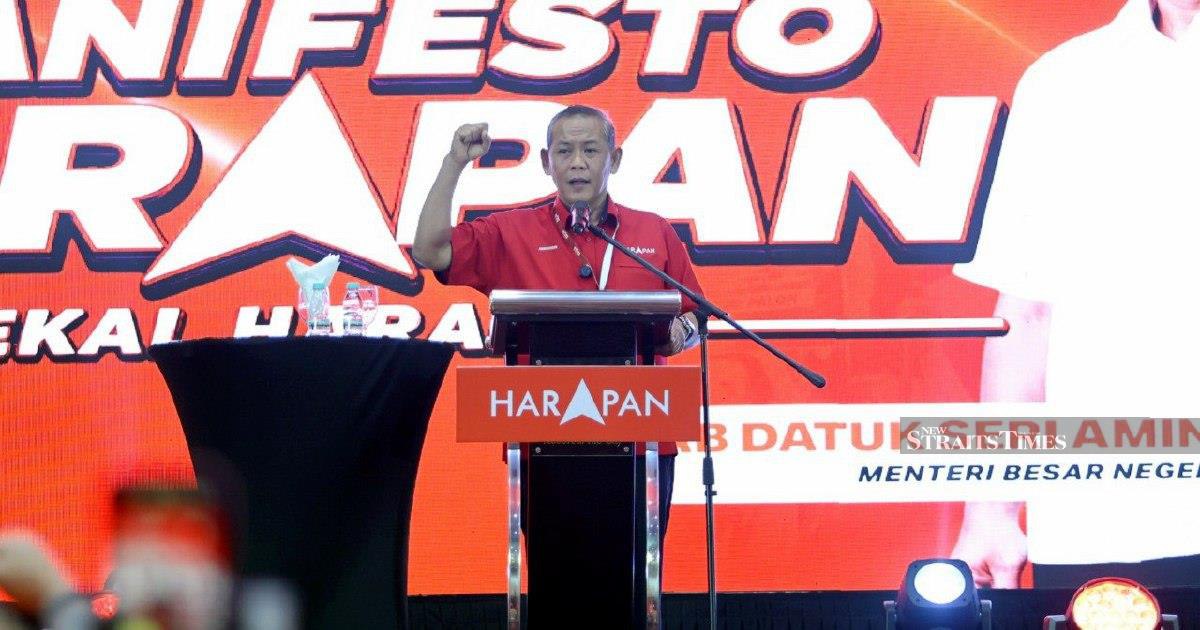
Datuk Seri Aminuddin Harun, the incumbent Menteri Besar of Negri Sembilan, has publicly challenged the originality of Barisan Nasional's campaign platform, contending that many of its central pledges closely mirror programmes that his Pakatan Harapan-led administration has already established and rolled out across the state.
The accusation, levelled during remarks made in Port Dickson, strikes at a sensitive point in Malaysian electoral politics—the question of who genuinely develops policy innovation versus who adopts ideas that have already demonstrated their value. With state elections in Negri Sembilan on the horizon, such disputes over manifesto authenticity often gain traction as coalitions seek to establish credibility with voters. For Malaysian readers familiar with the constant back-and-forth between coalitions, Aminuddin's assertion that BN has engaged in what amounts to policy imitation underscores how closely the major political groupings track each other's work.
The timing of Aminuddin's criticism is noteworthy. As campaigns intensify, parties typically unveil their visions through written manifestos that outline priorities, spending commitments, and specific initiatives. When one coalition leader suggests that the opposition's document is substantially derivative, it opens a broader conversation about the depth of policy formulation within Malaysia's political establishment. The charge also places Barisan Nasional in a defensive position, obliging the coalition to either demonstrate that its proposals are substantively distinct or acknowledge where it has drawn inspiration from existing state-level programmes.
From a practical standpoint, Aminuddin's administration in Negri Sembilan has had several years to implement policies and programmes that address local concerns. These initiatives, if successful, become reference points for voters evaluating future proposals. When a rival coalition incorporates similar-sounding commitments into its manifesto, it raises legitimate questions about whether those parties are genuinely rethinking state priorities or simply adopting proven ideas without credit. For residents of Negri Sembilan, distinguishing between genuine policy innovation and borrowed frameworks matters considerably, as it affects how they assess each coalition's commitment to addressing unique state challenges.
The political implications for Pakatan Harapan are also significant. By highlighting what it frames as wholesale adoption of its policies, PH can position itself as the originator of effective governance models, potentially influencing swing voters who may be persuaded that continuity with proven programmes offers greater certainty than starting afresh with rebranded versions of the same initiatives. This narrative becomes particularly potent in state-level contests where voters have direct experience with how particular policies have functioned in their communities.
For Barisan Nasional, the accusation requires a substantive response. The coalition could argue that any overlap in policy areas reflects common-sense governance priorities that any responsible administration would pursue, rather than deliberate copying. Alternatively, BN might contend that its specific implementation approaches differ meaningfully from PH's current methods, even if the headline goals appear similar. The coalition's response will significantly shape how observers perceive the originality of its campaign positioning.
Regionally, this dispute reflects patterns visible across Southeast Asia, where opposition coalitions frequently accuse governments of stealing their policy ideas once those ideas gain public traction. In Malaysia's context, where coalition politics dominates and power alternates between Barisan Nasional and Pakatan Harapan, such accusations carry particular weight. Voters in other Malaysian states watching Negri Sembilan's campaign may find the dispute instructive as they evaluate their own choices in future electoral contests.
The underlying question of policy originality also speaks to the maturity of Malaysia's electoral discourse. As voters become increasingly sophisticated in evaluating campaign promises, they increasingly expect concrete differentiation between rival visions rather than superficially distinct repackagings of similar commitments. Aminuddin's charge, whether accepted or disputed, implicitly acknowledges that Malaysian voters are paying attention to such details and can be persuaded by arguments about policy authenticity.
Looking ahead, the Negri Sembilan election will test whether voters value demonstrated implementation experience with programmes that Aminuddin's government has already established, or whether they prefer a fresh coalition offering its own interpretation of state priorities. The manifesto dispute provides one lens through which to observe this calculation. If Aminuddin's characterisation of BN's proposals as largely derivative gains traction among voters, it could substantially influence the outcome. Conversely, if BN can convince electors that its proposals represent meaningful improvements upon or reimaginings of existing frameworks, it may neutralise this line of criticism and focus debate on other issues.
As the campaign progresses, both coalitions will likely invest considerable energy in arguing either that policies are genuinely original or that they represent proven models worthy of continuation. For Malaysian political observers, this contest between innovation and experience, originality and implementation, encapsulates one of the central tensions shaping contemporary electoral politics in the country.

