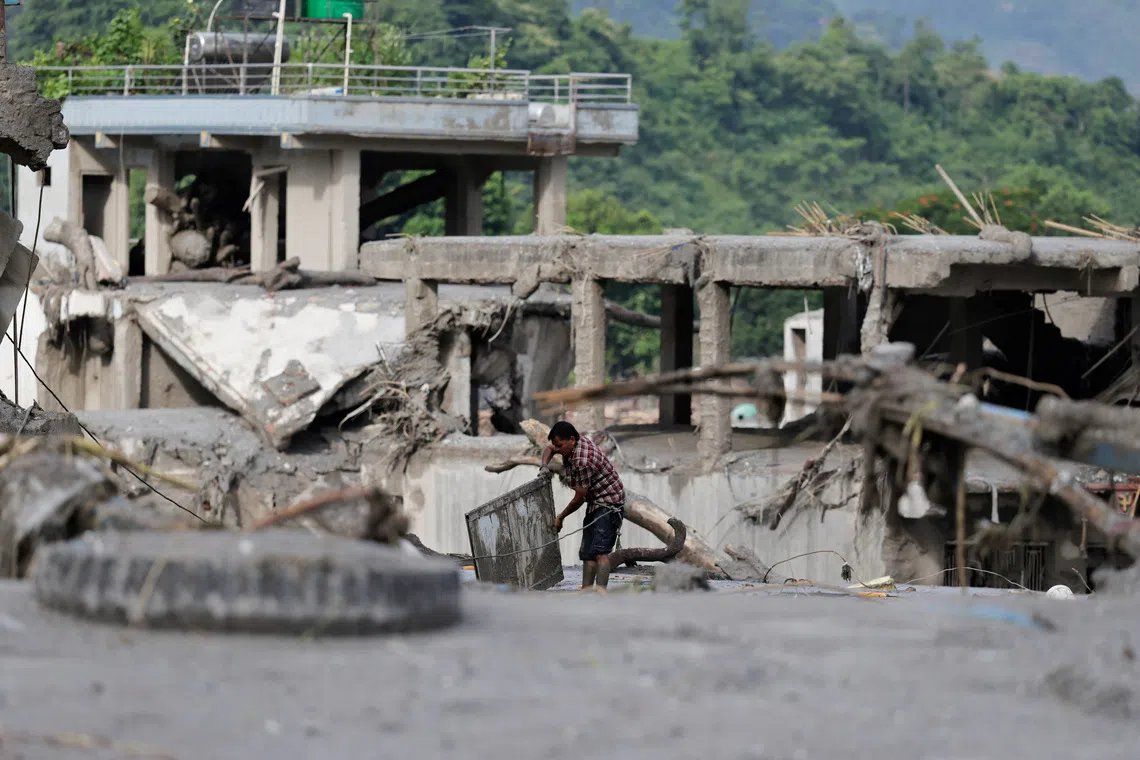
Authorities in Nepal and China issued simultaneous warnings on Thursday of an escalating crisis unfolding in the high mountain valleys along their shared border, where a catastrophic glacier collapse earlier this week has triggered a cascade of secondary hazards. With over 1,000 people still unaccounted for and confirmed death tolls reaching at least 362, rescue teams now face the terrifying prospect of massive surges of water overwhelming the already devastated terrain as swollen lakes threaten to burst through natural and artificial barriers.
The initial disaster, which struck on Wednesday, resulted from the sudden collapse of a glacier in the Himalayan region, sending an enormous volume of rock, ice, and mud cascading into river valleys. This debris created makeshift dams that have now trapped substantial water reservoirs on both sides of the Nepal-China border. Search and recovery operations that were already challenging under the debris-strewn conditions across hillsides and river valleys have taken on new urgency as meteorological and hydrological forecasts point to an imminent and potentially catastrophic phase of the disaster.
Nepal's disaster management authority has identified one particularly dangerous situation where accumulated water behind a debris blockage is rising steadily and poses an acute risk of sudden release. The authority's warning, issued on Thursday, urged residents, rescue personnel, and all others in the affected regions to vacate areas near river banks and relocate to elevated, secure positions immediately. The language employed by officials reflected the severity of the threat, emphasising that safety protocols needed to be observed with urgency rather than treated as precautionary measures.
The situation on the Chinese side presents equally formidable challenges. Chinese water resources officials have determined that approximately 3 million cubic metres of water—a volume equivalent to filling roughly 1,200 Olympic-sized swimming pools—is forecast to flow into an already-dammed lake on the Tibetan side of the border within just three days. Experts at China's water resources ministry have indicated that this influx creates conditions with extremely high potential for a catastrophic dam breach, with hydrologists projecting that the most critical period will occur around September 1 when water flow volumes are expected to peak.
The convergence of multiple risk factors has compounded official anxiety about the coming days. Zhu Jinfeng, a hydrology researcher at the water resources ministry's department, warned state television that the volume of water accumulating in vulnerable reservoirs continues to mount simultaneously with the escalating breach risk. Subsequent weather forecasts showing heavy rainfall expected across the region during the coming week have raised concerns that precipitation could accelerate the inflow into already-stressed lakes and dams, potentially precipitating sudden releases before mitigation efforts can be fully implemented.
The warnings have already prompted practical responses from those engaged in rescue and recovery efforts on the ground. Workers involved in search operations in Nepal have begun strategic repositioning toward higher elevations and safer ground following the Thursday alert. Pawan Koirala, leading a rescue team of 13 personnel, explained that their decision to move away from river beds and potentially vulnerable zones reflected a necessary prioritisation of safety alongside their humanitarian mission. The relocation of rescue teams underscores the genuine hazard these secondary flood risks pose to responders who have been working around the clock in treacherous conditions.
The prospect of additional flooding creates a particularly complex humanitarian challenge in a region that is geographically remote and already stretched in terms of infrastructure and resources. The initial disaster has already overwhelmed local capacity for managing displaced populations, caring for injured survivors, and conducting systematic search operations. A second major flood event, triggered by lake breaches, would likely render already difficult conditions nearly unmanageable and destroy vital recovery infrastructure established since Wednesday's initial catastrophe. The concentration of rescue and medical resources in lower-lying valley areas means that a sudden surge of water could compromise ongoing relief efforts.
For the broader Himalayan region and Southeast Asia, the Nepal-China border flooding serves as a stark reminder of the vulnerability of densely populated mountain and downstream areas to sudden glacial hazards. Climate change has been steadily accelerating glacial retreat and destabilisation across the Himalayas, creating conditions where the kind of debris collapse witnessed this week becomes increasingly likely. Countries throughout South and Southeast Asia with significant populations in downstream river valleys are beginning to face similar risks as glacial landscapes continue to transform under warming conditions.
The coordination between Nepal and China in issuing joint warnings and sharing hydrological data demonstrates the necessity of cross-border cooperation in managing transnational water emergencies. However, the limits of such cooperation become apparent when considering that immediate remedial action to prevent catastrophic breaches in remote mountain terrain is technically extremely challenging, especially under time constraints and in the aftermath of infrastructure damage. Both nations are primarily dependent on evacuation and emergency preparedness rather than engineered solutions to mitigate the secondary flood threat.
As rescue teams reposition and authorities intensify monitoring of the vulnerable lakes and dams, the coming days represent a critical window where prevention of further mass casualties depends heavily on successful early warning communication and public compliance with evacuation orders. The overlap between ongoing search operations for the 1,000-plus missing persons and the need to clear lower areas for population safety creates an agonising operational paradox for disaster managers. Officials are essentially racing against time to extract survivors and relocate inhabitants before the anticipated peak of secondary flooding arrives around the first day of September.

