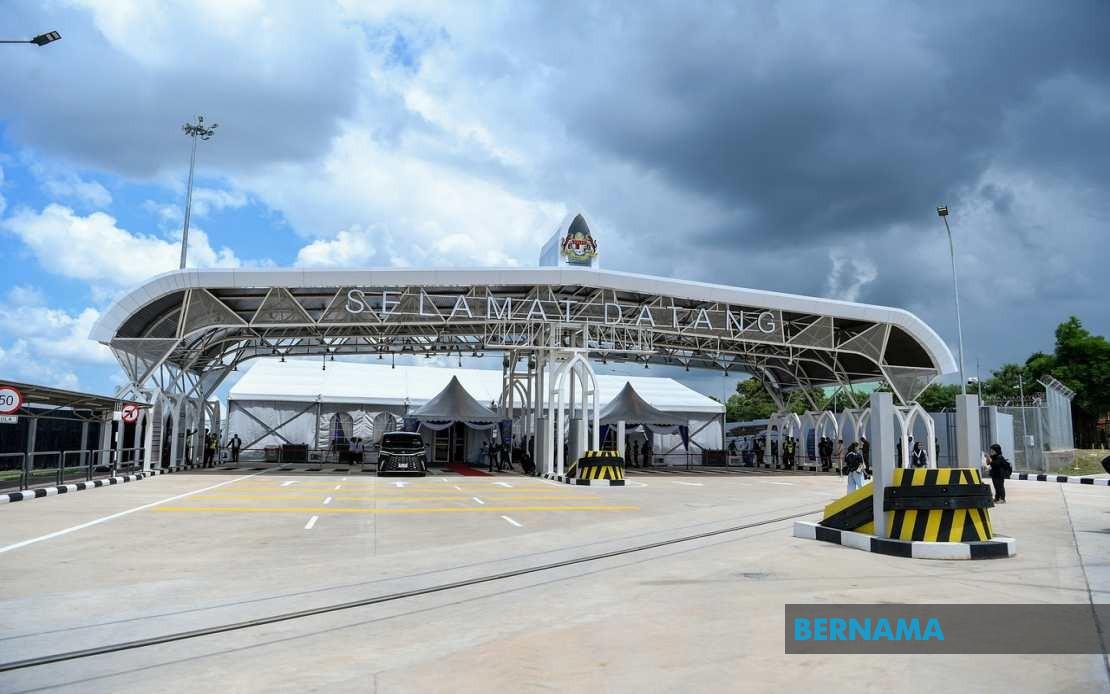
The newly inaugurated crossing between Malaysia's Bukit Kayu Hitam and Thailand's Sadao has quietly emerged as a significant facilitator of regional commerce since its July 11 launch, with preliminary indicators suggesting substantial efficiency gains across the bilateral trade corridor. The 900-metre connection directly links Kedah's Bukit Kayu Hitam Immigration, Customs, Quarantine and Security Complex with Thailand's corresponding Sadao Customs, Immigration and Quarantine facility, creating a dedicated passage that circumvents previous bottlenecks affecting commercial traffic in both directions.
Within its opening month, the corridor achieved near-universal adoption among commercial operators, with Sadao Customs director Buntoon Oucharoen confirming that virtually all lorries, buses and vans have migrated to the new thoroughfare. The abandonment of the congested legacy route represents a decisive shift in regional logistics behaviour, reflecting confidence in the facility's operational advantages. Current traffic flows reveal the scale of commercial interdependence between the two nations, with more than 1,000 logistics vehicles traversing the crossing daily—a figure that underscores the importance of this gateway to both economies.
The technological dimension distinguishes this facility from conventional border infrastructure. Integration of advanced X-ray scanning systems marketed as "Fast Scan" has revolutionized container inspection protocols, compressing examination windows from five minutes to under sixty seconds. This acceleration eliminates the queuing delays that historically constrained movement along the Kedah-Thailand border, allowing cargo information verification through direct computer system access rather than requiring physical documentation review. The mechanisation of preliminary inspections has created a velocity of processing previously unattainable through manual procedures, directly translating to reduced dwell times and lower operational costs for trading enterprises.
The commercial impact materialised almost immediately upon commencement. Comparative data from Sadao Customs for the initial three weeks of operation against the equivalent period in 2024 demonstrates marked expansion in bilateral merchandise flows. Import values reached 19 billion baht (RM2.35 billion) during July 11-31, 2024, representing a substantial 58 percent increase from the 12 billion baht (RM1.48 billion) recorded during the corresponding dates in 2023. Export performance proved even more pronounced, surging to 24 billion baht (RM2.97 billion) compared to the previous year's 13 billion baht (RM1.61 billion)—an 85 percent year-on-year expansion that suggests the route eliminated genuine bottlenecks rather than simply redistributing existing traffic.
The facility's strategic significance extends beyond freight logistics into the tourism and hospitality sectors. The integrated opening of eleven inbound and eleven outbound lanes facilitates not merely commercial vehicle circulation but also tourist movements, with the Hatyai-Songkhla Hotel Association highlighting weekend and public holiday benefits as leisure travellers enjoy smoother passage between Thailand and Malaysia. This multi-modal capacity—simultaneously accommodating heavy logistics, commercial buses, and private vehicles—reflects deliberate infrastructure design acknowledging the complex interchange of people and goods characterising the modern Malaysia-Thailand border.
Broader bilateral commerce patterns confirm the crossing's salience within the regional economic architecture. The first quarter of 2026 witnessed Malaysia-Thailand bilateral trade valued at RM31.33 billion (US$7.90 billion), contrasted with RM27.35 billion (US$6.15 billion) during the January-March 2025 period—a year-on-year increase of approximately 15 percent. The two governments have articulated an ambitious target of achieving US$30 billion (RM122.6 billion) in annual bilateral trade by 2027, a threshold that appears increasingly attainable given current momentum and the enhanced logistics capabilities now available.
The crossing's inauguration in July 2024 represented a rare moment of synchronized political commitment, with Thai Prime Minister Anutin Charnvirakul and Malaysian Prime Minister Datuk Seri Anwar Ibrahim jointly officiating the facility. This high-level endorsement signalled both nations' recognition that border infrastructure constitutes not mere administrative necessity but strategic economic architecture. The formal opening ceremony transformed what might otherwise have been a routine facilities upgrade into a substantive diplomatic expression of bilateral cooperation and shared development ambitions.
Contextualising this development within the broader Malaysia-Thailand relationship reveals significant undertones. The two nations approach their 70th anniversary of diplomatic relations in 2025, a milestone year underscoring decades of institutionalised cooperation. This border crossing represents the contemporary manifestation of that partnership, translating diplomatic goodwill into tangible infrastructure improvements that directly enhance the livelihoods and commercial prospects of millions dependent upon cross-border commerce. The facility embodies the principle that infrastructure investment serves as perhaps the most durable mechanism for deepening bilateral ties beyond symbolic gestures.
For Malaysian logistics operators and exporters, the Bukit Kayu Hitam-Sadao crossing offers immediate competitive advantages. Northern Malaysia's position as an agricultural and manufacturing hub requires efficient access to Thai and broader Southeast Asian markets. Previously, the congested border passage imposed significant time and cost penalties upon regional enterprises attempting to move goods northward. The new route essentially eliminates this friction, allowing Malaysian manufacturers and agricultural producers to service Thai and regional markets with reduced transport costs and improved delivery predictability—factors that enhance competitiveness against alternative sourcing and supply chain configurations.
Thailand's perspective mirrors Malaysia's: the crossing facilitates southward movement of Thai agricultural products, processed foods, and manufactured goods into Malaysian markets and, by extension, into the broader ASEAN trading system. The bilateral nature of the trade expansion evident in July's figures suggests both nations simultaneously benefit from enhanced passage, indicating the crossing removed mutually constraining bottlenecks rather than privileging one party.
Operational sustainability remains a consideration deserving monitoring. The initial month's enthusiasm must be sustained through consistent management, maintenance of inspection technology, and staff training across both complexes. Unexpected inspection failures or administrative delays could rapidly reverse the confidence currently exhibited by commercial operators. Nevertheless, the facility's early performance suggests that when border infrastructure meets contemporary technological standards and receives adequate political support, the results can substantially amplify regional economic integration while reducing friction within complex supply chains.
Looking forward, the Bukit Kayu Hitam-Sadao crossing serves as a proof-of-concept for infrastructure modernisation across Southeast Asia's land borders. Other Malaysia-Thailand crossings and international borders throughout the region will inevitably observe this facility's performance metrics, potentially stimulating investment in comparable upgrades. If the current trajectory continues, this single 900-metre facility may catalyse a broader regional commitment to eliminating border congestion as a structural constraint upon intra-ASEAN commerce, ultimately contributing to the bloc's collective competitiveness within global markets.

