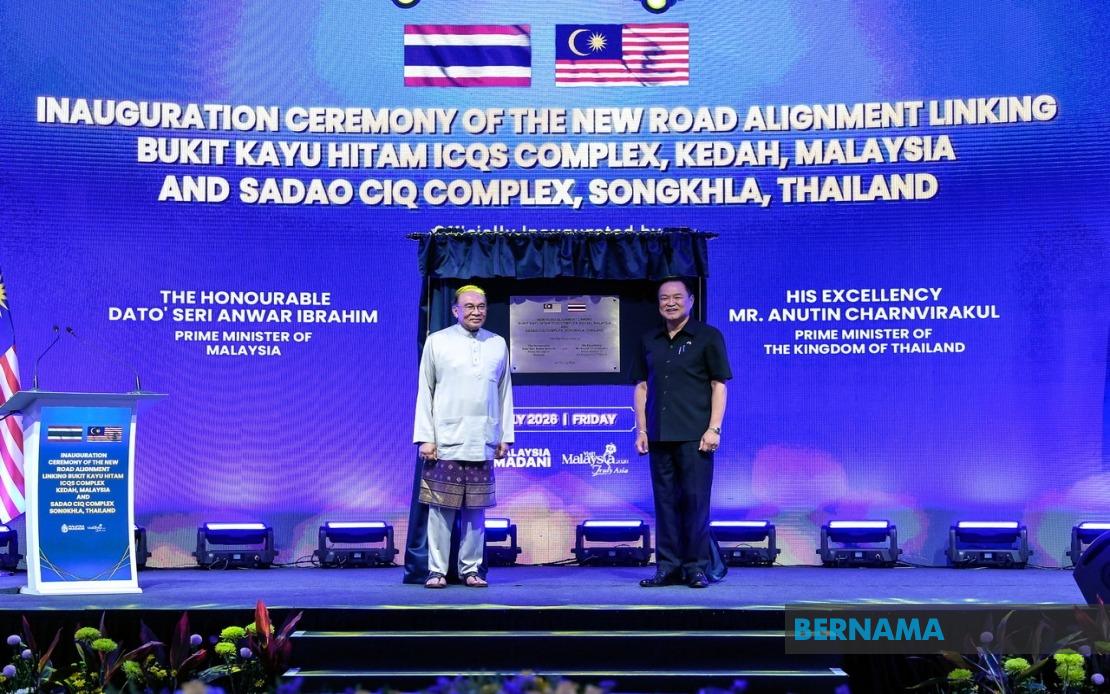
Prime Minister Datuk Seri Anwar Ibrahim marked a significant moment in bilateral relations by inaugurating a fresh road alignment at the Malaysia-Thailand border, positioning the infrastructure as a cornerstone for regional prosperity. The new thoroughfare connects the Bukit Kayu Hitam Immigration, Customs, Quarantine and Security Complex in Kedah with the Sadao Customs, Immigration and Quarantine Complex in southern Thailand, representing tangible evidence of both nations' determination to deepen ties through practical investment.
Anwar characterised the project as more than ceremonial infrastructure, framing it instead as a strategic pivot that would amplify economic momentum across northern Peninsular Malaysia and southern Thailand. Speaking at the launch ceremony attended by Thailand's Prime Minister Anutin Charnvirakul, the Malaysian leader stressed that enhanced connectivity would translate into measurable benefits for traders, businesses, and residents in communities often neglected by development initiatives focused on urban centres. This emphasis on inclusive growth reflects recognition that border regions, while geographically peripheral, hold significant potential for job creation and wealth distribution.
The collaboration extends beyond conventional bilateral diplomacy, Anwar explained, encompassing plans for a special economic border zone spanning five Malaysian states—Perlis, Kedah, Kelantan, Perak, and Penang—alongside Thailand's southern provinces. Such a framework would permit tailored regulations, incentive structures, and operational procedures designed specifically for cross-border commerce, potentially streamlining bureaucratic friction that historically impedes trade flows. The Malaysian premier acknowledged, however, that constructing such institutional architecture demands sustained political will and pragmatic negotiation, processes that cannot be rushed despite urgency surrounding economic recovery in both nations.
A critical dimension of this initiative involves resolving longstanding administrative bottlenecks that have constrained bilateral commerce. Anwar disclosed that Malaysia and Thailand had agreed to expedite resolution of outstanding challenges spanning customs procedures, immigration protocols, fisheries management, and trade mechanics. The commitment to swiftly address these friction points carries implications beyond mere convenience; streamlined border processing directly reduces transaction costs for businesses, enabling competitive advantage in regional supply chains and attracting multinational investment to the zone.
Both nations have anchored their ambitions to a concrete numerical target: achieving USD30 billion in bilateral trade by 2027. This objective, while ambitious, reflects confidence that infrastructural and institutional improvements will generate sufficient commercial incentives to significantly expand exchange volumes. For Malaysian manufacturers and exporters, particularly those in labour-intensive sectors competing against higher-wage jurisdictions, improved Thai market access and integrated supply chains offer pathways to sustained growth. Similarly, Thai enterprises gain improved connectivity to Malaysia's consumer base and its role as a gateway to broader ASEAN markets.
Anwar's comments regarding rapid resolution of long-standing disputes warrant scrutiny given their magnitude. He referenced issues that had consumed years or even decades of negotiation, suggesting that recent discussions yielded unexpected breakthroughs achieved in what he characterised as expeditious fashion. This acceleration likely reflects both leaders' assessment that geopolitical and economic circumstances favour momentum—regional competition from other trading blocs, recovery imperatives following pandemic disruptions, and demographic shifts in border communities all create pressures for tangible progress. Whether these purported advances prove durable under scrutiny remains an open question requiring verification through subsequent bilateral meetings and implementation progress.
The ceremonial presence of both prime ministers at the border site—a locale absent from routine high-level diplomatic theatre—signals intentional messaging about political prioritisation. Anwar's explicit appreciation for Anutin's willingness to travel to peripheral regions underscores how infrastructure projects and border development often suffer from neglect by urban-centric policymakers. By conferring visibility and prestige upon this particular location, both leaders tacitly acknowledge that genuine economic integration requires engagement with communities whose aspirations have frequently been overlooked in national development narratives.
For Malaysia specifically, this initiative addresses structural challenges confronting northern states. Kedah, Perlis, and Kelantan have experienced sustained economic underperformance relative to the Klang Valley and Johor Bahru corridors, with limited diversification opportunities and dependence on agriculture and low-wage manufacturing. Enhanced trade connectivity with Thailand, combined with special economic zone status offering regulatory flexibility, could catalyse business formation, attract foreign direct investment, and develop value-added manufacturing clusters. The five-state framework suggests planners envisage a comprehensive northern economic ecosystem rather than isolated border trade.
Thailand's southern provinces face comparable developmental constraints, compounded by security concerns in certain areas. Economic growth anchored to border commerce with Malaysia could provide stability dividends alongside prosperity gains, offering livelihoods that compete with criminal or insurgent recruitment. From Bangkok's perspective, this initiative represents prudent investment in regional stability as much as commercial opportunity.
The institutional architecture supporting this zone remains largely undefined in public statements. Critical questions persist regarding governance structures, dispute resolution mechanisms, labour standards, environmental compliance, and revenue-sharing arrangements. Malaysian policymakers must ensure that special zone incentives do not create race-to-the-bottom competitive pressures disadvantaging workers or generating externalities borne by broader society. Transparent frameworks, robust environmental impact assessments, and labour standards protections require embedding from the outset rather than retrofitting after problems emerge.
Successful implementation demands sustained attention beyond ceremonial launches. Infrastructure must be maintained, customs procedures genuinely streamlined, and regulatory coordination institutionalised through structures surviving individual leadership transitions. Both nations' track records on cross-border cooperation offer mixed lessons; historical initiatives have sometimes generated enthusiasm at launch only to atrophy through bureaucratic inertia or competing priorities.
For Malaysia's broader regional positioning, this border initiative complements efforts to strengthen ties across ASEAN while managing great power competition. Deepening integration with Thailand, particularly at subnational levels involving border communities, reinforces Southeast Asian cohesion while generating prosperity that stabilises both nations. Success could provide a replicable model for other border regions, potentially extending similar frameworks to Malaysia's frontiers with Brunei, Indonesia, and Singapore.
The road alignment itself represents modest physical infrastructure, yet its symbolic and practical significance transcends engineering specifications. It embodies commitment to cross-border prosperity, reflects recognition of regional potential, and materialises aspirations for integrated development. Whether this symbolic moment translates into sustained institutional cooperation and genuine economic transformation remains contingent upon implementation rigour, political perseverance, and realistic patience with bureaucratic change in both capitals.

