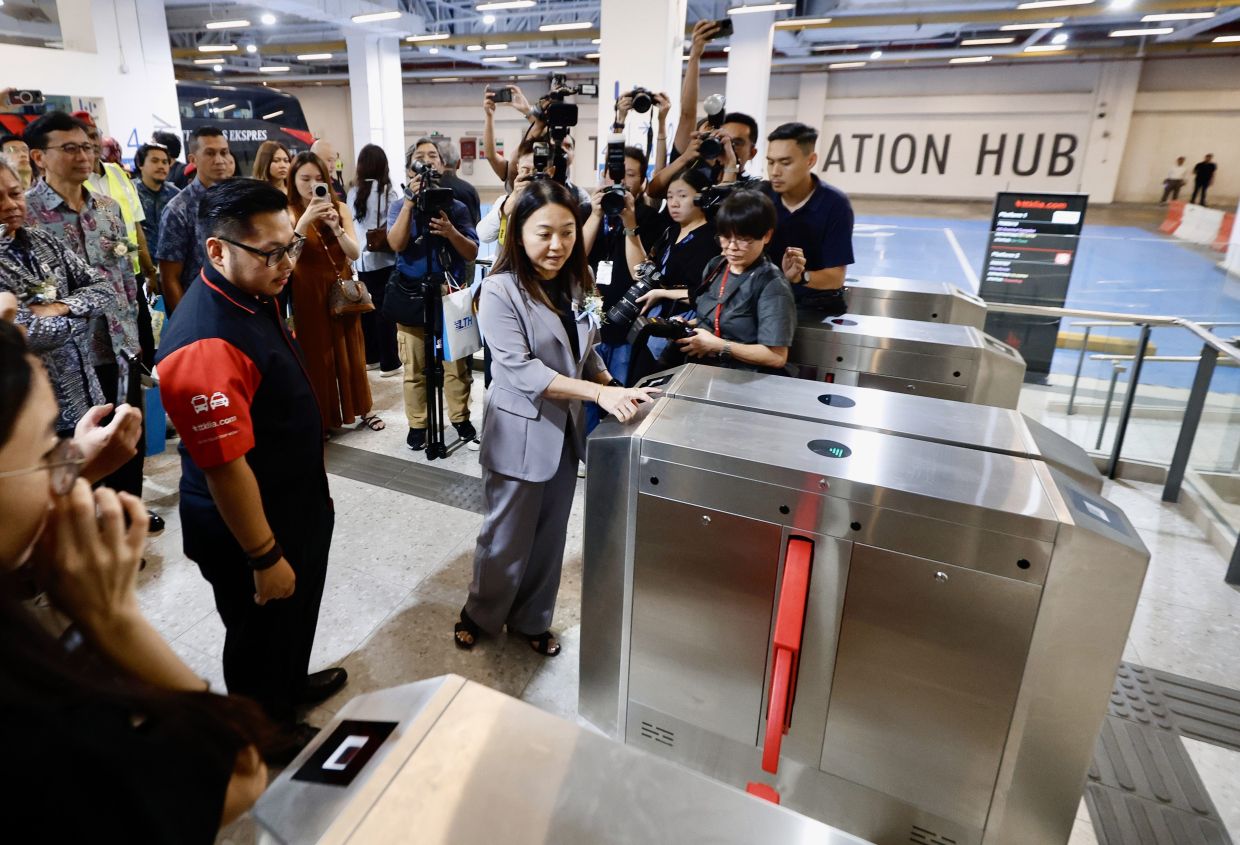
A newly operational transport hub at LaLaport Bukit Bintang City Centre is reshaping how express bus services operate in Kuala Lumpur's city centre, bringing together approximately 30 bus operators into a single, coordinated facility. Licensed by the Land Public Transport Agency (Apad), the LaLaport Transportation Hub represents an effort to streamline urban mobility in Malaysia's capital amid mounting congestion challenges.
Launched officially on Thursday (July 16) by Minister in the Prime Minister's Department (Federal Territories) Hannah Yeoh, the hub is designed to process roughly 3,000 passengers daily in its initial phase, with architects having engineered capacity for up to 10,000 travellers per day as demand grows. This expansion potential suggests planners anticipate significant uptake once the facility achieves greater visibility among commuters and the public transport ecosystem becomes more integrated.
The contextual urgency behind such consolidation is evident in Kuala Lumpur's transport statistics. According to data compiled by Kuala Lumpur City Hall (DBKL), the capital experiences an inflow of approximately 1.2 million vehicles daily, accompanying 5.5 million total journeys entering and departing the city. These figures underscore why Hannah Yeoh emphasised that urban mobility must remain a strategic priority for the nation's capital, particularly as private vehicle usage continues to strain infrastructure and contribute to congestion.
Physically, the facility occupies Level LG1 in the East Atrium of LaLaport BBCC, equipped with 11 dedicated bus bays that provide express passengers with clearly delineated boarding and alighting areas. Beyond the operational bays, the hub includes an air-conditioned waiting lounge—a critical comfort feature in Kuala Lumpur's tropical climate—alongside ticketing counters, self-service automated machines for fare payment, and passenger information displays delivering real-time bus schedules. The integration of modern passenger interface technology reflects a shift toward passenger-centric public transport design.
Connectivity with other modes forms a cornerstone of the hub's value proposition. Its strategic positioning next to the Hang Tuah interchange provides seamless access to both the LRT and Monorail networks through a sheltered pedestrian walkway, allowing commuters to chain multiple journeys without exposure to weather or unnecessarily complex transfers. For Malaysian travellers accustomed to navigating fragmented public transport systems, this kind of integrated interchange is relatively novel in Kuala Lumpur's landscape.
Beyond conventional bus services, the facility operates as a mobility interchange accommodating multiple transport modes. Shuttle van services operate direct routes to KL International Airport Terminals 1 and 2, addressing a critical gap in airport connectivity for residents and visitors. Demand-responsive transport (DRT) services—a flexible, technology-enabled alternative to fixed-route buses—are also available, catering to passengers whose travel patterns don't align with conventional timetables. Designated pick-up and drop-off zones for taxis and e-hailing vehicles acknowledge the reality that Kuala Lumpur's commuters employ a mixture of transport types.
The hub's phased launch beginning in February reflects a pragmatic approach to operational roll-out, allowing service providers and transport authorities to stress-test systems, address bottlenecks, and calibrate schedules before reaching full capacity. This measured implementation stands in contrast to the occasional grand opening followed by teething troubles that has characterised some transport initiatives. By operating and refining operations before the official July launch, planners have created a more robust foundation.
For Southeast Asian regional observers, the LaLaport hub exemplifies an emerging pattern in major cities attempting to manage sprawl through vertical and modal integration. Shopping malls in Kuala Lumpur, Bangkok, and Singapore increasingly function as mobility nodes rather than merely retail destinations. By embedding transport interchanges within premium commercial spaces, developers create mutual benefits: malls gain foot traffic while transport becomes more convenient and visually integrated into urban life rather than relegated to separate, often gritty transport terminals.
The involvement of Apad, Malaysia's land public transport regulator, signifies that the hub operates within the formal regulatory framework rather than as an informal or semi-legal arrangement. This institutional backing should theoretically mean consistent safety standards, fare regulation, and service accountability. For passengers fatigued by inconsistent service quality across Malaysia's fractured bus landscape, operating within a licensed framework offers at least theoretical assurance.
The broader implications for Kuala Lumpur's transport strategy are significant. As the capital confronts the reality that building additional roads merely induces additional traffic—a phenomenon known as induced demand—shifting commuters toward public transport through improved facilities and integration becomes increasingly essential. A hub serving 3,000 daily passengers initially, expandable to 10,000, represents tangible progress toward reducing that 1.2 million daily vehicle figure cited by DBKL, though realistically it represents only a fraction of necessary systemic change.
Yet challenges remain. Integration success depends on whether passengers perceive the hub as genuinely convenient relative to driving or informal transport options. Pricing must remain competitive, schedules must prove reliable, and information systems must function seamlessly. The 30 operators must coordinate rather than compete destructively. For Malaysian cities seeking to replicate this model, the LaLaport experiment will offer instructive lessons about what works when consolidating fragmented transport services into shared infrastructure.

