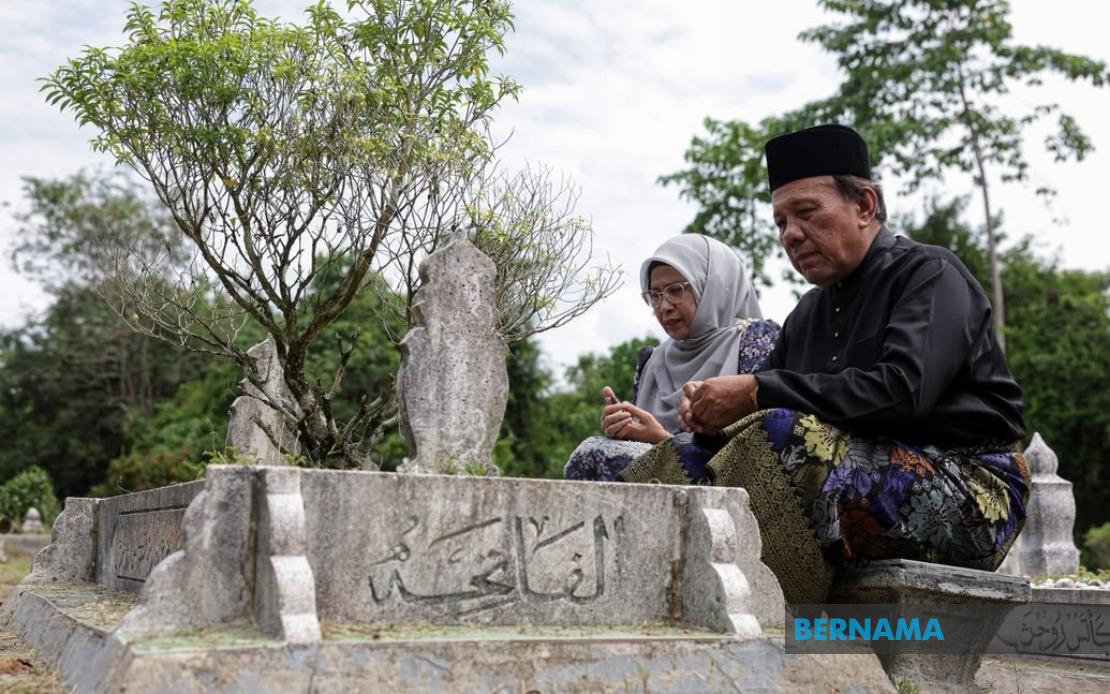
Datuk Ismail Lasim made a poignant personal pilgrimage shortly after being sworn in as Menteri Besar of Negeri Sembilan on August 2, visiting the graves of his deceased parents at the Tebing Tinggi Muslim cemetery in Kuala Pilah. The visit, undertaken together with his wife Datin Noraishah Othman, came mere hours after he formally took the oath of office in front of the Yang di-Pertuan Besar of Negeri Sembilan, Tuanku Muhriz Tuanku Munawir, at Istana Besar Seri Menanti. The gesture underscored the spiritual and familial dimensions often accompanying high-office transitions in Malaysia, where respect for ancestors remains deeply embedded in cultural practice.
Lasim's ascent to the state's top executive position followed a decisive electoral victory in Negeri Sembilan's sixteenth state election held the previous day. He secured the Juasseh state seat with sufficient backing to enable him to form a government, capitalising on broader coalition performance across the state. The timing of his cemetery visit reflected not merely personal reflection but also a symbolic acknowledgment of his family's role in shaping his journey to leadership.
His parents, both now deceased for several years, include his father Lasim Yaman, who passed away on March 5, 2020, at the advanced age of 97, and his mother Bedah Othman, who had died earlier on September 16, 2014. The extended gap between their deaths meant that Lasim had navigated his political career and personal milestones during periods of significant family loss. His decision to visit their resting place immediately upon assuming office suggested a continuity of duty and remembrance, even as he transitioned into demanding new responsibilities.
The election results that preceded Lasim's swearing-in demonstrated substantial voter preference for coalition politics in the state. Barisan Nasional emerged as the dominant force, securing eighteen of the contested state seats, while Perikatan Nasional captured seven seats. This distribution granted both coalitions sufficient parliamentary numbers to govern with a commanding two-thirds majority, a significant mandate that typically provides administrations with considerable legislative flexibility and policy implementation capacity. The outcome reflected broader patterns in Malaysian politics where coalition-building across ethnic and ideological lines remains essential to stable governance.
For Malaysian observers monitoring state-level political dynamics, Negeri Sembilan's election carries particular relevance given the state's geographic proximity to the Klang Valley and its role within the larger peninsular political ecosystem. The state has historically served as a bellwether for broader trends, with its electoral outcomes often prefiguring or reflecting shifts in national sentiment. The decisive nature of the latest contest, combined with the two-thirds majority outcome, suggests voter appetite for stability and consolidated executive authority in the state administration.
Lasim's background and path to the Menteri Besar position reflected the complex dynamics of Malaysian state politics, where electoral success must be paired with coalition negotiation and internal party positioning. His ability to unite sufficient support both within his party and across coalitional partners indicated not only electoral viability but also political acumen and acceptability among diverse stakeholder groups within Negeri Sembilan. His swearing-in ceremony, conducted according to constitutional protocol before the state's constitutional monarch, represented the formal culmination of this political process.
The transition to the Menteri Besar office carries substantial operational and strategic implications for Negeri Sembilan's administration. The role encompasses responsibility for state economic development, infrastructure planning, service delivery across critical sectors, and representation of state interests within federal-state relations. Lasim's immediate assumption of these duties, combined with his coalition government's two-thirds majority, positioned him to pursue substantive policy agendas without the constraints that minority or slender-majority governments typically face.
For residents across Negeri Sembilan, the new administration's priorities and performance trajectory will become evident through policy announcements, budgetary allocations, and implementation of campaign pledges. The state faces familiar challenges including economic diversification, human capital development, and infrastructure modernisation, alongside emerging priorities related to environmental sustainability and digital transformation. How effectively Lasim's government addresses these competing demands will shape public perception and potentially influence electoral outcomes at future contests.
The broader political context surrounding the Negeri Sembilan election also reflected national considerations regarding coalition stability and governance models. The successful two-thirds majority outcome suggested that voters trusted both Barisan Nasional and Perikatan Nasional to collaborate effectively at state level, even as their relationship at federal level remained more complex and contested. This separation between state and federal political calculations demonstrates the sophisticated voting patterns increasingly evident in Malaysian electoral behaviour, where constituents assess parties and coalitions based on specific contexts rather than applying uniform national preferences across all electoral levels.

