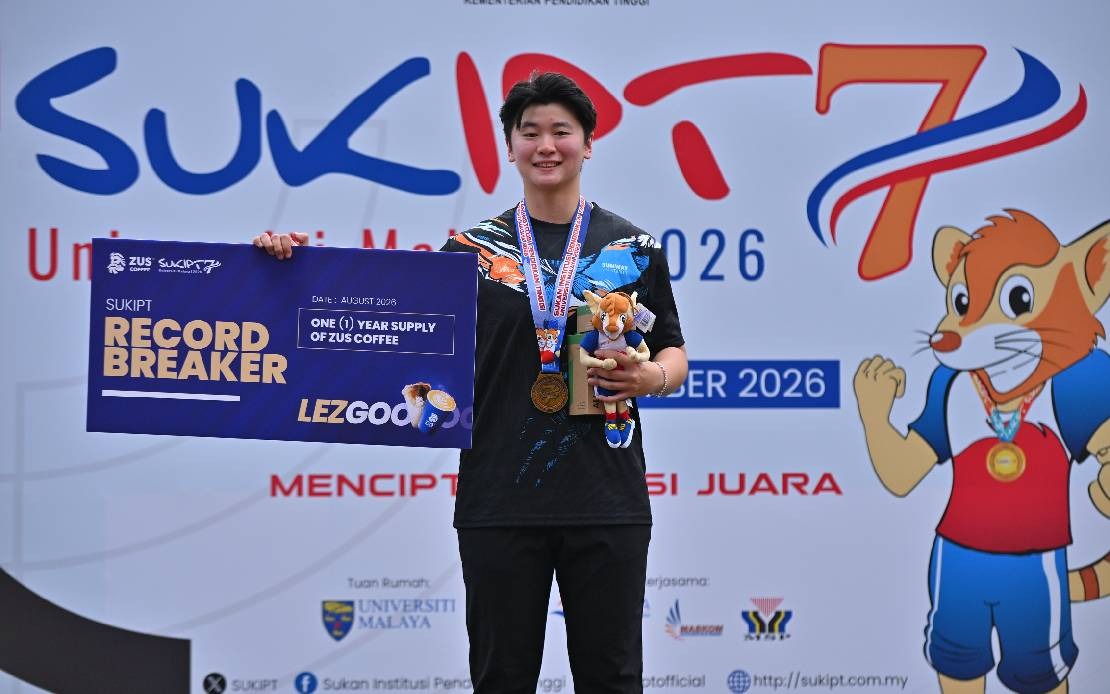
Ng Jing Xuan seized a symbolic moment for Malaysian athletics by erasing a decade-old record on National Day, launching a javelin 46.92 metres across the UM Arena at Universiti Malaya to claim victory in the women's javelin at the 2026 SUKIPT championships. The 22-year-old's performance surpassed the previous best of 44.41 metres established by Nur Fatin Adibah Suharman of Universiti Malaysia Perlis during the 2016 edition, marking a significant benchmark in the biennial higher education sports competition that draws Malaysia's university athletes.
The record-breaking throw delivered an immediate gold medal for Sunway University, yet Jing Xuan's celebration carried an undertone of unfulfilled ambition. Her primary objective entering the championships had been to breach her own national record of 52.17 metres, a target that remains just beyond her grasp despite months of dedicated preparation. The gap between what she achieved and what she envisioned—nearly five and a half metres—reflected the exacting standards she has set for herself as Malaysia's elite javelin competitor.
Jing Xuan attributed her inability to reach peak performance to several operational factors that disrupted her competitive rhythm. A last-minute schedule adjustment that shifted the women's javelin final from the afternoon slot to the morning session introduced unfamiliar conditions that she felt compromised her throwing mechanics. Such scheduling changes, often necessary for logistical reasons in multi-sport tournaments, can meaningfully impact athletes whose bodies and minds have been primed for competition at a particular time of day. She acknowledged that her throws felt sluggish during the morning competition, suggesting she had not fully acclimated to the revised timing.
The athlete's preparation timeline underscored the compressed nature of elite sporting schedules for Malaysian competitors. Jing Xuan had recently returned from representing Malaysia at the Asian U23 Athletics Championships, an international competition demanding significant physical and mental exertion. Rather than extending her recovery period, she immersed herself in intensive training for a full month to prepare for SUKIPT, leaving minimal margin for adaptation or rest. This demanding cycle illustrates the delicate balance required by athletes seeking to maintain peak condition across multiple competitions within a single calendar window.
Despite her disappointment with the national record attempt, Jing Xuan maintained perspective about the day's achievement. The SUKIPT record represented a meaningful accomplishment on a symbolically significant date, and she recognised that transcending previous benchmarks in any competitive setting constitutes real progress. Her willingness to find value in the gold medal and meet record, even while processing the setback of missing her ultimate goal, demonstrated the psychological resilience necessary for sustained high-level athletic performance. Athletes who fixate exclusively on unmet targets risk diminishing their appreciation for genuine advances, a trap Jing Xuan appears conscious of avoiding.
The competition's results contextualised Jing Xuan's dominance within Malaysian university athletics. Farisha Athirah Wai of Universiti Pendidikan Sultan Idris secured silver with 36.21 metres, a performance more than ten metres behind the winner and reflecting the significant technical and physical gap between Malaysia's elite javelin thrower and her nearest competitors at the university level. Bronze medallist Tai Yu Tian from Universiti Putra Malaysia managed 32.74 metres, further emphasising how far the broader field trails the national standard-bearer.
Jing Xuan's focus has now shifted toward two imminent international competitions that will test her capabilities against Southeast Asia's strongest athletes. The ASEAN University Games scheduled for December will bring together university-based competitors from across the region, offering her a competitive platform against peers from Thailand, Vietnam, Indonesia, and other neighbouring nations. Beyond that lies the SEA Games, the region's flagship multi-sport event, where she will represent Malaysia against established rivals from sporting powerhouses throughout Southeast Asia.
These forthcoming competitions assume heightened importance within Malaysia's athletic ecosystem. The SEA Games in particular represents a showcase moment for Southeast Asian sports talent, and national federations prioritise medal accumulation at these games as a measure of their sporting health and development. Jing Xuan's trajectory places her among Malaysia's medal prospects in track and field, making her preparation for these events a matter of national sporting interest. Her ability to harness the momentum from the SUKIPT record while continuing to refine her technique toward breaking the national record will substantially influence Malaysia's javelin medal prospects.
The athlete's willingness to channel her National Day appearance into motivational fuel for upcoming challenges reflects the strategic mindset required for international sports success. Rather than allowing disappointment over the missed national record to undermine her confidence, she has articulated clear objectives for the next phase of her competitive calendar. This forward-facing orientation, combined with her demonstrated technical excellence and willingness to absorb competitive lessons, positions her as a central figure in Malaysia's athletics programme as the region prepares for heightened competition.
Jing Xuan's journey also illuminates the role Malaysian universities play in developing national sporting talent. SUKIPT provides a structured environment where university athletes can compete at meaningful levels whilst pursuing tertiary education, creating a pathway that acknowledges both academic and athletic development. The meet's existence ensures that Malaysia's sporting pipeline includes competitive opportunities between school-level athletics and senior national competitions, a crucial intermediate stage in athlete development that many countries struggle to maintain effectively.

