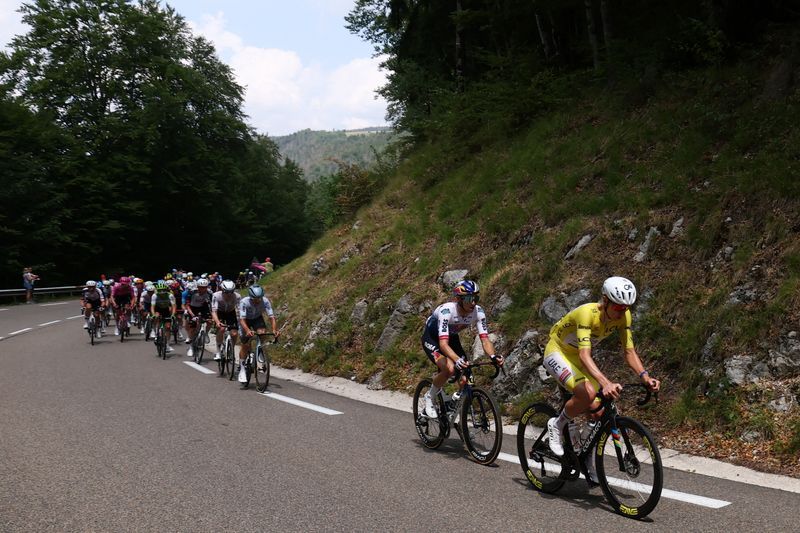
Jonathan Vaughters, the prominent cycling administrator and former professional rider, has stepped into the escalating controversy surrounding unannounced pre-dawn doping tests at the Tour de France, offering a perspective shaped by his unique vantage point as both a participant in cycling's tainted past and a contemporary architect of cleaner practices. Speaking through social media, Vaughters contended that the predawn testing regime, which disrupted the sleep schedules of race contenders Tadej Pogacar and Jonas Vingegaard ahead of the 15th stage, represents one of sport's most effective safeguards against the sophisticated performance-enhancing schemes that plagued professional cycling for decades.
The testing controversy erupted when top-ranked competitors were roused in the early hours of Sunday morning for unannounced anti-doping controls. The early timing provoked significant pushback from riders who argued that the disruption to their rest undermined fairness and raised safety concerns during a gruelling mountain stage that would follow just hours later. Vingegaard, who was tested at 2 a.m., reported losing approximately 40 minutes of sleep before a demanding climbing stage where he subsequently suffered a crash that fractured his collarbone. Pogacar, summoned at 5 a.m., managed to secure just four hours of sleep before continuing in the race. Remco Evenepoel, who ultimately won that stage, dismissed the practice as fundamentally inhumane, reflecting the broader rider sentiment that the timing created an unjust competitive environment.
Vaughters' intervention carries particular resonance because of his credibility on the subject of cycling's doping past. His comments gain weight not from abstract theorising but from lived experience within the sport's darkest chapter. During his professional career spanning the late 1990s and into the early 2000s, Vaughters competed as a teammate of Lance Armstrong on the U.S. Postal Service team, which later emerged as the nexus of systematic doping. Vaughters eventually admitted to using performance-enhancing substances, including EPO, during his racing years. Rather than allow this history to diminish his voice, Vaughters has channelled it into advocacy, subsequently providing testimony for the U.S. Anti-Doping Agency's landmark investigation into Armstrong, an inquiry that concluded Armstrong orchestrated what officials characterised as the most elaborate and scientifically sophisticated doping program in sport's annals.
In his social media commentary, Vaughters made an explicit historical counterfactual argument that carries implications for how cycling approaches anti-doping governance today. He stated that had the International Testing Agency and the Union Cycliste Internationale implemented 2 a.m. testing protocols during his competitive era in 2001, the entire peloton would have faced suspension and the sport would have been spared what he characterised as 25 years of institutional scandal and reputational damage. This assertion reflects the reality that peptide-based substances such as EPO and human growth hormone, along with testosterone protocols that rely on micro-dosing strategies, remain detectable only within narrow time windows after administration. The substances clear the body within hours, making them particularly vulnerable to evasion if testing occurs exclusively during predictable daytime hours when athletes can plan their doping calendars accordingly.
Vaughters has transformed his personal reckoning with doping into institutional action by founding the team now operating under the Cannondale-EF banner, an organisation he has explicitly positioned as a counterweight to the doping culture that once dominated the sport. This positioning as an advocate for clean racing lends credibility to his defence of stringent testing measures, even those that impose genuine logistical inconvenience on contemporary athletes. The argument he advances suggests that the temporary disruption to sleep schedules represents a necessary cost for safeguarding the sport's fundamental integrity.
The International Testing Agency has sought to address rider complaints by acknowledging that night-time testing does create genuine disruption to rest and recovery periods, which bear direct consequences for athletic performance and safety. However, the agency has maintained that effective anti-doping protocols cannot remain constrained to convenient daytime hours if they are to successfully detect the micro-dosing practices that concerned authorities regard as particularly pernicious. The ITA's position reflects a calculus that favours preventive efficacy over competitor convenience, reasoning that limited and justified circumstances warrant testing outside standard hours.
The broader significance of this dispute for Malaysian and Southeast Asian readers extends beyond cycling itself, touching on fundamental questions about how sporting bodies balance competitive fairness against integrity enforcement. As professional sports development accelerates across the region, governance frameworks must grapple with the tension between protecting athletes' welfare and preventing systematic cheating. The Vaughters intervention suggests that willingness to accept short-term inconvenience may be the price of credibility in anti-doping regimes, a principle applicable to emerging sporting communities seeking to establish transparent and trustworthy competition structures from their inception rather than scrambling to restore faith after scandals emerge.
The strategic rationale underlying early-morning testing reflects scientific understanding of how performance-enhancing substances behave within human physiology. Micro-dosing protocols allow athletes to maintain elevated performance benefits while minimising detection risk through careful timing of substance administration and clearance. Daytime-only testing windows create predictability that permits sophisticated users to game the system, administering substances in ways that ensure complete metabolic clearance before any foreseeable control. Night-time testing eliminates this predictability, forcing potential doping athletes to choose between accepting higher detection risk or abandoning the practice entirely. From this perspective, the disruption to Vingegaard's and Pogacar's sleep schedules represents the mechanism through which the testing regime achieves its deterrent effect.
The Armstrong investigation, which concluded with the stripping of seven Tour de France titles in 2012, provided the cycling world with definitive evidence of how systematic, well-funded doping programs could operate for extended periods under the sport's regulatory radar. The investigation revealed not merely individual cheating but an institutional conspiracy that corrupted competition at the sport's highest levels. Vaughters' willingness to testify in that investigation and subsequently advocate for rigorous testing protocols suggests a genuine conversion from complicit participant to reform advocate, though his credibility necessarily remains contested given his own admitted involvement in the conduct he now opposes.
The tension between rider welfare and anti-doping effectiveness reflects a broader governance challenge facing international sport. Regulatory bodies must convince athletes and public audiences that testing measures, even those creating inconvenience, serve the greater good of preserving competitive integrity. The Vaughters intervention attempts to reframe night-time testing not as arbitrary imposition but as historically justified necessity, grounded in evidence that predictable testing regimes permitted the systematic abuse that nearly destroyed cycling's reputation. His argument essentially contends that contemporary riders should accept moderate sleep disruption as preferable to the alternative, which would be permitting a return to the conditions that enabled the Armstrong era and its decades of deception.
For Malaysian sports governance, this case study illuminates how anti-doping infrastructure requires both scientific sophistication and willingness to implement measures that inconvenience competitors when logic demonstrates such inconvenience serves legitimate regulatory purposes. The global evolution of anti-doping policy, as exemplified by the cycling dispute, suggests that sports organisations operating in Southeast Asia must establish credible testing frameworks early, embedding rigorous protocols before doping problems become entrenched. The Vaughters perspective, however complicated by his own history, offers the important insight that short-term athlete dissatisfaction may be the necessary price for long-term sport integrity.

