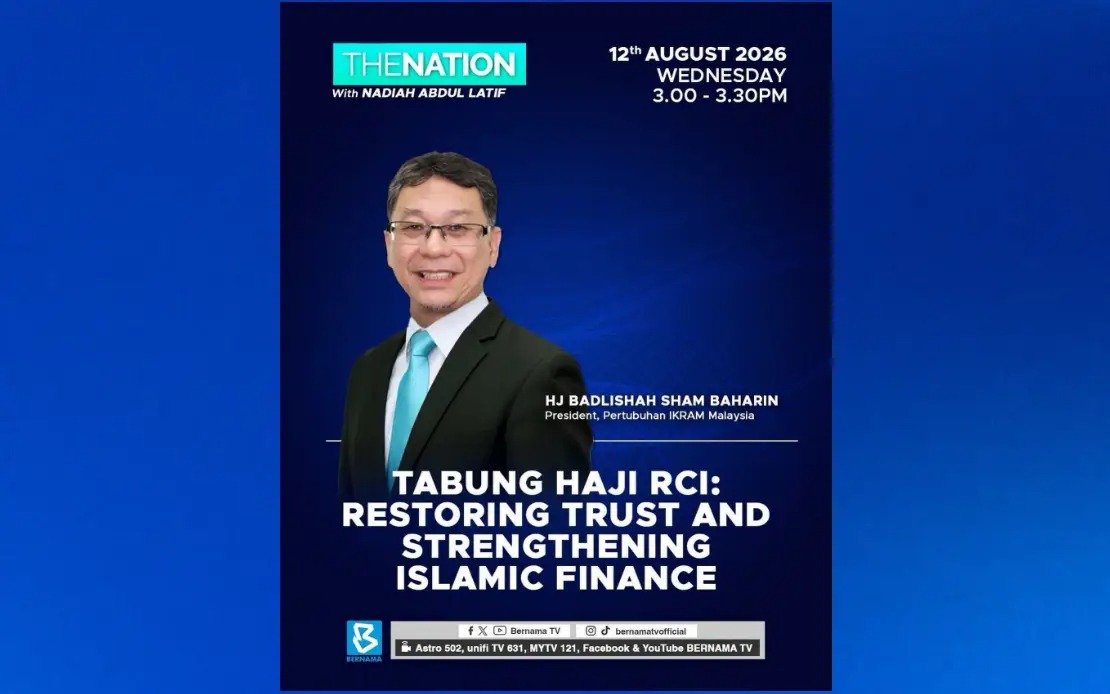
The president of Pertubuhan IKRAM Malaysia has pushed back against calls for a new Royal Commission of Inquiry into Lembaga Tabung Haji, arguing that current investigations by Malaysian authorities provide sufficient oversight of the pilgrimage fund's troubled affairs. Badlishah Sham Baharin made his position clear during a television discussion on Islamic finance governance, contending that the ongoing probe by relevant agencies, particularly the Malaysian Anti-Corruption Commission, represents an adequate institutional response to documented irregularities at the fund.
The intervention highlights growing concern about the proliferation of such high-level inquiries and their impact on public confidence in governance mechanisms. Badlishah Sham articulated a nuanced position that distinguishes between establishing comprehensive investigative bodies for exceptional cases of national importance and relying on standard law enforcement procedures for issues, however substantial, that fall within normal institutional accountability frameworks. He stressed that the overuse of RCIs carries a tangible cost: it erodes their credibility and signals to the public that they have become routine tools rather than extraordinary measures.
Parliamentary opposition from both Barisan Nasional and Pakatan Harapan lawmakers has mounted pressure on the government to commission a new RCI specifically to examine Tabung Haji's management between 2021 and 2025, extending beyond the scope of the existing inquiry that covered 2014 to 2020. This gap in investigative coverage has become a focal point for critics who argue that unresolved questions about more recent investment decisions warrant independent scrutiny. The political momentum behind such calls reflects broader public concern about institutional safeguards, particularly regarding how the fund manages billions in deposits from Malaysian pilgrims.
The scale of historical losses now documented provides context for the intensity of this debate. During the recent Dewan Rakyat special sitting on the existing RCI report, Finance Minister II Datuk Seri Amir Hamzah Azizan revealed that Tabung Haji sustained losses approaching RM13 billion through fourteen problematic investments. The financial hemorrhaging split across multiple channels: the government absorbed approximately RM10.2 billion through a rescue operation conducted via Urusharta Jamaah Sdn Bhd in 2018, while the fund itself recorded RM2.6 billion in impairment charges between 2018 and 2025 for troubled investments still under management. These figures underscore why scrutiny of the fund's investment protocols remains a live political issue.
Among the documented failures, the Al-Rawda transaction emerged as particularly egregious. Between 2015 and 2017, Tabung Haji paid 1.4 billion Saudi riyals, equivalent to roughly RM1.5 billion, to intermediaries arranging lease agreements for four hotels across Makkah and Madinah intended to house pilgrims during the Hajj season. The arrangement unraveled when Al-Rawda ceased rental payments from the first quarter of 2019 onward, ultimately forcing the fund to recognize a complete RM1 billion impairment loss by 2024. This single transaction exemplifies the systemic governance weaknesses the original RCI was designed to illuminate.
While opposing a fresh RCI, Badlishah Sham demonstrated willingness to support institutional innovations aimed at preventing recurrence of similar fiascos. He endorsed the proposal to establish a multi-agency task force capable of monitoring and evaluating investments carrying elevated loss risk. His vision for such an institution hinges on rigorous preliminary due diligence procedures and grassroots ethical review before capital deployment. He emphasized that any investment framework must incorporate compliance verification and procedural accountability throughout the decision-making pipeline, suggesting that the core problem was not necessarily the absence of investigation but rather the failure of preventive mechanisms upstream.
The existing RCI report, released publicly on July 29, documented operational and managerial deficiencies spanning the 2014 to 2020 period and proposed twenty-five corrective recommendations. By July 30, Tabung Haji had implemented approximately 75 percent of these suggestions, indicating some responsiveness to investigative findings. However, the gap between formal recommendations and substantive change in investment culture remains unclear, and the temporal limitation of the inquiry leaves questions about whether systemic vulnerabilities have genuinely been addressed or merely papered over.
Badlishah Sham's remarks also took aim at parliamentary conduct during the special sitting, particularly the decision by some opposition members to walk out rather than engage with the RCI discussion. He characterized such behavior as dereliction of duty, noting that elected representatives carry an obligation to provide institutional checks and balances on executive authority. With nearly 10 million Malaysians holding deposits in Tabung Haji, he argued that lawmakers elected to represent those citizens bore a responsibility to participate actively in parliamentary scrutiny, even when disagreeing with government positions. His criticism implicitly questioned whether legislators were prioritizing political theater over substantive advocacy for depositors' interests.
The debate over a new RCI reflects deeper tensions within Malaysia's governance architecture regarding how institutions should investigate and remediate failures involving public assets. The government's position, articulated through the MACC's existing investigations, assumes that conventional law enforcement mechanisms suffice when executive and regulatory agencies have already been compromised by the failures they should have prevented. The opposition view assumes that extraordinary institutional investigation becomes necessary precisely when conventional oversight has demonstrably collapsed on such a massive scale. IKRAM's intervention suggests a middle position: continuing standard investigations while implementing preventive reforms, though critics might counter that this approach privileges efficiency over thoroughness.
For Malaysian investors and depositors in Islamic finance products, these institutional questions carry practical implications. The Tabung Haji case has become a cautionary narrative about the risks of inadequate investment governance within religious financial institutions, raising concerns about whether other entities operating under similar frameworks possess sufficient oversight safeguards. Southeast Asian nations with significant Muslim populations and growing Islamic finance sectors may also observe how Malaysia resolves these accountability questions, potentially influencing regulatory and institutional design decisions elsewhere in the region.
The determination of whether existing investigations prove adequate or whether a new RCI becomes necessary will likely remain contested in parliamentary and public discourse. Badlishah Sham's argument for restraint in deploying RCIs reflects an institutional perspective that prioritizes preserving the tool's perceived authority and legitimacy for truly extraordinary circumstances. Yet this logic may struggle against the political reality that Tabung Haji's losses represent precisely the kind of governance breakdown that historically has prompted extraordinary inquiries. The resolution of this tension will test whether Malaysian institutional responses to public sector failures remain calibrated to actual harms or have become attuned primarily to political considerations and resource limitations.

