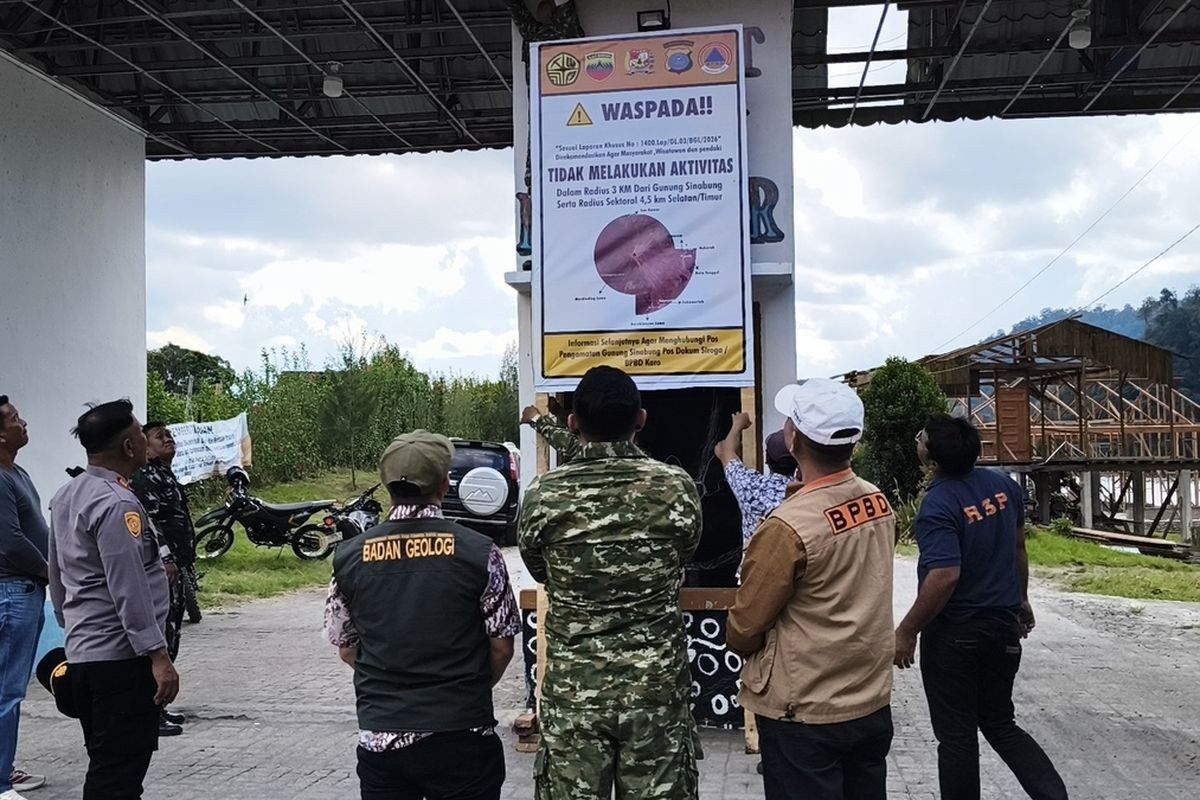
The Karo regency administration in North Sumatra has implemented an indefinite closure of Lau Kawar Lake and an adjacent camping facility in Kuta Gugung village, Naman Teran district, as Mount Sinabung exhibits intensifying signs of volcanic unrest. The suspension of public access took effect from August 19 following formal recommendations from the Vulcanology and Geological Disaster Mitigation Center's monitoring command post stationed at the volcano, according to Juni Antomi Kemit, head of the Karo Youth Affairs, Sports and Tourism Agency.
The decision reflects growing concern among Indonesian geological authorities about the trajectory of volcanic activity at the 2,460-metre peak. Armen Putra, head of the Mount Sinabung monitoring post, confirmed that the alert status has been elevated from Level I Normal to Level II Waspada—the "advisory" tier in Indonesia's four-tiered volcanic alert classification system. This represents a meaningful escalation in official concern and signals that residents and visitors should exercise heightened caution in the vicinity of the volcano. The Karo regent's public announcement issued on August 14 explicitly instructed residents, tourists, and climbers to refrain from all activities in the Mount Sinabung region, providing the regulatory foundation for the tourism closures that followed.
The scientific data underpinning the alert upgrade paints a picture of accelerating geophysical instability. Monitoring officials documented five volcanic earthquakes originating within Mount Sinabung's interior during early Thursday morning, a significant increase from just one recorded on the previous day, alongside multiple tectonic earthquakes. The frequency and character of seismic activity function as leading indicators of potential eruptive behaviour in volcanic systems. Armen noted that thick columns of smoke have been observed rising between 100 and 800 metres above the summit, further substantiating the assessment that Mount Sinabung is transitioning toward a more active phase. The monitoring station issued a stark warning that heightened seismic frequency correlates directly with elevated eruption potential.
Geological authorities have established protective perimeters around the volcano to guide evacuation and activity restrictions. Residents and visitors are advised to maintain a minimum three-kilometre radius from the summit, while the southeastern sector faces an extended 4.5-kilometre exclusion zone due to particular vulnerability to pyroclastic flows and lahars in that direction. Those residing along riverbanks with watercourses originating from Mount Sinabung's slopes face particular hazards from potential mudflows and have been specifically cautioned to maintain vigilance. These safety parameters reflect scientific understanding of how Mount Sinabung's eruptions typically manifest and propagate across the surrounding landscape.
The current heightened alert status represents a significant escalation from the volcano's recent dormancy. Between May 2019 and July 2021, Mount Sinabung operated under Level III Siaga—the "watch" status—following a notable period of reduced activity. However, the volcano's eruptive history demonstrates that such quiet periods should not breed complacency. The volcano remained in near-continuous eruptive mode for eleven years between its 2010 awakening and the 2021 eruption, creating a pattern of unpredictable behaviour that shapes how contemporary risk managers approach monitoring and public safety.
The volcanic profile of Mount Sinabung reveals a pattern of dormancy interspersed with dramatic periods of activity that have repeatedly devastated surrounding communities. After approximately four centuries of quiescence, the volcano dramatically awakened on August 29, 2010, introducing ash emissions and moderate seismic activity to the region. Though activity subsided by September 2010, Mount Sinabung continued its awakening process, with renewed eruptions commencing in September 2013. The situation escalated dramatically in November 2013 when a major eruption forced the alert level to reach Level IV Awas—the maximum "warning" designation. That catastrophic event claimed dozens of lives through deadly pyroclastic flows and compelled over 30,000 residents to evacuate from 21 villages and two hamlets across the region.
The 2021 eruption demonstrated that Mount Sinabung remains capable of producing substantial volcanic events. That eruption ejected ash columns reaching 4,500 metres elevation and generated pyroclastic flows extending approximately 1,000 metres toward the east-southeast sector. Volcanic ash blanketed multiple districts across North Sumatra, creating public health hazards and disrupting normal economic activity across an extensive area. The 2021 event constituted the most significant eruption since the volcano initiated its modern eruptive cycle more than a decade earlier, underscoring the substantial destructive potential that Mount Sinabung continues to pose to the surrounding region.
For Malaysian readers and Southeast Asian observers, Mount Sinabung's renewed volatility carries regional implications beyond North Sumatra's immediate vicinity. The volcano's previous eruptions have distributed ash across broader areas of Indonesia and occasionally affected air quality in neighbouring countries, including during major 2013 and 2015 events. Indonesian volcanic activity influences regional air quality and climate patterns, making the monitoring and management of such threats a matter of transnational concern. The decision to preemptively close tourism facilities represents a prudent approach that prioritises public safety over economic benefit, demonstrating the Indonesian government's commitment to preventing another catastrophic eruption outcome.
The closure of Lau Kawar Lake and its associated camping facilities will create temporary economic disruption for local tourism operators and guide services who depend on visitor revenue. However, authorities clearly view such economic sacrifice as necessary given the escalating scientific indicators. The indefinite nature of the closure reflects uncertainty about Mount Sinabung's future trajectory—volcanic systems sometimes stabilise following initial escalations, while others progress toward full eruptive sequences. The monitoring command post will reassess conditions periodically and adjust alert levels as new instrumental and observational data accumulate.
For residents and organisations operating in the affected region, the current alert upgrade signals the need to activate preparedness protocols and maintain heightened awareness of volcanic hazards. Local communities have accumulated considerable experience managing Mount Sinabung's behaviour over the past fourteen years, having endured multiple evacuations, ashfall events, and disruptions to normal life. Schools, hospitals, and government offices in the region maintain contingency plans for rapid response should conditions deteriorate further. The Karo regency administration's decision to close tourism infrastructure reflects confidence that current monitoring capabilities can provide adequate warning of imminent major eruptive activity, though the volcano's complex behaviour continues to present significant scientific and management challenges.
The coming weeks will prove critical in determining whether Mount Sinabung's current escalation represents a precursory phase to a major eruption or a temporary surge of activity that eventually subsides. Monitoring teams will intensify their observations of seismic patterns, gas emissions, ground deformation, and visual characteristics of volcanic emissions. Should seismic frequencies continue rising or intensity of eruptive indicators accelerate, authorities would likely elevate the alert status further toward Level III Siaga or Level IV Awas, triggering more extensive evacuation protocols. Conversely, if activity stabilises or declines, the alert status could be downgraded and tourism facilities reopened. The scientific community will monitor Mount Sinabung closely, cognisant that the volcano's behaviour over the coming days may determine whether this episode becomes another chapter in its volatile history or returns to the calmer conditions of the recent years.

