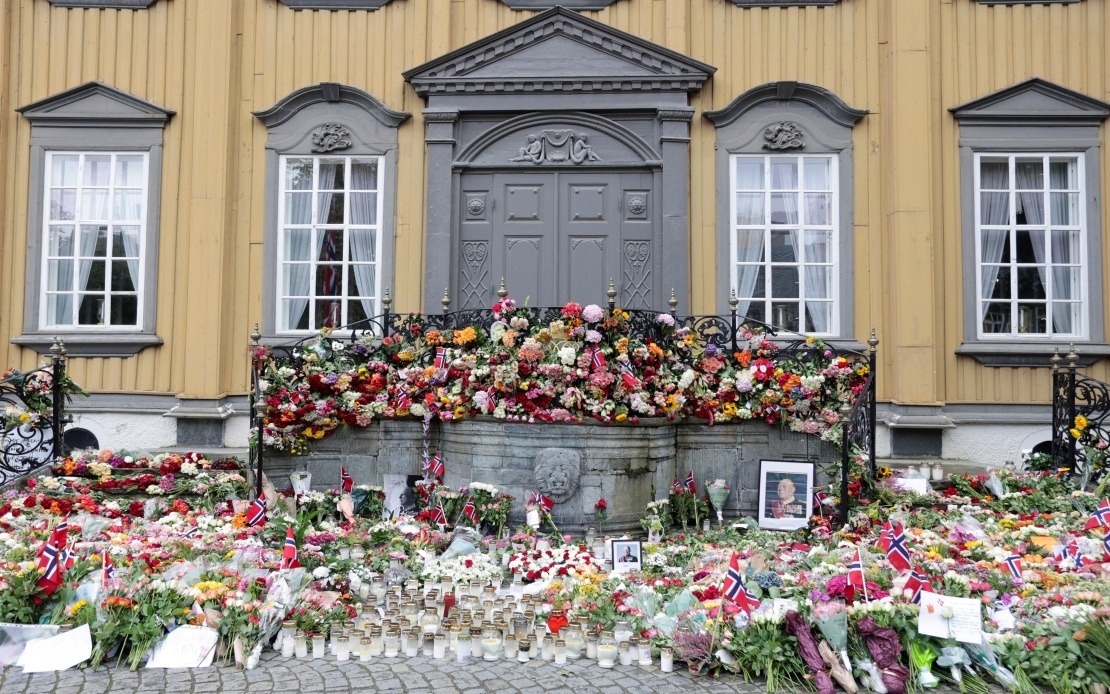
Norway came to a standstill on Sunday as the kingdom mourned King Harald V following his death at the age of 89 on Friday. Across the country, memorial services were conducted in churches and cathedrals, drawing tens of thousands of mourners who wished to pay their final respects to the monarch who had reigned since 1991. The Norwegian Royal House formally announced that the state funeral will be held on September 9, providing Norwegians and international dignitaries with a ceremonial occasion to bid farewell to their late sovereign.
The outpouring of public grief reflected the deep affection Norwegians held for Harald V, whose decades-long reign had seen significant social and technological transformation across the Nordic nation. Citizens gathered solemnly at religious institutions nationwide, creating scenes of quiet reflection and collective mourning. The spontaneous tributes that materialised outside Oslo's Royal Palace—flowers, candles, and handwritten notes left by well-wishers—demonstrated the intimate bond between the monarchy and the Norwegian people, transcending the formal protocols typically associated with royal institutions.
In accordance with Norway's long-established constitutional succession framework, Harald V's eldest son assumed the throne immediately following his father's passing. The new monarch, aged 53, has taken the regnal title Haakon VIII, continuing a naming tradition rooted in Norwegian medieval history. This seamless transition of power reflects the stability and institutional strength of Norway's constitutional monarchy, wherein succession arrangements are predetermined and universally accepted across Norwegian society.
King Haakon VIII now inherits the responsibility of representing Norwegian values and interests both domestically and on the international stage. The timing of his accession places him at a critical juncture in Nordic and European geopolitics, as questions surrounding regional security, energy policy, and Norway's relationship with the European Union continue to shape continental affairs. His early weeks as monarch will likely involve consultations with government officials and international partners regarding Norway's ongoing roles and commitments.
The September 9 funeral date provides sufficient time for formal preparations and allows international leaders, royal families, and foreign dignitaries to arrange attendance at what will become a significant state ceremony. Such occasions serve not merely as expressions of grief but as important moments for reaffirming diplomatic relationships and demonstrating respect between nations. Norway's funeral arrangements will likely draw representatives from other Scandinavian monarchies, European royal houses, and world leaders, underscoring the late king's standing within international circles.
Harald V's 33-year reign witnessed Norway's emergence as a stable, prosperous democracy with substantial influence in global affairs despite its relatively modest population. His tenure encompassed periods of significant economic growth driven by North Sea oil revenues, alongside cultural evolution in Norwegian society regarding gender equality, immigration, and social values. The late king maintained a reputation for approachability and modernity, characteristics that helped sustain public confidence in the Norwegian monarchy during decades of rapid change.
For Southeast Asian observers, Norway's successful monarchical transition offers instructive parallels regarding institutional stability and orderly succession planning. Many regional nations maintain their own monarchical systems, and the Norwegian example demonstrates how constitutional clarity and public consensus regarding succession arrangements can preserve institutional legitimacy and social cohesion during potentially destabilising moments. The absence of political uncertainty surrounding Haakon VIII's accession stands in marked contrast to succession crises that have occasionally emerged elsewhere.
The new King faces immediate priorities including consoling a grieving nation, continuing his father's diplomatic work, and charting his own vision for Norwegian monarchy in an evolving European context. As an experienced constitutional figure who has long prepared for this role, Haakon VIII brings continuity to the institution while potentially introducing his own perspectives on pressing national and international issues. His first acts and statements as sovereign will be closely observed both within Norway and across Scandinavia as indicators of his approach to the monarchy's future.
Norway's nationwide memorial services underscore how the monarchy remains deeply embedded within Norwegian national identity and civic life. Unlike some republics where state symbolism derives from abstract constitutional principles, Norway's monarchy embodies historical continuity and cultural continuity with previous generations. The spontaneous public mourning observed across the kingdom illustrates the monarchy's enduring relevance in contemporary Norwegian society, regardless of ongoing debates about the institution's modern purpose and function.
The period leading to September 9 will see Norwegian institutions, media, and society engaged in extensive reflection upon Harald V's legacy, his personal qualities, and his contributions to Norwegian development. Historical assessments will likely emphasise his role in modernising the monarchy's image, his advocacy for environmental causes, and his maintenance of dignified neutrality during politically contentious moments. These evaluations will shape how Norwegians remember their late sovereign and will inevitably influence expectations placed upon his successor.

