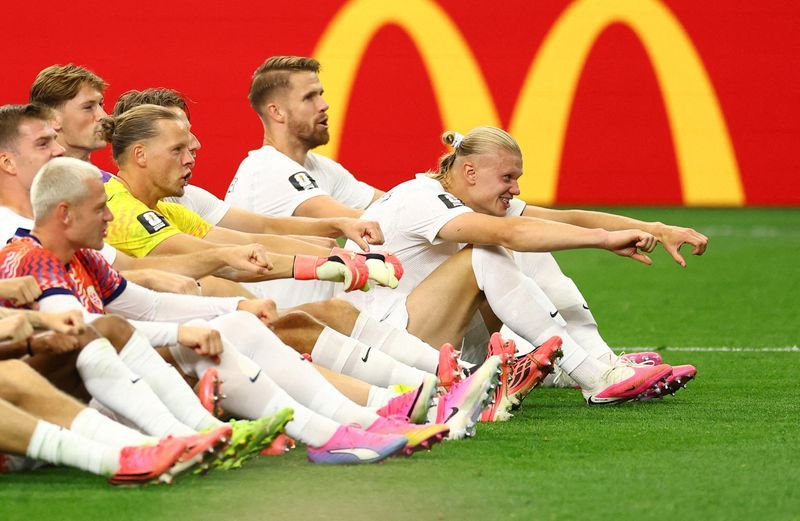
Norway's improbable World Cup journey reached its conclusion on Saturday in Miami, where Stale Solbakken's side succumbed to England 2-1 in a gruelling quarter-final encounter marked by extra-time drama. The defeat marked the end of a tournament that exceeded expectations for a nation returning to football's greatest stage after nearly three decades away, having previously competed in 1998. Yet despite the heartbreak of elimination, Norwegian football departs with its reputation substantially elevated and its future prospects brighter than at any point in recent memory.
The Scandinavian outfit's World Cup narrative began with a deliberately crafted identity, their squad embracing Viking imagery through pre-tournament photoshoots that would become emblematic of their entire campaign. This wasn't merely cosmetic theatre; it reflected a coherent national approach to tournament football that prioritised authentic expression alongside tactical discipline. The visual identity resonated powerfully with spectators worldwide, particularly in the United States, where the towering figure of Erling Haaland became an unexpected fan favourite, his tongue-in-cheek personality and devastating finishing transcending typical football celebrity.
Norway's progression from the group stage represented only a baseline expectation given their qualification credentials, but their subsequent knockout performances transformed scepticism into genuine belief. A commanding 2-1 victory over Ivory Coast in the last 32, underpinned by a Haaland brace, established their credentials as serious contenders. What followed was perhaps their finest moment: a 2-1 triumph against Brazil that dismantled the five-time champions with such clinical superiority that supporters throughout the continent dared imagine a semi-final berth might be achievable. The performance vindicated Norway's approach and suggested that elite-level tournament football was no longer beyond their reach.
The England quarter-final revealed the physical toll accumulated over such an arduous run. Norway carried a single-goal advantage into the latter stages before Jude Bellingham's decisive double intervention in extra time proved decisive, exposing exhaustion that had accumulated particularly around captain Martin Odegaard and the perpetually-marked Haaland. Rather than constituting failure, however, this exit demonstrated that Norway possessed the tactical sophistication and player quality to genuinely compete against the established football hierarchy, falling to an opponent rather than systematic inferiority.
Solbakken's characteristically understated post-tournament assessment—that "the summer of '26 has been fairly OK"—belied the genuine achievement his squad accomplished. This diplomatic understatement, reflecting broader Norwegian cultural traits of measured confidence and self-deprecating humour, obscured transformational shifts occurring within the national game. The spectacle of the "Viking row" celebration, adopted en masse by Norwegian supporters throughout the tournament, transcended football to become a cultural phenomenon that global audiences embraced with genuine enthusiasm.
Norway's recent footballing trajectory contradicts long-standing perceptions of Scandinavian football as fundamentally direct and unsophisticated. Bodo/Glimt's successive European competition campaigns have demonstrated that Norwegian clubs operate within genuinely competitive continental frameworks, producing players who function comfortably at elite levels. This infrastructure development represents years of systematic investment in youth development and tactical evolution, creating conditions where talents like Haaland and Odegaard emerge within a supporting ecosystem of capable colleagues.
The triumvirate of Solbakken, Odegaard, and Haaland embodies a particular Norwegian approach to international football: confident without arrogance, technically proficient, and psychologically resilient. Their collective demeanour conveys the sense that confronting world-class opposition represents opportunity rather than presumed disadvantage. Odegaard's captaincy in particular reflected mature leadership, while Haaland's performance consistently demonstrated why Europe's elite clubs competed so intensely for his signature. Solbakken's tactical management navigated complex tournament demands with remarkable composure.
The manager identified explicitly that his players departed carrying a conviction that they belong within football's upper echelon. This psychological shift carries implications extending well beyond the immediate tournament cycle. Norwegian players approaching future club selections and contract negotiations possess documented evidence that they performed competitively against global football's finest. This confidence translates into enhanced bargaining positions and greater willingness among elite European clubs to consider Norwegian talent seriously.
For Malaysian and Southeast Asian observers, Norway's trajectory offers instructive lessons regarding the relationship between systematic development, cultural authenticity, and international sporting competitiveness. The Norwegian federation's willingness to embrace national identity whilst maintaining tactical sophistication suggests that regional identity need not conflict with playing attractive, effective football. The path from 28-year absence to quarter-final genuinely represents the kind of progressive development that emerging footballing nations aspire toward, demonstrating that relatively smaller populations can punch above their weight through investment and coherent strategy.
Looking forward, Norway possesses sufficient player quality and organizational infrastructure to mount sustained World Cup campaigns. Several squad members remain in their peak years, whilst youth development pathways continue producing emerging talents. The psychological breakthrough achieved through this tournament—the collective belief that Norwegian football can operate as equals with traditional powerhouses—may ultimately prove the tournament's most valuable legacy. When Solbakken reflects in coming weeks on "summer of '26," that familiar Norwegian modesty will mask genuine pride in transformational achievement.

