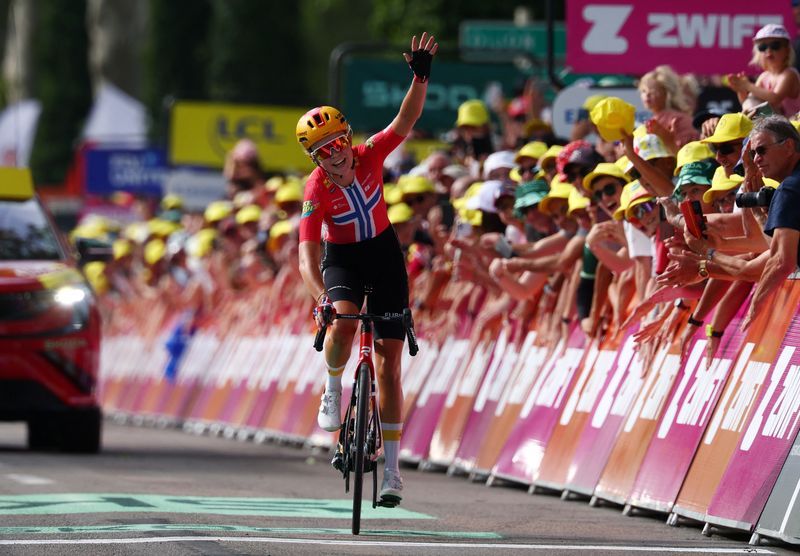
Sigrid Haugset made cycling history on Monday when she powered to a decisive solo victory during the Tour de France Femmes, cementing her position as the first Norwegian ever to both win a stage and wear the yellow jersey in this prestigious women's cycling competition. The 27-year-old rider from Uno-X Mobility demonstrated exceptional endurance and tactical acumen on a challenging mountain stage, holding off determined pursuit from Belgium's Lotte Kopecky to secure not only the stage win but also commandment of the overall standings.
The Norwegian's triumph represents a significant milestone for Scandinavian cycling in one of the sport's most gruelling competitions. Speaking immediately after crossing the finish line in Poligny, Haugset struggled to comprehend the magnitude of her achievement, describing the moment as surreal. Her emotional response underscored the historic nature of her accomplishment, as Norwegian cyclists have historically competed at the highest levels of cycling yet had never claimed victory in this particular event's history.
Haugset now leads the general classification with an advantage of two minutes and 22 seconds over Kimberly Le Court of Mauritius, positioning herself as a genuine contender for the overall title as the race approaches its decisive stages. This commanding margin at this stage of the competition suggests that her victory was built on genuine superiority rather than fortunate circumstances or tactical positioning. Her lead over Le Court provides substantial breathing room, though cycling's unpredictability means maintaining such margins requires continued strong performances.
The stage itself proved treacherous when the peloton encountered its first significant mountain test of the race. During the category-one climb to Col de la Faucille, multiple riders struck the tarmac simultaneously, a dramatic development that included reigning world champion Magdeleine Vallieres and former Tour de France winner Demi Vollering among those who went down. The rapid recovery of the affected riders and the absence of serious incidents demonstrated both the professionalism of the competitors and modern cycling's improved safety protocols.
Haugset's winning move came during the ascent toward Col de la Savine, where she launched her decisive attack that separated her from the main peloton. Kopecky responded with admirable urgency, mounting a sustained chase that briefly threatened to erase Haugset's advantage. The Belgian rider, considered one of the race's strongest performers, managed to close the gap to merely ten seconds with ten kilometres remaining, creating genuine tension about whether Haugset could maintain her lead.
The climax of the 156.5-kilometre stage showcased Haugset's mental fortitude and physical resilience. As fatigue mounted and Kopecky pressed relentlessly, Haugset discovered reserves of strength that allowed her to distance her rival further. By the three-kilometre marker, she had established a gap approaching one minute, effectively securing the victory and the symbolic yellow jersey. This performance highlighted not merely physical capacity but also the psychological dimensions of elite cycling, where mental toughness often determines outcomes.
Wiebes, the previous race leader, faded significantly during the mountain phase, finishing thirteen minutes adrift of Haugset at the stage's commencement. The Dutch rider's loss of the yellow jersey marked a dramatic shift in the race dynamics, suggesting that the mountainous terrain would favour climbers over sprinters and all-rounders. Le Court and Vollering, who had occupied the second and third positions heading into the stage, proved unable to sustain contact with the day's strongest competitors and remained embedded within the main peloton, losing significant time.
Haugset's post-race remarks revealed both her competitive mentality and her physical exhaustion. When asked about her reluctance to celebrate as she crossed the finish line, she explained with characteristic humour that she lacked the physical capacity even to lift her arms from the bicycle handlebars. Yet her comment about honouring supporters back home in Norway illustrated her awareness that this achievement transcended personal satisfaction, representing national pride and inspiration for future Scandinavian cyclists aspiring to compete at the highest levels.
For Malaysian and Southeast Asian cycling enthusiasts, Haugset's breakthrough serves as a reminder that prestigious international cycling competitions remain open to athletes from lesser-represented nations and regions. Her success demonstrates that sustained development programmes, quality training facilities, and individual determination can overcome geographical disadvantages and limited historical precedent. The Tour de France Femmes, increasingly recognised as a premier event in the sport's calendar, continues to showcase remarkable performances from cyclists worldwide.
The implications of Haugset's yellow jersey acquisition extend beyond individual glory. Norwegian cycling now possesses a genuine contender for the overall victory, and Haugset must navigate the remaining stages while managing pressure and maintaining form. The race format traditionally reserves its most decisive tests for the closing stages, meaning her current advantage, though substantial, cannot guarantee eventual triumph. Competitors will view Haugset's dominant performance as both intimidating and motivating, spurring tactical cooperation among rival teams seeking to dislodge the Norwegian from the leader's position.
As the Tour de France Femmes progresses through increasingly demanding terrain, Haugset's stage victory and yellow jersey acquisition have altered the competitive landscape significantly. Her demonstrated climbing prowess and mental resilience suggest she possesses the attributes necessary to defend her position effectively. However, cycling's inherent unpredictability—punctures, mechanicals, crashes, and rivals' improved performances—means maintaining her advantage will require continued excellence across the remaining competition days.

