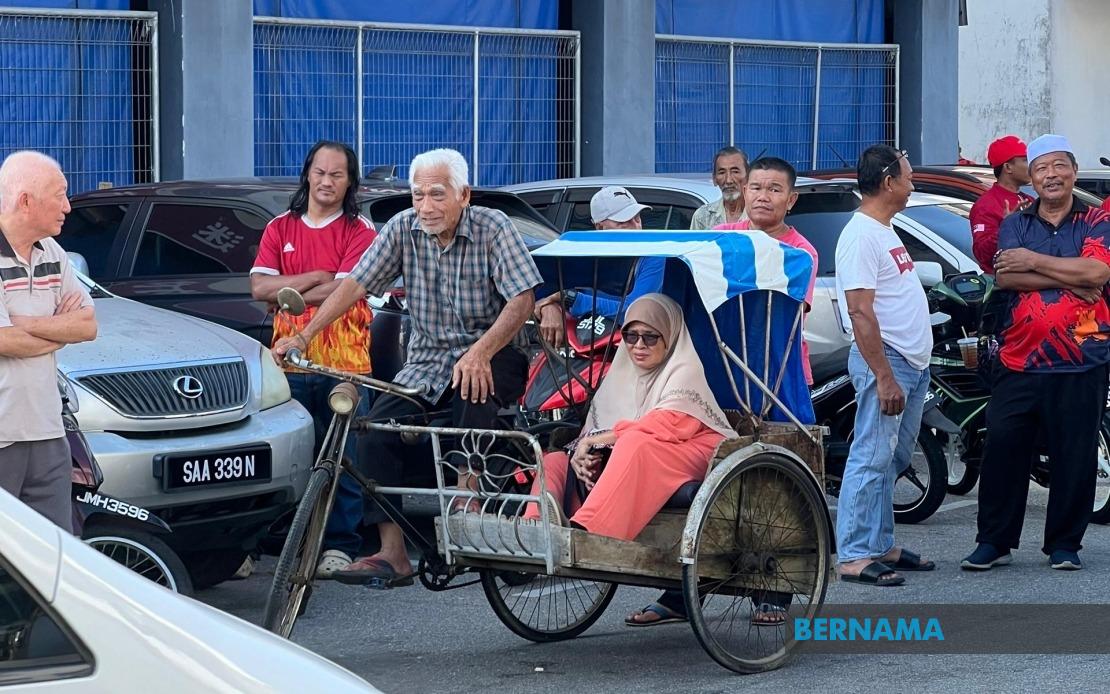
In a striking display of civic enthusiasm, an 86-year-old resident of Batu Pahat in Johor pedalled his trishaw through sweltering conditions to bring his wife to witness Prime Minister Datuk Seri Anwar Ibrahim's visit to the town. Abdul Razak Pelangga undertook the nearly one-kilometre journey from Kampung Parit Bugis to Kedai Kopi Hailam Sri Medan on July 5, driven by his determination to grant his wife Jamilah Samsudin a long-held desire to see the nation's leader in person.
Abdul Razak, who serves as imam at Masjid Raudhatul Jannah Parit Bugis, has nursed a personal connection to Anwar spanning decades. He recounted how the Prime Minister had visited his mosque years before ascending to his current office, an encounter that left a lasting impression. During that earlier meeting, the two men exchanged cordial greetings and prayers, creating a memory that Abdul Razak had frequently recounted to his wife over the years. When word spread that Anwar would be stopping in Senggarang for breakfast, the elderly imam saw an opportunity to transform his wife's television-screen familiarity with the Prime Minister into a tangible, real-world experience.
The choice to travel by trishaw rather than motorised transport reveals pragmatic thinking amid the anticipated crowds. Though Abdul Razak possessed the option to drive a car or ride a motorcycle, he determined that the trishaw would spare him the frustration of seeking parking in the congested town centre. This decision, made despite the oppressive heat typical of Johor in early July, underscores the lengths to which he was willing to go to fulfil what had become a shared family aspiration. The symbolic significance of the journey—the physical exertion required, the choice of a humble mode of transport—added a deeply human dimension to what might have otherwise been a routine political event.
During his breakfast stop lasting approximately fifty minutes, Prime Minister Anwar engaged in the PMX Meet-and-Greet Programme, an initiative designed to build direct connections with constituents in Senggarang during the lead-up to the Johor state election. The event permitted residents and supporters to interact informally with the Prime Minister while he took meals at the local establishment. Datuk Fahmi Fadzil, the Communications Minister and director of Pakatan Harapan's communications apparatus, accompanied Anwar, ensuring media coverage of the engagement. Such grassroots encounters form a critical element of campaign strategy in Malaysian state and federal elections, allowing political leaders to demonstrate accessibility and concern for rural and semi-rural communities.
Though the anticipated face-to-face conversation did not materialise due to the substantial crowd that had gathered, Abdul Razak expressed satisfaction with the outcome. The simple fact of witnessing the Prime Minister at close quarters—a marked upgrade from the mediated experience of television coverage—fulfilled the core objective of their expedition. His wife had achieved her wish, and the memory would outlast the physical discomfort of the journey. For many Malaysians, particularly those in less urban settings, such proximity to national leaders carries profound personal significance, transcending ordinary political interest and touching upon broader themes of representation and recognition.
The octogenarian's participation in the democratic process added another layer to his narrative. Abdul Razak expressed particular enthusiasm about his forthcoming civic duty on July 11, the scheduled polling day for the Johor state election, which notably coincides with his 87th birthday. Though he had exercised his right to vote on numerous prior occasions, this election held special resonance. The convergence of his birthday with the opportunity to cast his ballot created a sense of occasion that transformed routine participation into a milestone moment. He reflected that while voting had always been important, this particular instance felt qualitatively distinct, infused with the emotional weight of personal and political significance aligning on a single date.
The Johor state election represents a consequential political contest within Malaysia's federal framework. As one of the nation's most populous and economically significant states, Johor's electoral outcome carries implications extending beyond its borders, influencing national political calculations and coalition dynamics. The election schedule allows for early voting on July 7, accommodating voters unable to participate on the main polling day. For constituencies like Senggarang, Prime Minister Anwar's personal campaign appearance signals the high stakes attached to the contest and the strategic importance of securing support in traditionally competitive regions.
Abdul Razak's story resonates within the broader Malaysian political context, illustrating how elections function not merely as constitutional mechanisms for representation but as occasions for personal connection and community engagement. The physical journey undertaken by an elderly couple, the deliberation over transport options, the anticipation and partial realisation of a shared aspiration—these elements capture something essential about democratic participation as lived experience rather than abstract principle. His willingness to brave environmental discomfort and physical exertion reflects deeper commitments to civic engagement and family relationships that transcend generational divides.
The narrative also highlights the importance of political leaders' engagement with constituencies beyond urban centres and formal institutions. Rural and semi-rural areas like Senggarang, with their distinct demographics and concerns, require direct political attention and presence. Campaign activities such as the meet-and-greet programme serve to validate such communities' relevance within the national political framework and demonstrate responsiveness from those seeking electoral mandates. For voters like Abdul Razak and his wife, such occasions affirm that their voices matter and that national leadership remains accessible despite the hierarchical distances that often characterise politics in large democracies.
As Malaysia moves toward the Johor state election, stories like that of Abdul Razak's trishaw journey inject human dimension into what might otherwise remain abstract political reporting. They illustrate the diverse ways citizens engage with electoral processes, the personal meanings they invest in political participation, and the continuing significance of direct encounters between leaders and led. The image of an octogenarian pedalling steadily through the heat, motivated by a promise made long ago and a wish cherished by his wife, encapsulates enduring values of perseverance, devotion, and civic commitment that persist across generations and communities within the Malaysian electorate.

