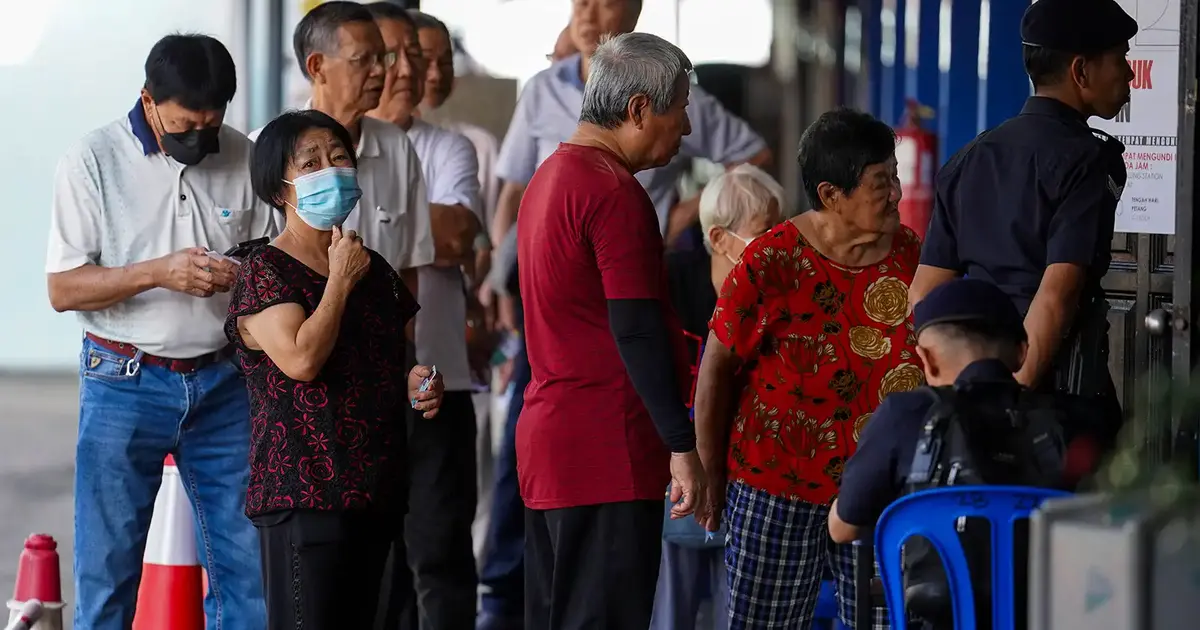
Former Bangi member of parliament Ong Teng Cheong has offered a more nuanced reading of Pakatan Harapan's disappointing performance among Chinese voters during the Johor state election, arguing that the problem was not wholesale abandonment of the coalition but rather a crisis of participation. Rather than Chinese voters flocking to support Barisan Nasional en masse, Ong contended that the principal factor undercutting PH's electoral fortunes was substantially lower turnout among this crucial demographic, a distinction that carries important implications for the coalition's strategy going forward and its ability to rebuild support in the state.
Ong's assessment challenges the more alarming narrative that emerged in some quarters following the election results, which suggested that Chinese voters had definitively switched their allegiance to the ruling coalition. Such a reading would have implied deep erosion of PH's core support base and fundamental rejection of the opposition coalition's political agenda. Instead, Ong's framing points to a different problem: insufficient motivation among Chinese voters to participate in the electoral process, a phenomenon that might be reversible through improved messaging, candidate selection, and party engagement at the grassroots level.
The distinction between voter attrition and voter migration is particularly significant in Malaysian politics, where community-based voting patterns have historically determined electoral outcomes. Chinese voters, who comprise a substantial minority in Johor and remain pivotal in determining the balance of power in many constituencies, have long been considered a swing demographic capable of deciding close contests. A decline in turnout among this group directly benefits the party that can mobilize its own supporters more effectively, which in recent elections has consistently been Barisan Nasional through its established machinery and ground networks developed over decades of governance.
Ong's remarks suggest that PH faced organizational and engagement challenges in the lead-up to the Johor election, potentially encompassing inadequate campaigning in Chinese-majority areas, candidate quality concerns, or message alignment issues that failed to resonate with Chinese voters' immediate concerns. The decision by some voters to abstain from participating altogether rather than switch support to BN indicates a gap in enthusiasm rather than a fundamental realignment, a gap that could theoretically be closed through renewed effort and strategic adjustment.
The implications for Pakatan Harapan are significant as the coalition looks ahead to future contests and seeks to stabilize its position in states where it has traditionally competed. Johor remains strategically important both as a large state with substantial electoral weight and as a bellwether for political sentiment in the southern region. Repeated losses or declining performance in Johor could gradually erode the coalition's credibility and forward momentum, making recovery more difficult in subsequent election cycles.
For Chinese voters specifically, depressed turnout may reflect broader dissatisfaction with political choices available to them, frustration with progress on issues of concern to the community, or simply election fatigue following multiple contests in recent years. Malaysian politics has witnessed a succession of state and federal elections, by-elections, and political crises that have generated campaign fatigue and voter exhaustion. Chinese voters, like others, may have calculated that their participation would not substantially alter outcomes or that neither major coalition adequately addressed their priorities.
The composition of Pakatan Harapan itself may also play a role in turnout patterns among Chinese voters. The coalition's dominance by parties with primarily Malay and Muslim constituencies has periodically raised questions about Chinese representation and influence within the broader alliance structure. While PH includes the Democratic Action Party, a primarily Chinese-based party, the coalition's overall trajectory and policy positioning may not always feel aligned with Chinese community interests or aspirations, a perception that could depress turnout even without corresponding shifts toward Barisan Nasional.
Barisan Nasional, conversely, has benefited from China's historical position as the senior coalition partner with significant patronage resources and established networks in Chinese-majority areas. Even when Chinese voters do not actively support BN, the coalition's ability to turn out its own supporters and control the electoral narrative has provided structural advantages. The lower PH turnout thus translated directly into improved relative performance for BN without necessarily indicating fundamental shifts in community preference.
Ong's analysis also carries implications for how PH strategists should approach rebuilding efforts in Johor and other states with similar electoral dynamics. Rather than accepting that Chinese voters have departed permanently, the coalition can focus on understanding and addressing the specific barriers to participation that depressed turnout. This might involve reconsidering candidate selection processes, allocating more campaign resources to Chinese-majority constituencies, or articulating clearer positions on issues affecting Chinese voters, from vernacular education to business opportunity equity to cultural preservation.
Looking forward, the test for Pakatan Harapan will be whether it can meaningfully reverse the turnout decline among Chinese voters in Johor and other states. The 2023 Johor election results, interpreted through Ong's lens, present both challenge and opportunity. The challenge lies in diagnosing why participation fell short; the opportunity lies in recognizing that voter engagement issues can often be addressed more readily than fundamental shifts in political ideology or community loyalty.
The broader context matters as well. Malaysia's Chinese voters have historically demonstrated pragmatism in their electoral choices, supporting parties and coalitions that they perceive as delivering effective governance, stability, and policies beneficial to the community. Neither PH nor BN has managed to secure overwhelming or permanent support from this critical demographic. Turnout fluctuations therefore often reflect specific electoral circumstances rather than permanent allegiances, providing openings for coalitions willing to invest effort in reengagement.
As Malaysian politics continues to evolve and coalitions adjust their strategies, the question of how to mobilize Chinese voter participation will remain central to PH's prospects. Ong's intervention suggests that the former Bangi MP and his allies believe the coalition remains competitive in Johor and beyond, provided it can solve the organizational and engagement puzzle that manifested as reduced turnout. Whether PH can execute such recovery in the medium term will significantly influence the trajectory of Malaysian politics.

