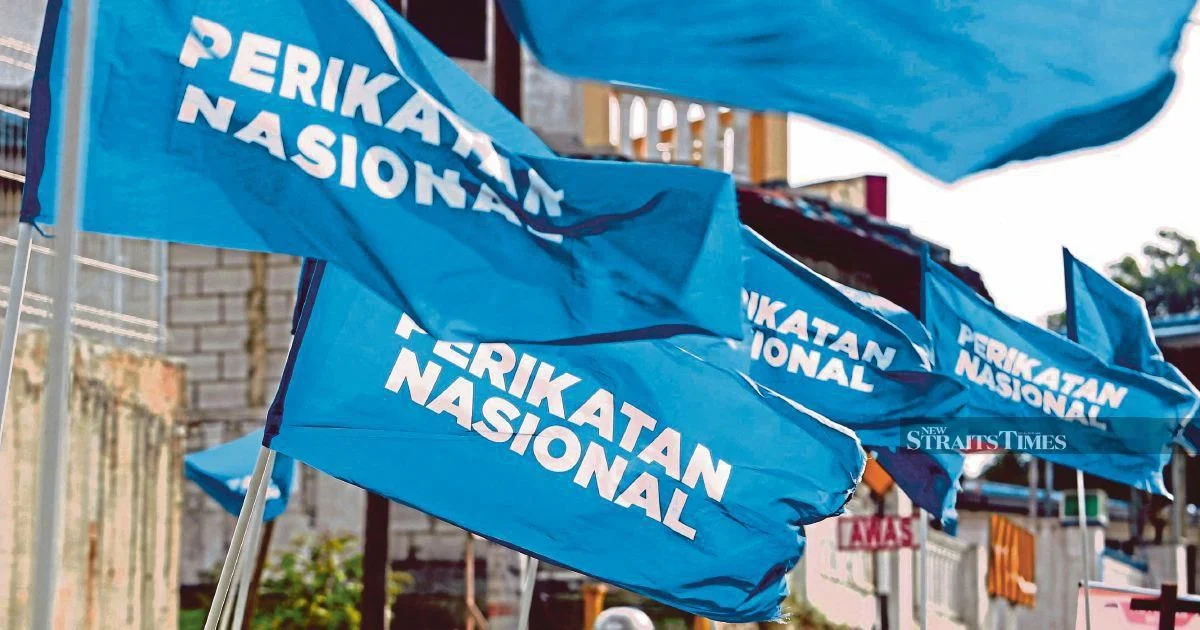
Tensions within the Perikatan Nasional coalition intensified this week as PAS leadership moved to restrict Bersatu's use of the bloc's official logo, marking another visible crack in an alliance that has struggled with internal cohesion since its formation. Speaking from Kota Baru, party officials from PAS argued forcefully that the authority to permit any member organisation's deployment of the PN symbol rests exclusively with the coalition chairman, a position that effectively challenges Bersatu's apparent intention to contest the upcoming Johor and Negri Sembilan elections under the shared banner.
The dispute over branding authority may seem procedural on its surface, yet it reflects deeper ideological and strategic divisions that have plagued the PN coalition. Since its establishment as an electoral and political alliance, the partnership between PAS, Bersatu, and affiliated parties has faced recurring questions about decision-making protocols, resource allocation, and the respective roles of component parties. By asserting that only the chairman possesses the discretionary power to authorise logo use, PAS has essentially questioned whether Bersatu consulted the appropriate channels before preparing for the state elections.
For Malaysian readers accustomed to following the intricate dynamics of federal and state politics, the significance of logo usage extends well beyond aesthetics. Coalition symbols carry considerable weight in electoral strategy, as they signal to voters that a candidate represents a united front with established resources and national backing. In Malaysian state elections, where local and national considerations often intertwine, the symbolic authority conveyed by sharing a recognisable coalition logo can meaningfully influence voter perception and campaign momentum. PAS's intervention therefore represents an attempt to control not merely the technical question of logo permissions, but the broader narrative about PN's cohesion heading into crucial electoral contests.
The timing of this escalation is particularly noteworthy given the electoral calendar. Both Johor and Negri Sembilan represent significant political battlegrounds where control of state governments carries implications for Malaysia's delicate federal political balance. Johor, in particular, has traditionally served as a crucial power base that influences national political calculations. Any weakness or visible discord within PN during the pre-election period could advantage opposition coalitions seeking to portray the alliance as unstable or plagued by internal disagreements.
Bersatu's apparent confidence in proceeding with plans to use the PN logo suggests that the party may have believed it had either obtained the necessary approval or operated under a different interpretation of coalition governance rules. The party, which joined PN after its departure from the Pakatan Harapan coalition and prior to joining Barisan Nasional, has frequently sought to assert its independence and decision-making authority within various alliances. This history implies that Bersatu may view itself as entitled to certain privileges by virtue of its electoral performance or political weight, a perspective that PAS clearly does not share.
The institutional question of governance within PN has never been fully resolved since the coalition's inception. Unlike more formalised structures with explicit constitutional frameworks, PN has largely operated on the basis of implicit understandings and personal relationships between party leaders. Without a comprehensive charter explicitly detailing procedures for logo usage, franchise decisions, and dispute resolution mechanisms, ambiguity persists regarding which party or individual can authorise specific electoral actions. PAS's assertion that only the chairman holds this power represents one interpretation, but the absence of documented procedures means other parties might contest this reading.
For Southeast Asian observers of Malaysian politics, the instability evident within PN carries broader implications for regional political dynamics. Malaysia's coalition politics significantly influence the region's political trajectory, and coalitions viewed as fractious or poorly managed tend to pursue less coherent regional policies. Opposition parties in neighbouring countries sometimes monitor Malaysian political developments carefully, seeking to understand shifting alliances and emerging power distributions that could eventually affect bilateral relationships or regional initiatives.
The PAS intervention also reflects the party's own strategic positioning within the coalition. As a traditionally influential force in Malaysian politics, particularly in states with significant Muslim-majority populations, PAS may harbour concerns that Bersatu receives disproportionate attention or resources within PN despite the other parties' electoral contributions. By enforcing procedural discipline through the logo question, PAS reasserts its organisational weight and reminds coalition partners that decisions cannot be made unilaterally.
Moving forward, resolution of this dispute will require either explicit negotiation between the parties or clarification of previously ambiguous governance procedures. The PN coalition chairman, whoever currently holds that position, faces mounting pressure to either validate Bersatu's approach or enforce PAS's interpretation. Failure to establish clear, binding protocols risks transforming logo usage into a recurring flashpoint. More fundamentally, the dispute exposes underlying questions about whether PN possesses sufficient institutional maturity and procedural clarity to function as a genuine coalition or whether it remains essentially a loose alliance prone to periodic disputes when member interests diverge.