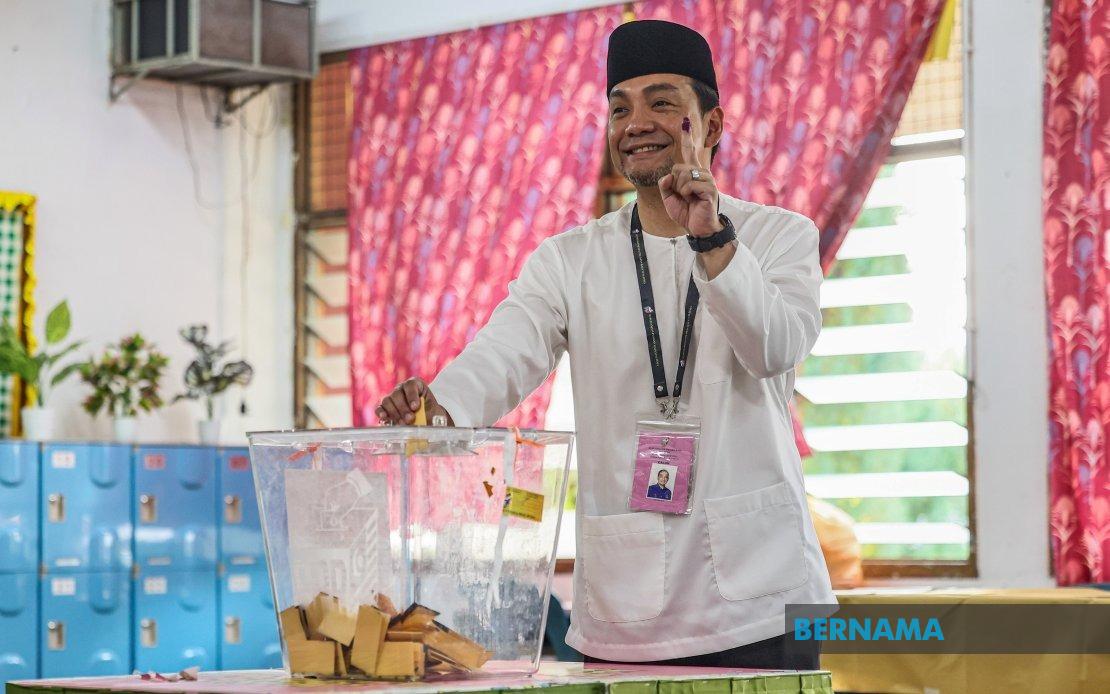
Johor Menteri Besar Datuk Onn Hafiz Ghazi exercised his democratic right early on July 11, arriving at Sekolah Kebangsaan Simpang Renggam just after 8.30 am to vote in the 16th Johor state election. The timing of his appearance at the polling station signalled the incumbent's confidence as he pursued another mandate to lead Southeast Asia's most developed state, an economy that has repeatedly demonstrated resilience through successive political transitions over recent decades.
As chairman of the Johor Barisan Nasional division, Onn Hafiz embodies the ruling coalition's attempt to consolidate its position in a state where demographic shifts and urbanisation have gradually reshuffled the electoral landscape. His decision to arrive early and engage with fellow voters reflected a campaign strategy that emphasises accessibility and connection with the grassroots. The moments spent greeting those queuing to cast their ballots served a dual purpose: reinforcing his presence as a people's leader while simultaneously generating the informal momentum that campaigns rely upon during the decisive closing hours of polling day.
The straight contest between Onn Hafiz and Pakatan Harapan's Nur Hafiz Roslan represented a crystallisation of competing visions for Johor's governance. The incumbent's first term had been marked by efforts to position the state as an economic powerhouse within Malaysia's federal structure, though the challenge of delivery against heightened public expectations remained substantial. His opponent carried the weight of an opposition coalition still seeking to regain ground after the 2022 general election results had modified the national political equation in ways that reverberated through state-level contests.
Beyond the headline race, the election unfolded across multiple constituencies with considerable complexity. In the Puteri Wangsa state seat, the contest expanded to five candidates, illustrating how Malaysian electoral politics had fragmented beyond the traditional two-coalition framework. Dr Maszlee Malik, the Pakatan Harapan aspirant who previously served as education minister in the Mahathir administration, arrived at his polling station shortly before 9 am. His participation underscored how the election drew former federal-level figures into state-level contests, a pattern that reflected both the political realignment following recent federal elections and the permeability between national and state political arenas.
Maszlee's opponents in the five-way race encompassed the ideological spectrum of contemporary Malaysian politics. Rashifa Aljunied represented MUDA, the relatively newer political force that has carved out space by appealing to younger, urban voters dissatisfied with both Barisan Nasional's incumbent conservatism and Pakatan Harapan's perceived compromises. Teow Chia Ling carried the Barisan Nasional banner, seeking to retain traditional support bases. Nicholas Paul Vincent represented Parti Bersama Malaysia, reflecting the emergence of personality-driven micro-parties that have occasionally disrupted conventional electoral calculations. The presence of independent candidate Wang Wee Siong rounded out a contest that mirrored the increasingly pluralistic nature of Malaysian electoral competition, where winning required not merely defeating a single rival but navigating a fractured field of challengers.
Onn Hafiz's public exhortation to voters following his ballot cast revealed campaign messaging priorities in the final hours of polling. His emphasis on early participation and the mechanical aspects of electoral administration—ensuring smooth operations at polling stations—suggested an effort to frame the exercise as one of collective civic responsibility rather than partisan competition. Such rhetoric frequently appeals to voters fatigued by intense electioneering and seeking assurances that the process itself would be conducted fairly and efficiently, concerns that have periodically surfaced in Malaysian electoral discourse.
The July 11 polling represented a significant test for both Barisan Nasional's continued dominance in Johor and for opposition coalitions attempting to make inroads in a state that remains economically significant to the federation. Johor's position as a gateway to Singapore and its role as a manufacturing and petrochemical hub meant that the election carried implications extending beyond state boundaries. Foreign investors monitoring political stability and governance quality in the region would closely observe how results shaped the state government's capacity to implement infrastructure projects and maintain the business-friendly environment that has historically attracted regional investment.
For Malaysian readers, the Johor election demonstrated how state-level contests had evolved from simple two-way competitions into complex multi-party engagements requiring sophisticated voter navigation. The emergence of candidates like Maszlee, once prominent nationally, contesting at state level illustrated the vertical mobility within Malaysian politics, where federal experience and state-level ambitions increasingly intertwined. The presence of multiple opposition and independent candidates suggested that Malaysian voters had access to genuinely diverse choices, though whether this fragmentation ultimately strengthened or weakened the democratic process remained contested among analysts and observers.
The polling day itself represented the culmination of weeks of campaigning across Johor's diverse constituencies, from urban centres like Johor Bahru with their professional and service-sector populations to rural areas dependent on agriculture and traditional manufacturing. How voters in these varied settings responded to competing appeals about economic management, development priorities, and social policies would shape not only Johor's trajectory but also provide indicators of broader shifts in Malaysian electoral preferences heading toward future federal contests. The timing and early voting by key figures like Onn Hafiz and Maszlee signalled confidence in their respective positions, though election results would ultimately determine whether such confidence proved justified or whether unexpected movements in voter behaviour would reshape political alignments in Southeast Asia's most developed state.

