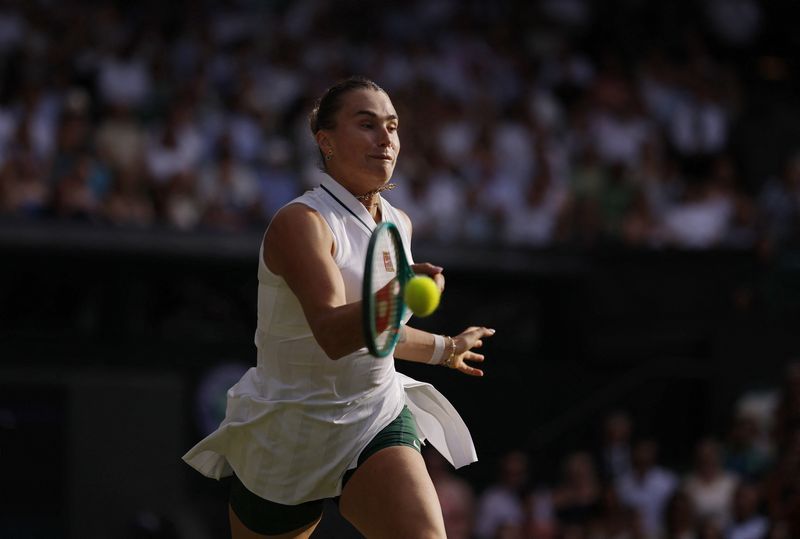
The women's draw at Wimbledon has been thrust into unpredictable territory following Naomi Osaka's commanding dismissal of world number one Aryna Sabalenka on Sunday, with the 14th-seeded Japanese star prevailing 6-2 7-6(2) in an absorbing Centre Court encounter. The result represents far more than a single upset victory—it signals a significant reset in the women's championship race after defending champion Iga Swiatek and second-seeded Elena Rybakina fell in earlier rounds, leaving the path to the title considerably less certain for any remaining contender.
Osaka's performance underlined her effectiveness as she surged into her first Wimbledon quarter-final, combining precision in her return of serve with aggressive baseline play to neutralise Sabalenka's typically dominant power game. The opening set lasted merely 32 minutes, a stark demonstration of Osaka's control and Sabalenka's uncharacteristic struggles to locate her rhythm. What was anticipated as a tightly contested battle between two former Grand Slam champions instead became a masterclass in tactical execution, with Osaka's composed demeanour standing in sharp contrast to Sabalenka's visible frustration throughout the opening period.
The second set proved more competitive in appearance, though Osaka never relinquished control despite Sabalenka's determined efforts to mount a comeback. The pivotal moment came in the tiebreak, where Osaka broke an otherwise impeccable streak—Sabalenka had not lost a single tiebreak across all Grand Slam tournaments since before this season. For the Belarusian champion, the defeat stung sufficiently that she vented her frustration by launching a ball far beyond the stadium's confines after the final point. Sabalenka's post-match demeanour reflected the anguish of squandering what appeared to be her most realistic opportunity to claim the Wimbledon title, having reached three consecutive semi-finals without securing the championship.
Osaka's triumph carries particular resonance given her journey since welcoming daughter Shai. Her return to competitive tennis has been measured, yet this victory against the sport's highest-ranked player represents her most significant achievement since resuming her career. The Japanese star radiated satisfaction in her courtside interview, describing the experience as genuinely enjoyable despite the magnitude of facing Sabalenka. She noted the distinct pleasure of claiming victory against an opponent who had previously defeated her three times consecutively, underscoring how thoroughly she had engineered a reversal of recent head-to-head fortune.
The two players share considerable parallel history, having been born merely seven months apart and building careers primarily on hardcourt surfaces where each holds four Grand Slam titles. However, their trajectories have diverged markedly—Osaka captured all her major championships before Sabalenka secured her first, and they had not faced each other at a Grand Slam for eight years prior to this encounter. Osaka's maiden Grand Slam victory had come against Sabalenka during her breakthrough run to the 2018 U.S. Open title, providing historical context to this reversal of form.
From the opening games, Osaka imposed her game through exceptional return-of-serve quality that consistently unsettled Sabalenka's serving rhythm. The world number one, accustomed to dictating points through her powerful delivery and baseline dominance, found herself immediately on the defensive. Sabalenka attempted to marshal her emotions through visible displays of determination—including striking her racket against her own head in the second set—yet such psychological tactics failed to unlock the aggressive, penetrating tennis that had characterized her rise to the ranking. For long stretches, she never appeared genuinely in command of proceedings despite intermittent flashes of her customary firepower.
Osaka's demeanour throughout remained notably serene, her breathing never becoming laboured despite the intensity of contest. She accelerated through the decisive tiebreak without hesitation or uncertainty, sealing advancement to face tenth-seeded Czech player Karolina Muchova in the quarter-finals. This consistency under pressure distinguished Osaka's performance and explained why Sabalenka's usual advantages in power and aggression yielded no dividends. The Japanese player's recent fashion choices—incorporating Japanese-inspired aesthetics into her court attire—have attracted attention, yet her tennis itself has become the genuine conversation piece among observers tracking her rehabilitation.
For Malaysian and Southeast Asian followers, Osaka's resurgence carries additional significance given the region's passionate tennis following. Her demonstrated ability to navigate the physical and mental demands of Grand Slam competition whilst balancing motherhood provides a compelling narrative beyond the sport's technical dimensions. The broader implication for the women's tournament is that multiple contenders now harbour realistic prospects of claiming the title, with the earlier eliminations of higher-seeded players creating opportunities for players ranked lower who possess the temperament and skill to capitalise on unpredictability.
Sabalenka's post-match comments, delivered with raw candour, reflected the magnitude of her disappointment. She expressed a desire to abandon tennis thoughts entirely, suggesting she intended to process the loss through deliberate distraction rather than immediate analysis. Yet for Osaka and her supporters, the focus remains firmly on momentum building toward the later stages of the championship. Her quarter-final appointment against Muchova presents another significant test, though her performance against Sabalenka suggests she possesses sufficient tactical flexibility and mental fortitude to threaten any remaining competitor. The Wimbledon women's draw has been fundamentally altered, and Osaka now stands among those with genuine ambitions for the title.

