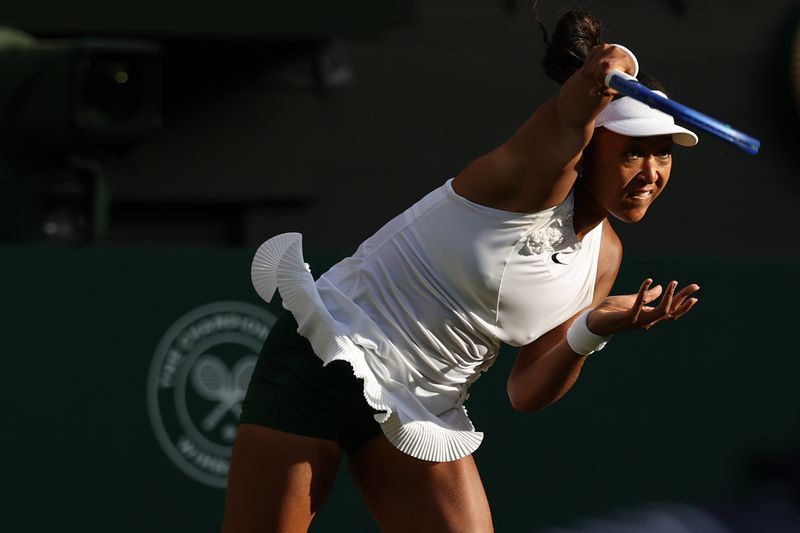
Naomi Osaka's Wimbledon journey has taken a dramatic turn from stylish preparation to ruthless execution. The 14th-seeded Japanese player, who arrived at the All England Club in striking form with a kimono-inspired outfit paying tribute to the character O-Ren Ishii from Quentin Tarantino's 'Kill Bill', has translated her fashionable presence into dominance on the grass courts. Her demolition of top seed Aryna Sabalenka, whom she dispatched 6-2 7-6(2) to claim a berth in the quarter-finals for the first time, represents the most significant scalp of her return to competitive tennis following maternity leave in 2024.
The magnitude of Osaka's victory extends beyond the individual match result. Her dismissal of Sabalenka compounds what has become the most dramatic upheaval of Wimbledon's upper seedings in recent memory. Defending champion Iga Swiatek already departed in the third round, while 2022 champion Elena Rybakina fell at the same stage. With Barbora Krejcikova, the fourth major presence among the tournament's elite, eliminated by fellow Czech Karolina Muchova in the fourth round, the entire top tier of women's seeding has collapsed with unprecedented suddenness. The consequence is virtually assured: Wimbledon will crown a first-time champion for the ninth successive year, a remarkable string of new victors that underscores how radically the landscape of women's tennis continues to shift.
Osaka's display against Sabalenka exhibited the tennis that propelled her to four Grand Slam titles during her ascendancy. Working across the grass with precision and overwhelming power, she maintained near-constant pressure throughout, forcing the world number one into uncharacteristic errors while capitalising on every fractional opening. Sabalenka, typically the arbiter of pace and aggression, found herself repeatedly on the back foot, her frustration boiling over visibly during Centre Court's afternoon session. The Japanese player's control appeared effortless, her movement economical, her shot selection deliberate. After their initial meeting during Osaka's 2018 U.S. Open triumph, the pair had not crossed paths for nearly eight years. When competition resumed between them this season, Sabalenka had seized all three encounters, establishing psychological advantage heading into their Wimbledon encounter. Yet Osaka's imperious performance thoroughly erased that recent history.
Osaka revealed her emotional investment in reversing that sequence following her victory. Reflecting on her three consecutive defeats to the Bulgarian player, she explained: "I lost to her like three times in a row, so that really sucked." The psychological release of reclaiming dominance over a rival who had dominated their recent encounters seemed genuinely to buoy her confidence. Yet she acknowledged deliberately restraining her creative impulses in subsequent interviews, suggesting that her primary focus has shifted squarely toward competitive performance rather than off-court spectacle. When questioned about whether she might return to the showier sartorial choices that have characterised her Wimbledon presence, she indicated a deliberate repositioning: "I actually really wanted to focus on the match. So that was me being very tame. I kind of want to focus on my tennis now, so I might dial back a little bit."
Osaka's pathway forward now presents fresh challenges despite her commanding form. She encounters 10th seed Karolina Muchova in the quarter-finals, the Czech player who herself delivered a decisive performance against defending champion Barbora Krejcikova, prevailing 7-5 5-7 6-3 in a tightly contested fourth-round encounter. Muchova demonstrated remarkable versatility and composure in navigating that high-pressure match, suggesting that despite lower seeding, she represents a formidable obstacle to Osaka's progression.
Meanwhile, the men's draw continues its trajectory toward potential history, though Novak Djokovic's progress carries the unmistakable stench of struggle rather than triumph. The 39-year-old Serbian champion advanced past Russian qualifier Roman Safiullin, claiming a 7-6(6) 6-3 3-6 6-3 victory that extended his men's record for most Wimbledon match wins to 106, surpassing the Swiss legend Roger Federer. Yet Djokovic's own assessment proved brutally candid: he described his performance as lacking the satisfaction and enjoyment expected at his level, admitting to feeling fundamentally uncomfortable throughout the contest. The victory carries him toward the significant milestone of an eighth Wimbledon title, equalling the modern record, yet the manner of progression suggests physical or technical vulnerabilities that future opponents may exploit.
Djokovic's route to potential semi-final confrontation with defending men's champion Jannik Sinner requires negotiation of Canadian third seed Felix Auger-Aliassime, who himself emerged from an exhausting fourth-round battle against Spain's Alejandro Davidovich Fokina. That encounter consumed four hours and twenty-six minutes before Auger-Aliassime prevailed 6-7(4) 7-6(6) 6-3 6-7(2) 6-1, concluding with heated exchanges at the net that suggested significant emotional intensity beneath the surface. Such gruelling contests raise questions regarding physical reserves remaining available for subsequent rounds.
Polish player Hubert Hurkacz's Wimbledon aspirations terminated in heartbreaking circumstances when German veteran Jan-Lennard Struff, himself a surprise quarter-finalist at age 36, forced his opponent to retire during their fifth-set encounter. Struff's improbable progression through the rounds demonstrates that Wimbledon's grass courts continue generating unexpected opportunity for players operating outside the tournament's established hierarchy.
The American women's contingent has emerged as an unexpected source of strength within the depleted women's draw. Five American players reaching the fourth round represents their strongest collective showing since 2002, a figure that speaks to both the systematic disadvantages befalling the traditional tennis powers and the gradual development of greater depth across American women's ranks. Fourth seed Jessica Pegula demonstrated precisely why experience and tactical intelligence remain prerequisites for sustained success, overwhelming 18-year-old American prospect Iva Jovic 4-6 6-3 6-1 in their Court One encounter. Pegula has now matched her finest Wimbledon performance, and potentially faces fellow American Coco Gauff should the latter overcome Swiss player Belinda Bencic in their pending encounter. Such accumulation of American female representation in the later stages represents a structural shift in women's tennis dynamics.
The confluence of these developments paints a Wimbledon championship whose trajectory appears fundamentally unpredictable. The women's draw has fractured its established hierarchy almost entirely, guaranteeing unprecedented representation at championship stage. The men's competition, while still dominated by Djokovic's veteran presence, exhibits vulnerabilities that less heralded competitors continue to exploit. For Malaysian observers particularly, these dynamics illustrate how even the sport's most prestigious and traditionally conservative tournaments cannot escape the broader transformation currently reshaping professional tennis across all segments of global competition.

