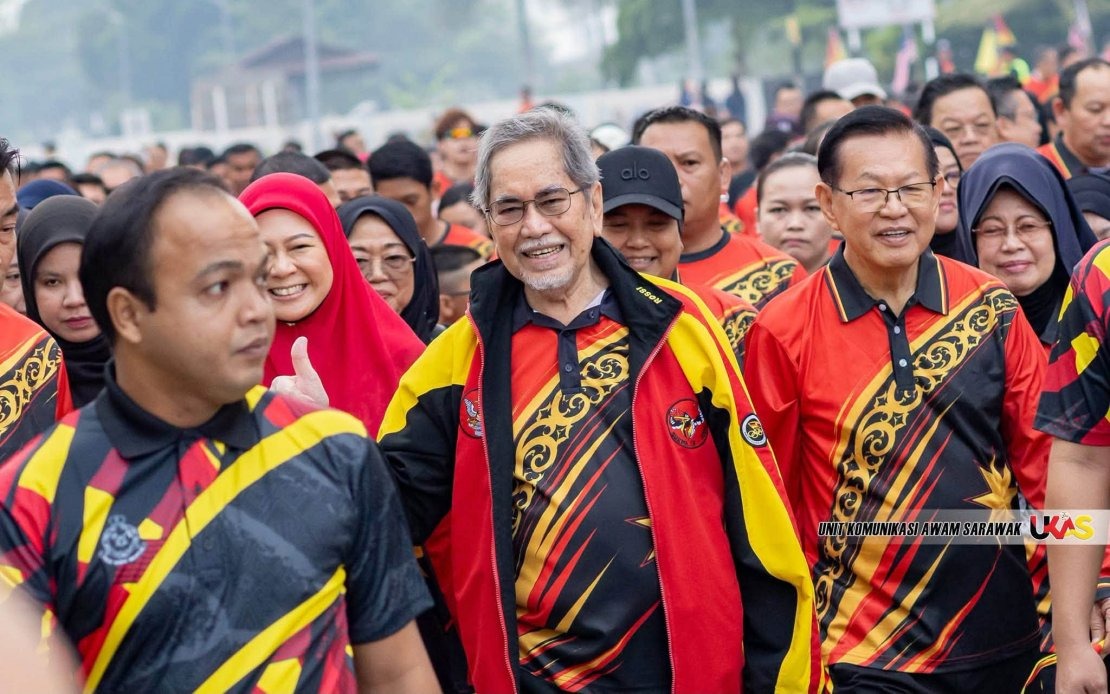
The streets of Sibu witnessed an outpouring of regional pride on July 22 as more than 10,000 residents participated in the Sarawak Day Unity Walk 2026, a celebration that underscored the multicultural fabric of Malaysian Borneo's largest state. Converging at Dataran Tun Tuanku Bujang in the early hours, participants dressed predominantly in red, yellow and black created a visual testament to shared identity, their presence representing one of the year's most significant grassroots gatherings in Sarawak's urban centres.
The march itself traversed nearly five kilometres through some of Sibu's most recognizable thoroughfares, including Jalan Kampung Datu, Jalan Kampung Hilir, the Simpang 3 Roundabout, Jalan Awang Ramli Amit and Jalan Tun Abang Haji Openg, before returning to the starting point. As the procession moved through the heart of the city, participants waved both the Jalur Gemilang and Sarawak flags while patriotic songs resonated through the streets, punctuated by rhythmic chanting of "Sarawak Maju Makmur," a rallying cry emphasizing collective progress and prosperity. The atmosphere captured the essence of what state authorities intended: a celebration transcending ethnic and communal boundaries.
The composition of participants reflected Sarawak's renowned diversity, with Malays, Melanau, Iban, Bidayuh, Chinese and Orang Ulu communities all represented in the march. The inclusion of families spanning multiple generations—from senior citizens to children and youth—transformed the walk into a intergenerational statement about regional identity. This cross-generational participation is particularly significant in Southeast Asian context, where such unified public expressions of state patriotism often serve to reinforce social cohesion in increasingly fragmented urban landscapes.
Governor Tun Dr Wan Junaidi Tuanku Jaafar, accompanied by his wife Toh Puan Fauziah Mohd Sanusi, formally inaugurated the march by flagging off the participants. The presence of multiple state ministers—including Datuk Seri Lee Kim Shin (Transport), Datuk Seri Abdul Karim Rahman Hamzah (Tourism, Creative Industry and Performing Arts), and Datuk Seri Fatimah Abdullah (Women, Childhood and Community Wellbeing Development)—alongside numerous deputy ministers, elected representatives and community leaders, underscored governmental endorsement of the event. Such high-level political participation reflects the strategic importance placed on civic engagement and regional identity-building within Sarawak's contemporary governance framework.
Following the walk, state leadership visited the accompanying Sarawak Day 2026 History Exhibition, which charted the state's historical trajectory toward self-governance. This curatorial choice reveals an important narrative dimension: the commemoration of Sarawak Day inherently connects contemporary celebrations to the state's distinctive constitutional status within Malaysia. The exhibition served as a pedagogical complement to the morning's festive march, providing intellectual and historical scaffolding to popular demonstrations of solidarity.
For Malaysia's broader regional context, such celebrations carry implications beyond symbolic significance. Sarawak's historical experience as a former British protectorate that joined Malaysia in 1963 creates a unique political consciousness. These annual observances function as platforms through which state residents articulate their distinctive identity while remaining integrated within the Malaysian federation. The successful mobilization of 10,000 participants suggests sustained public engagement with state-level commemorations, even as federal political dynamics continue to evolve.
The evening's scheduled continuation—the Sarawak Day Assembly and People's Concert at the same venue, to be officiated by Sarawak Premier Tan Sri Abang Johari Tun Openg—indicated that the day's celebrations extended beyond morning festivities into sustained programming. This extended calendar demonstrates organizational sophistication and reflects how Malaysian states have increasingly professionalized their annual commemorative events, treating them as multifaceted cultural and political productions rather than single-moment observances.
For observers across Southeast Asia, the Sibu gathering illustrates how subnational identities function within the Malaysian political system. Unlike some federal structures where regional commemoration might generate tensions with national identity, Sarawak Day celebrations appear largely integrated into broader Malaysian patriotic frameworks. The simultaneous display of both Jalur Gemilang and Sarawak flags symbolizes this dual loyalty structure, where state pride and national citizenship coexist rather than compete.
The demographic composition of the march—spanning urban professionals, rural communities, various age groups and all major ethnic clusters—offers insights into Sarawak's contemporary social fabric. In an era when urban-rural divides and intercommunal tensions characterize many Southeast Asian societies, Sibu's unity walk demonstrated practical capacity for large-scale public assembly around inclusive rather than divisive themes. This achievement becomes noteworthy when contextualized within Malaysia's own periodic communal tensions, suggesting that deliberate civic programming around shared identity can mobilize participation across traditional cleavages.
Sibu's significance as the venue reinforces these observations. As Sarawak's second-largest city and the economic and cultural hub of the Rajang Delta region, Sibu has historically served as a crucible of interethnic commerce and cohabitation. The choice to stage this major celebration in Sibu rather than the state capital Kuching underscores how state commemorations are increasingly distributed geographically, ensuring that regional cities share in high-profile celebratory events and governmental attention. This decentralization of commemoration reflects evolving state-building strategies within Malaysian federalism.

