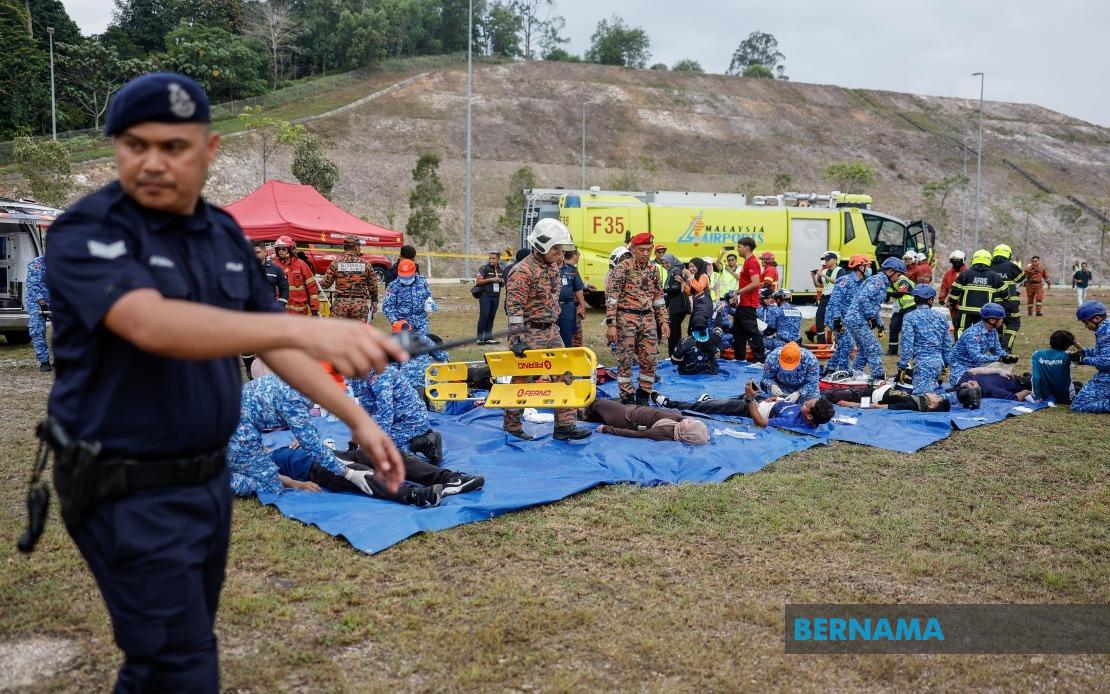
Authorities in Malaysia staged a comprehensive emergency response exercise on July 16 at the Denai Alam Rest and Service Area, bringing together more than 20 enforcement and rescue agencies to rehearse procedures for handling an aircraft disaster beyond the airport boundary. The Ex Urban Falcon 2026 drill simulated an ATR72 aircraft crash approximately six kilometres from Sultan Abdul Aziz Shah Airport in Subang, marking the first such exercise to test operations in territory far removed from airport infrastructure. The simulation drew 450 participants from critical public and private-sector organisations working across the aviation safety spectrum, underscoring the complexity and multi-agency coordination required when disasters strike away from established emergency facilities.
Airport Fire and Rescue Services general manager Muhammad Hidayat Ismail outlined the strategic importance of testing capabilities beyond traditional boundaries. Under the National Aeronautical Search and Rescue Manual, AFRS maintains responsibility for an eight-kilometre radius from the airport's midpoint, yet most previous exercises had focused on scenarios occurring near or within the airport perimeter itself. This limitation meant response teams had never fully tested their operational capacity in realistic off-airport terrain, where accessibility challenges and unfamiliar geography could significantly hamper rescue efforts. The decision to conduct Ex Urban Falcon 2026 away from standard training locations reflected recognition that actual emergencies do not always occur where infrastructure and planning assumptions are most concentrated.
The exercise revealed the formidable logistical obstacles facing emergency responders when disaster strikes beyond carefully controlled airport environments. Teams confronted the harsh reality of navigating narrow roads and negotiating multiple toll plazas en route to a crash site, bottlenecks that could delay critical minutes in life-or-death situations. Muhammad Hidayat acknowledged these challenges represented the most significant operational hurdle identified during the drill. Unlike airport crashes, where runways serve as clear assembly points and rescue infrastructure stands ready, off-airport incidents demand that responders locate the scene using civilian road networks, coordinate across municipal boundaries, and adapt procedures designed for different terrain. The exercise exposed gaps between theoretical preparedness and practical execution when teams operate outside their primary operational sphere.
The terrain itself presents a secondary but equally pressing challenge for rescue and recovery operations. Aircraft crashes outside airports typically occur on uneven ground, often in rural or semi-developed areas lacking the flat, open space characteristic of airfields. This geographical reality translates directly into reduced survival prospects for victims, as the impact dynamics differ substantially from controlled descent scenarios. Muhammad Hidayat emphasised that off-airport incidents frequently result in casualty profiles inverse to those seen at airports, where survivors may outnumber the deceased. The simulation provided teams with a realistic casualty scenario requiring substantially greater disaster victim identification capacity, forcing coordinators led by the Royal Malaysia Police to manage overwhelming numbers of deceased requiring forensic and identification processing. Understanding this mortality dynamic proved crucial for calibrating medical response, resource allocation, and psychological support systems.
The technical capacity for aircraft firefighting represents one dimension where Malaysia has invested substantially, equipping response teams with state-of-the-art vehicles meeting International Civil Aviation Organisation and Civil Aviation Authority of Malaysia specifications. These sophisticated apparatus performed effectively during the exercise, demonstrating that hardware and engineering standards meet global requirements. However, the drill revealed that technological capability, while necessary, cannot substitute for operational coordination across agencies with different command structures, communication protocols, and institutional priorities. The exercise thus functioned as a stress test for organisational integration rather than equipment performance, exposing the friction points where bureaucratic boundaries and procedural differences could impede seamless response.
The cross-institutional nature of Ex Urban Falcon 2026 reflected partnership among Malaysia Airports Holdings Berhad, the National Disaster Management Agency, the Selangor state government, and PROLINTAS-DASH, the expressway operator. This collaborative framework acknowledged that aircraft disasters transcend airport company responsibility, demanding coordination among transportation authorities, local government, police, medical services, and the private sector. Bringing these entities into joint planning and execution served multiple purposes: establishing common understanding of roles and responsibilities, identifying procedural gaps before actual disasters occur, and building relationships that facilitate rapid communication when minutes determine life outcomes. The partnership model demonstrated recognition that modern emergency management succeeds only through sustained institutional alignment across traditionally separate domains.
Review of the exercise findings is scheduled for a special workshop on July 26 and 27, where participating agencies will examine performance data, identify procedural deficiencies, and develop enhancement measures. This systematic evaluation approach converts a single simulation into institutional learning, embedding insights gained from the drill into updated protocols and training programmes. The workshop will assess communication effectiveness, decision-making speed, resource coordination, and victim management procedures, translating operational observations into specific improvements. Rather than treating the exercise as a one-time event, authorities recognised that sustained readiness demands continuous refinement based on realistic testing, ensuring that gaps identified in July inform preparations for future contingencies.
Muhammad Hidayat characterised the exercise as foundational work in advancing national preparedness for low-probability, high-consequence events. Air disasters outside airports remain statistically rare, which paradoxically creates complacency in planning and training. By deliberately testing procedures for scenarios that have not recently occurred, Malaysia demonstrated commitment to maintaining readiness despite extended periods without activating full emergency response infrastructure. This preventive philosophy reflects understanding that aviation safety depends upon continuous preparation during uneventful periods, rather than reactive scrambling after incidents occur. The exercise thus represents insurance against the institutional decay that occurs when emergency systems remain untested for extended intervals.
The broader implications for Southeast Asian aviation extend beyond Malaysia's immediate borders. The region encompasses numerous airports with similar crash risk profiles and comparable off-airport terrain challenges, yet many nations have not conducted equivalent exercises. Malaysia's willingness to test procedures in challenging scenarios and transparently identify shortcomings establishes a model for regional peers. The exercise demonstrates that advanced equipment and formal procedures alone prove insufficient; only through realistic simulation can organisations identify the operational friction points where theoretical plans encounter practical constraints. As air traffic volumes continue expanding across Southeast Asia, the capacity to respond effectively to off-airport disasters becomes increasingly critical, making Malaysia's systematic approach to testing and improvement relevant to neighbouring nations confronting identical challenges.

