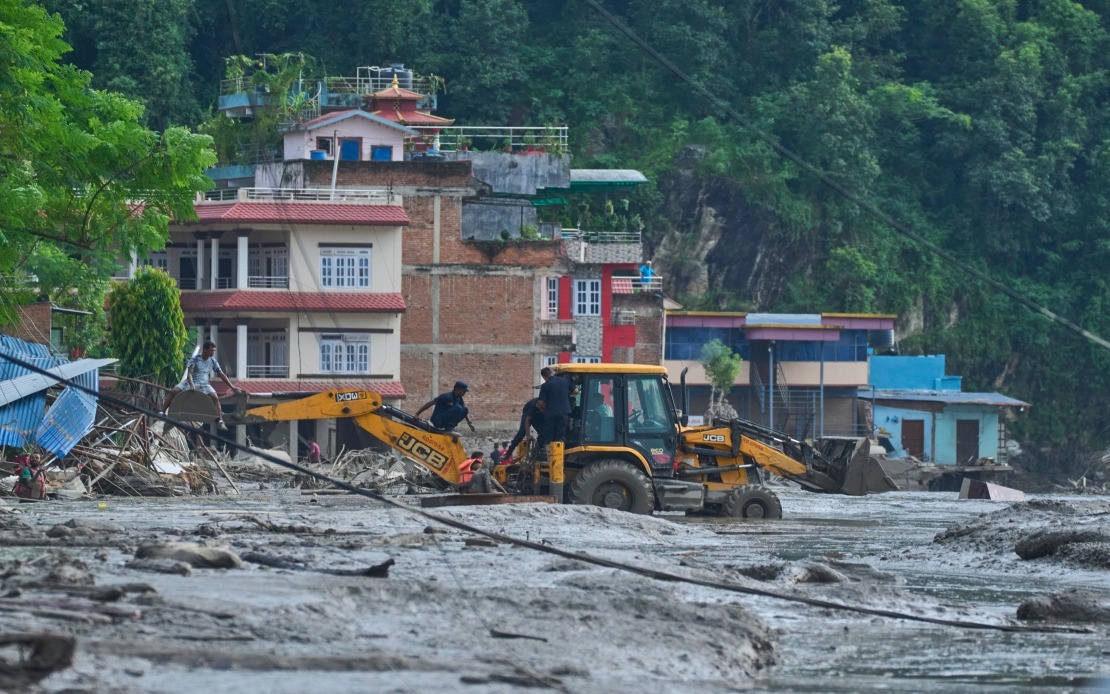
The Nepal-China border region faces a humanitarian catastrophe as devastating flash floods and mudslides have killed at least 160 people and left more than 680 others unaccounted for, according to officials monitoring the crisis. The scale of the disaster has prompted coordinated rescue efforts on both sides of the border, with authorities deploying helicopters, drones, and specialised teams to search through debris and floodwaters. The situation represents one of the most severe natural disasters to strike the region in recent years, with the death toll climbing steadily as recovery teams access previously unreachable areas.
Nepalese authorities confirmed that rescue teams have recovered 157 bodies so far, while managing to pull 54 survivors from the flood-affected zones. The missing encompass a diverse population including 44 military personnel, 28 police officers, 13 armed police operatives, and 60 civilian staff employed by hydropower development projects in the region. Beyond government and security personnel, the Nepalese Prime Minister's Office reported that 484 tourists and travellers remain unaccounted for, comprising 391 foreign nationals and 93 Nepali citizens. Chinese state-run media outlets reported a separate toll within their territory, with three confirmed deaths and 265 people missing in the southern Tibet region, indicating the disaster's cross-border impact.
The geographical scope of destruction extends across multiple Nepalese districts, with the Rasuwa, Dhading, and Chitwan areas suffering the most severe damage. The infrastructure damage catalogue is equally alarming: at least 19 bridges have been completely swept away by floodwaters, approximately 40 kilometres of road network has been destroyed or rendered impassable, and 13 hydropower projects sustained significant damage. Foreign Minister Sishir Khanal, briefing parliament on the unfolding emergency, characterised the destruction as comprehensive, noting that hydropower installations, government offices, and critical transportation infrastructure across the affected zones have been effectively erased by the disaster's force.
The international dimension of the missing adds complexity to search and rescue operations. Citizens from Nepal, India, the United Kingdom, South Africa, Malaysia, Australia, the Netherlands, and South Korea are among those unaccounted for, with many nationalities still being verified as communications infrastructure in the affected region remains compromised. The South Korean Foreign Ministry specifically noted that eight of their nationals are unaccounted for, while an additional ten South Korean citizens are stranded in Nepal awaiting evacuation assistance. This multinational aspect reflects the Rasuwagadhi area's significance as a major transit point for international trekking expeditions targeting the renowned Langtang region, one of Nepal's premier mountain destinations, as well as a crucial gateway for pilgrims and tourists heading toward Mount Kailash and Lake Mansarovar in Tibet.
On the Chinese side, the mudslide struck near Gyirong Port, a principal border crossing linking Nepal and Tibet. The disaster's impact at this critical chokepoint has severed road connectivity leading to the port, while simultaneously destroying communications and power infrastructure throughout the Gyirong County area, according to reports from Xigaze City's emergency management bureau. The isolation of this major border crossing carries significant implications not only for humanitarian relief operations but also for bilateral trade and tourism movements between the two nations. Chinese President Xi Jinping has ordered comprehensive search and rescue mobilisation, instructing authorities to prioritise resident evacuation, medical treatment deployment, and casualty minimisation through intensive coordination across all relevant agencies.
Rescue and recovery operations have achieved remarkable coordination despite the challenging terrain and infrastructure damage. Nepalese security forces, comprising Nepal Police, Armed Police Force, and Nepal Army contingents, have been deployed with sophisticated equipment including helicopters, unmanned drones for surveillance, and rafting apparatus for river operations. In Kathmandu, government hospitals and medical facilities operated by security establishments have been cleared and prepared to receive injured survivors, ensuring medical capacity matches the anticipated patient intake. Chinese authorities have similarly mobilised forces in Xizang for concurrent search and rescue efforts, working to maintain communication with Nepalese counterparts to prevent duplication and ensure efficient resource allocation.
Regional governments have rapidly mobilised support mechanisms in response to the cross-border emergency. Indian Prime Minister Narendra Modi communicated directly with his Nepalese counterpart Balendra Shah, conveying formal condolences and pledging comprehensive humanitarian support. India subsequently dispatched ten tonnes of emergency supplies including disaster relief materials, essential medicines, and humanitarian provisions to assist Nepal's response capacity. Furthermore, Samrat Choudhary, chief minister of Bihar state in eastern India, issued directives to implement heightened monitoring protocols across the region, including round-the-clock embankment surveillance and intensive night patrols throughout sensitive districts bordering Nepal, reflecting concerns about potential secondary flooding impacts from water flowing downstream into Indian territory.
The broader implications of this disaster extend beyond immediate casualty figures and infrastructure damage. The flooding at a critical international border crossing threatens to disrupt established tourism circuits that funnel thousands of international visitors through Nepali mountain regions annually. The damage to hydropower projects, which represent significant development investments and energy generation capacity for Nepal, raises questions about reconstruction timelines and the resilience of infrastructure development in geologically hazardous zones. For Malaysian and other Southeast Asian readers, this disaster underscores the vulnerability of border regions to extreme weather events and the necessity of robust cross-border disaster management protocols, particularly given the region's exposure to monsoon flooding and the increasing intensity of weather events associated with climate change patterns.
The coordinated international response to this emergency, featuring rapid bilateral communication, resource sharing between India and Nepal, and the involvement of multiple nations in search operations, demonstrates established frameworks for regional cooperation in natural disasters. However, the scale of missing persons and the difficulty accessing remote mountain areas suggest that final casualty figures may increase significantly as recovery operations progress. The disaster's impact on the Rasuwagadhi border crossing and the Langtang trekking circuit carries implications for Nepal's tourism-dependent economy and for international travellers planning Himalayan expeditions. As search operations continue and rescue teams access more remote sites, authorities anticipate that comprehensive damage assessments will emerge, potentially altering current estimates of infrastructure reconstruction needs and the timeline required for normalising cross-border movement and economic activity.

