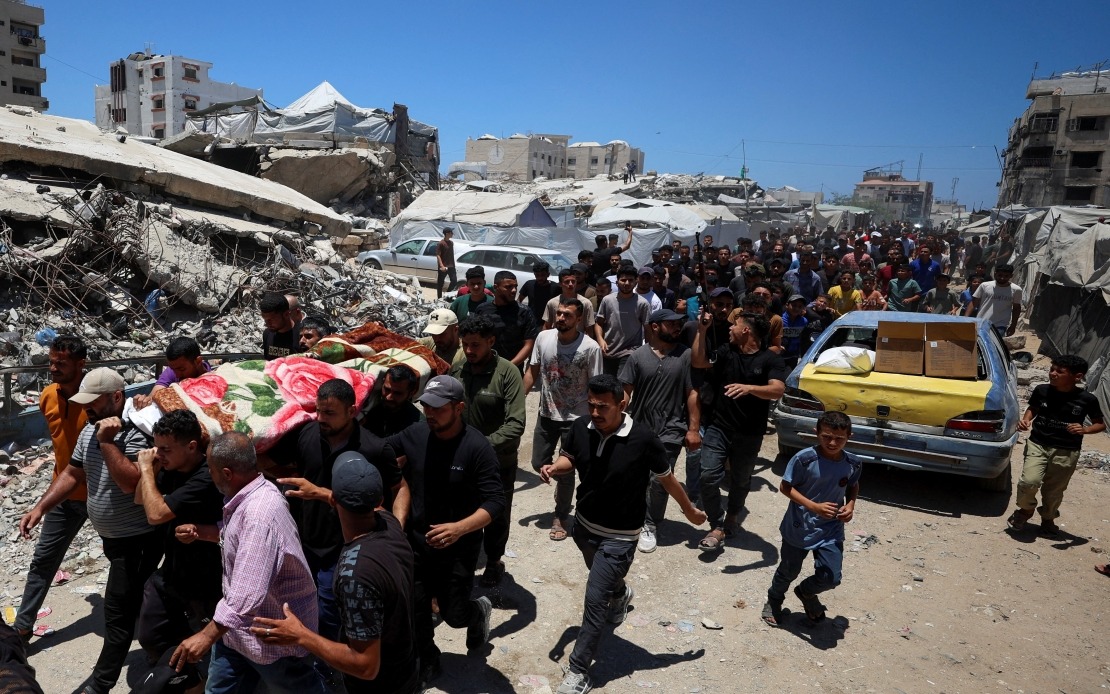
The humanitarian catastrophe unfolding in Gaza shows no signs of abating even after a ceasefire took effect, according to the latest assessment from the Palestinian Prime Minister's Office. Since the truce commenced, Israeli military operations have claimed an additional 1,021 Palestinian lives, pushing the cumulative death toll to 73,032 individuals since the conflict erupted in October 2023. These grim figures underscore the magnitude of the ongoing crisis in the densely populated coastal enclave, where basic survival has become a daily struggle for millions.
The ceasefire, despite its formal implementation, has failed to arrest the deterioration of living conditions on the ground. The Palestinian Government Communication Centre characterised the humanitarian landscape as increasingly dire, with Israeli bombardments persisting alongside severe restrictions on the entry of aid supplies. Access to clean drinking water has become critically scarce, forcing the vast majority of residents to depend entirely on whatever humanitarian assistance organisations can deliver through increasingly obstructed supply routes. This water crisis compounds an already precarious public health situation where disease outbreaks pose an existential threat to a population with minimal medical infrastructure.
The scale of physical destruction across Gaza remains staggering. Approximately 76.6 per cent of the territory's housing stock has been destroyed or severely damaged by military operations, leaving nearly one million Palestinians with no option but to live in temporary tent settlements. These makeshift camps, scattered across already congested areas, lack adequate sanitation, healthcare facilities, and protection from the elements. The displacement crisis has unfolded alongside a complete collapse of normal economic activity, leaving families without employment prospects or means to purchase essentials even if supplies were available. For Malaysian observers, this scale of infrastructure destruction parallels some of humanity's worst humanitarian emergencies, presenting a scenario where rebuilding will require international commitment spanning years or decades.
Recent military operations have concentrated in several populated areas. Israeli air and drone strikes in Nuseirat, Al-Mawasi, Khan Younis and Gaza City have continued to generate civilian casualties despite the ceasefire framework. These operations have further destabilised an already fragile situation, with each strike triggering fresh displacement and adding to the trauma affecting the Palestinian population. The ongoing nature of these strikes suggests that the ceasefire agreement contains significant loopholes or enforcement mechanisms that have proven inadequate in preventing military action.
Children represent a particularly vulnerable segment bearing the brunt of this prolonged conflict. Data from UNICEF indicates that 265 Palestinian children have been killed and more than 400 wounded specifically since the ceasefire announcement. These figures highlight how young lives continue to be lost even during periods nominally designated as peaceful. The psychological impact on surviving children—exposed to constant threats, displacement, and deprivation—will likely shape an entire generation's relationship with conflict and stability. International child welfare organisations have documented widespread malnutrition and preventable diseases spreading rapidly among the paediatric population.
Humanitarian organisations operating in Gaza have raised urgent alarm about continued Israeli restrictions limiting their capacity to function. Oxfam presented testimony to the United Nations Security Council detailing how access barriers persist in preventing the delivery of life-saving medical supplies, food, and water treatment materials. These restrictions operate at multiple levels—checkpoints, border controls, and administrative procedures—creating a system where even willing aid providers cannot effectively reach those in need. This represents a systematic constraint on humanitarian operations that distinguishes the current situation from many other global crises where access restrictions are less formalised.
Beyond Gaza, the occupied West Bank faces its own escalating crisis. The United Nations High Commissioner for Human Rights has documented a dramatic surge in forced displacements of Palestinian communities, driven by settler violence, military home demolitions, movement restrictions, and forced evictions. East Jerusalem, where Israeli control over land and resources has intensified, has experienced particularly acute displacement pressures. This parallel crisis in the West Bank indicates that the conflict has fractured Palestinian territorial integrity across multiple fronts simultaneously. For regional stability, this two-front deterioration raises concerns about the viability of any long-term solution that does not address underlying territorial disputes.
Agriculture and rural livelihoods have suffered devastating losses. The Palestinian Ministry of Agriculture documented the destruction of 7,258 trees by Israeli settlers and occupation forces, including 1,270 olive trees that represent both economic assets and cultural heritage. The estimated financial damage reaches approximately US$5.17 million, a sum that devastates agricultural communities already facing severe resource constraints. Additionally, arson attacks have targeted mosque buildings in Jiljilya and Mazra' al-Nubani, indicating that religious sites have become casualty sites in the broader conflict. These agricultural losses compound food security challenges already created by import restrictions and destroyed supply chains.
Refugee camps in the northern West Bank have endured intensive military operations. Israeli military campaigns in Jenin, Tulkarem and Nour Shams since January 2025 have displaced more than 33,000 Palestinians from these densely populated facilities. These camps, originally established decades ago to house earlier refugee populations, have become centres of acute humanitarian vulnerability. Medical professionals and human rights monitors have raised serious concerns regarding conditions in Israeli detention facilities, reporting overcrowding, inadequate sanitation, and disease transmission—allegations that suggest detainee populations face additional layers of suffering beyond their incarceration.
Despite these extraordinary challenges, Palestinian educational institutions have attempted to maintain continuity in the academic calendar. The Palestinian government completed preparations for the General Secondary Education Examination, involving approximately 91,000 students overall, including roughly 37,000 in Gaza. For the third consecutive year, Gazan students are sitting examinations electronically due to the absence of functioning traditional schools and the impossibility of gathering large student populations. This adaptation underscores both Palestinian institutional resilience and the total transformation of normal life imposed by conflict. Malaysian educational observers might reflect on how this continued commitment to examinations, despite circumstance, reflects Palestinian determination to preserve human capital and future prospects even amid present devastation.
The regional implications for Southeast Asia remain significant, particularly regarding humanitarian responsibility and the precedent set by responses to mass displacement crises. Malaysia, as a Muslim-majority nation with historical solidarity with Palestinian causes, faces ongoing pressure to articulate meaningful positions on humanitarian access and international accountability. The situation also serves as a cautionary example of how ceasefire agreements, without robust enforcement mechanisms and comprehensive political settlements, can merely pause active hostilities while preserving underlying structural violence. International observers continue monitoring whether diplomatic efforts might generate sustainable solutions addressing root causes rather than temporary amelioration of symptoms.