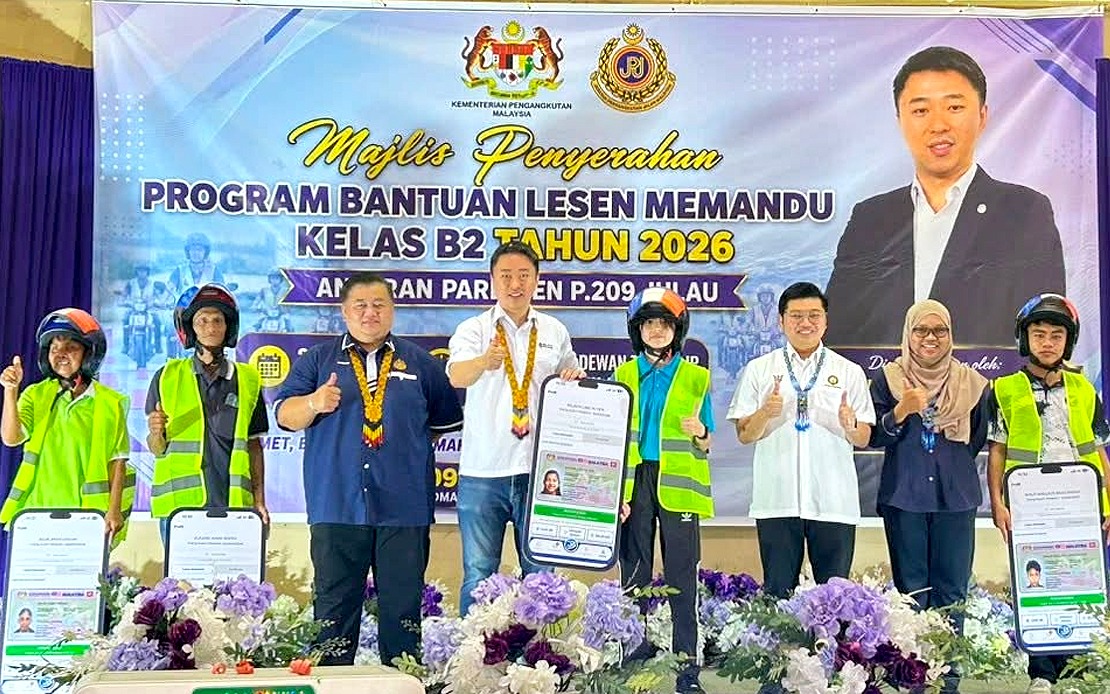
Rural communities in the Julau parliamentary constituency have welcomed a significant opportunity to formalise their riding credentials and access fuel price relief. The closure of the 2026 Class B2 Driving Licence Assistance Programme brought together 885 participants at the Julau Closed Stadium in Sarikei, marking a milestone for residents who previously lacked valid documentation to operate motorcycles legally. The initiative, championed by Julau Member of Parliament Datuk Larry Sng Wei Shien and overseen by Sarawak Road Transport Department director Norizan Jili, directly addresses mobility challenges faced by communities dependent on two-wheeled transport for agricultural and commercial activities.
For many participants, obtaining a Class B2 Probationary Driving Licence represents far more than regulatory compliance. The qualification unlocks eligibility to purchase petrol at government-subsidised rates, a tangible economic benefit that reduces operational costs for smallholders, farmers, and rural workers. In an environment where fuel prices have climbed steadily, this access to cheaper petrol cushions the daily expenses of individuals who rely on motorcycles as their primary means of reaching scattered agricultural plots, conducting business, and accessing essential services across dispersed settlements.
Bajik Undum, a 57-year-old farmer from Rumah Ajau in Ulu Kuntau, Pakan, exemplifies the programme's impact on rural livelihoods. Previously unable to purchase fuel at subsidised rates due to the absence of a valid licence, she faced inflated transport costs when visiting her orchard and delivering agricultural produce to market. With her newly acquired credentials, she can now access the same fuel concessions available to formally licensed riders elsewhere in Malaysia, substantially lowering the burden on her household finances. Her participation as the oldest female recipient underscores how the scheme accommodates residents across age groups who had previously operated outside the formal licensing framework.
Kudang Jenggi, the oldest male participant at 64 years old, articulated a complementary advantage: the psychological and practical security of holding valid documentation. Working as a bird's nest house caretaker in Bayong, Sarikei, Kudang previously navigated road checkpoints with apprehension, mindful of penalties for riding without proper identification. His newly acquired licence eliminates this anxiety while simultaneously granting him access to subsidised fuel, fundamentally reshaping his daily work experience. The combination of legal compliance and economic benefit demonstrates how the programme addresses multiple dimensions of rural welfare simultaneously.
Daniel Padong, 45, from Rumah Pom in Ulu Amot, Pakan, highlights the scheme's particular relevance to agricultural workers in Sarawak. His motorcycle serves as his sole connection to an oil palm smallholding that anchors his family's income. Recent petrol price increases had directly eroded his profit margins, but the licence assistance programme provided a pathway to recover some of these mounting costs through subsidised fuel access. For smallholders operating on narrow margins and distant from major commercial centres, such savings accumulate meaningfully across months and years.
The Driving Licence Assistance Programme reflects a deliberate policy recognition that formal licensing barriers can inadvertently exclude productive rural populations from legitimate economic participation and government benefit schemes. Malaysia's subsidised fuel framework, while subject to fiscal constraints and periodic adjustments, remains a critical support mechanism for rural transport users whose alternatives are limited. By removing the administrative and potentially financial hurdles to obtaining Class B2 credentials, the initiative bridges a gap between formal policy structures and remote communities that might otherwise remain peripheral to such arrangements.
Sarawak's geographical characteristics—dispersed settlements, limited public transport infrastructure, and distances that make motorcycles essential rather than optional—create particular urgency for such programmes. Rural residents often lack convenient access to licensing centres or encounter affordability barriers when compelled to travel to urban administrative hubs. The programme's deployment in Julau, a constituency with significant rural and indigenous populations, demonstrates targeted effort to extend formal recognition and economic benefits to communities whose needs have historically received less policy attention than densely populated urban areas.
The composition of participants—predominantly older residents and individuals from longhouse communities—reveals that the licensing gap persisted across generations. Some may have operated motorcycles for decades without formal credentials, normalising unlicensed riding in remote areas where enforcement was sporadic. This programme thus represents not merely a contemporary initiative but a retrospective correction of long-standing exclusions, bringing into the formal system individuals whose practical riding experience may exceed that of many formally licensed riders in developed areas.
Beyond individual household finances, the initiative carries implications for road safety infrastructure in Sarawak. Formal licensing systems generate data on rider distributions, support insurance frameworks, and create accountability mechanisms that can underpin safety campaigns. As rural populations transition into the documented licensing system, authorities gain better visibility into usage patterns and can tailor road safety interventions accordingly. The programme therefore contributes incrementally to professionalising Sarawak's transport ecosystem, even as it extends economic relief to vulnerable populations.
The success of the Julau scheme—enrolling 885 participants in a single closure event—suggests substantial underlying demand for such programmes across rural Malaysia. Similar initiatives in other constituencies, particularly in Sabah and other rural-dominated areas, could yield comparable participation and alleviate comparable financial pressures. The model demonstrates that removing barriers to formal participation in government schemes often requires targeted outreach and localised delivery rather than assuming that conventional administrative channels will reach dispersed populations effectively.
Looking forward, sustainability of such programmes depends on maintaining subsidised fuel access for the populations they serve. Regional fuel price volatility and fiscal constraints mean that benefits secured today could face pressure tomorrow. Rural participants who have restructured their household budgets around subsidised fuel costs may face severe disruption if the scheme undergoes contraction. This argues for policy durability commitments that extend beyond individual programme cycles, recognising that rural livelihoods increasingly depend on these support structures.
The Julau programme ultimately reflects a nuanced understanding that rural development requires attention to seemingly technical issues—motorcycle licensing—that have concrete consequences for agricultural productivity, household finances, and social equity. By linking formal credentials to tangible economic benefits, the initiative creates incentive structures that encourage compliance while delivering immediate relief to populations whose daily survival depends on efficient, low-cost mobility across challenging terrain and dispersed geography.

