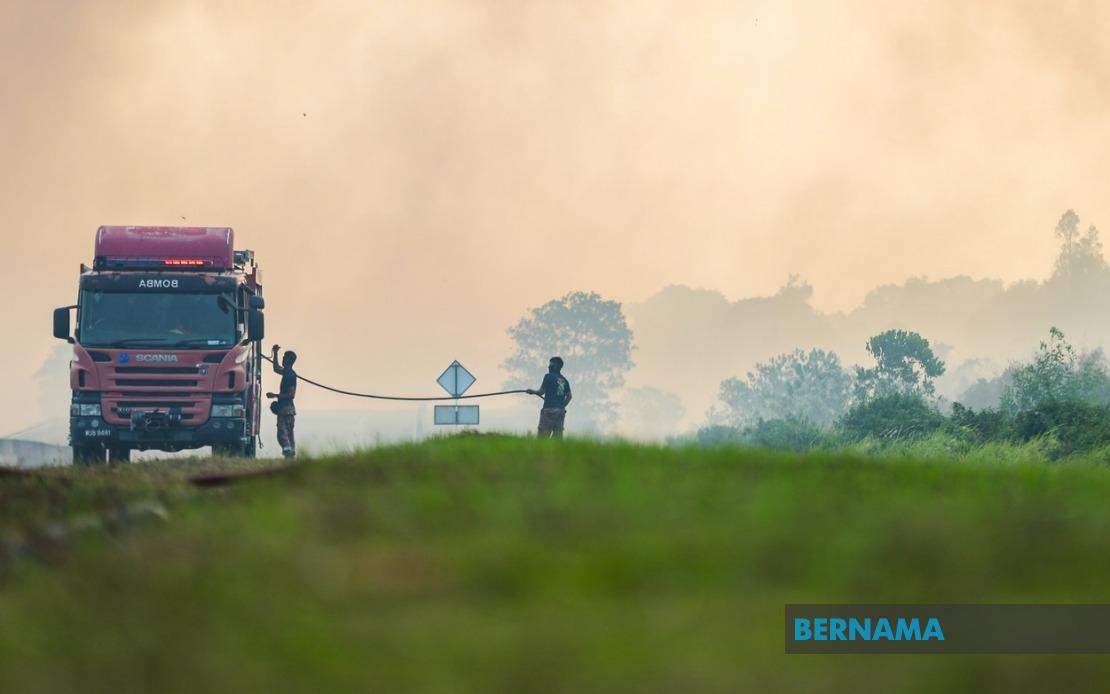
A major peatland fire that erupted on Monday along Jalan Bypass Punggai-Sebana Cove in Pengerang, near Kota Tinggi in Johor, has seen significant progress with crews extinguishing more than 57 percent of the affected area as of mid-afternoon on Tuesday. The blaze consumed 29 of the 51.4 hectares initially engulfed, according to updates from emergency responders managing the ongoing containment effort in this environmentally sensitive region.
The firefighting campaign has been structured across two distinct operational zones to manage the sprawling nature of the peat fire. Sungai Rengit Fire and Rescue Station's operations commander, Fire Superintendent II Baharuddin Idris, explained that crews have sustained round-the-clock activities since the fire's outbreak, maintaining continuous surveillance and tactical firefighting manoeuvres designed to snuff out remaining hotspots while erecting firebreaks to shield unburnt areas from further encroachment.
Sector A presented the more formidable challenge, with approximately 21 hectares still requiring active firefighting attention and the establishment of additional firebreaks to contain the blaze's perimeter. Meanwhile, Sector B had been reduced to near-total suppression by the time of the afternoon update, demonstrating the effectiveness of concentrated effort in one zone once adequate resources were directed there. This differential progress illustrates the complexities of managing peatland fires, where underground combustion and inconsistent moisture distribution can prolong suppression efforts.
Recognising the limitations of ground-based operations, authorities arranged for aerial assistance to supplement terrestrial firefighting crews. An aircraft authorised by the Air Operations Control Centre launched from its base at 2.30 pm, adding a critical aerial dimension to the suppression campaign. Aircraft deployment in peatland fire scenarios offers strategic advantages, enabling crews to deliver water or retardant across wider areas and access zones difficult for ground personnel to reach, thereby accelerating the overall containment timeline.
The multi-agency coordination underpinning this response demonstrates the scale of resource mobilisation required for significant environmental incidents in Malaysia. The operation drew together 36 firefighters from the regular fire service, nine personnel seconded from the Malaysian Civil Defence Force, 14 specialists from Ranhill SAJ—a water utility company with emergency response capabilities—alongside two environmental department representatives and three municipal council staff from Pengerang. This diverse composition reflects how peatland fires demand expertise spanning fire suppression, environmental management, and local infrastructure considerations.
Peatland fires present particular hazards compared to conventional vegetation blazes. The organic-rich soil composition allows fire to penetrate deep underground, creating subsurface combustion that can reignite after surface flames appear extinguished. This characteristic extends suppression timelines significantly and necessitates prolonged monitoring even after visible flames cease. The 24-hour operational posture described by Baharuddin acknowledges this reality, ensuring that teams maintain vigilance throughout the night when temperature fluctuations and reduced visibility might otherwise allow dormant fires to flare anew.
The incident's location near Pengerang, within Kota Tinggi district, positions it in an area where industrial and agricultural land uses intersect with natural peatland ecosystems. Peatland regions across Southeast Asia serve critical ecological functions as carbon stores and habitat reservoirs, making their protection a matter extending beyond immediate firefighting concerns. Peat fires release disproportionate quantities of atmospheric carbon dioxide and hazardous particulate matter, creating air quality impacts across state boundaries and potentially affecting populations far beyond the immediate fire zone.
For Malaysian readers, this incident underscores the environmental vulnerabilities within the country's industrial zones and the infrastructure challenges facing emergency responders in rapidly developing regions. Johor, as a major industrial and agricultural hub, faces recurring peatland fire threats, particularly during drier seasons when moisture levels in peat deposits decline, increasing flammability. The coordination demonstrated in this response—involving federal firefighting apparatus, state civil defence forces, and private sector specialists—represents an evolving disaster management model that may require further refinement as climate patterns potentially intensify fire risk across the region.
The successful mobilisation of aerial resources also signals growing sophistication in Malaysia's fire management capabilities, though the continued reliance on multi-agency coordination suggests that no single organisation maintains comprehensive resources to address large-scale peatland incidents independently. As the country continues developing economically, balancing industrial expansion with environmental protection remains a recurrent policy tension, particularly in states like Johor where both imperatives compete for attention and investment.
Firefighting officials indicated that suppression operations would persist until all visible and subsurface flames were definitively extinguished and monitoring protocols confirmed no rekindling risk. The deployment of aircraft support represented a tactical escalation intended to accelerate this process, though peatland fire dynamics mean that complete resolution may extend beyond the immediate 24-hour operational window. Residents in surrounding areas were advised to monitor air quality and remain alert to any resurgence of flames, though authorities expressed confidence in containment given the progress achieved by late afternoon.

