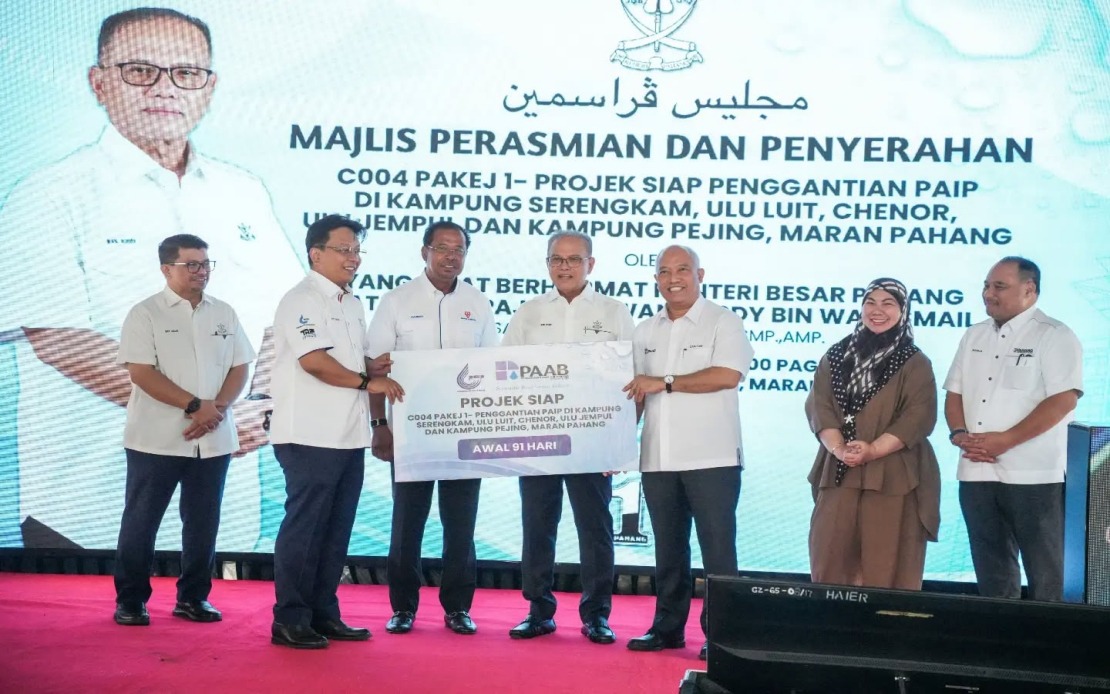
The water infrastructure crisis afflicting Maran residents for nearly twenty years has finally reached resolution, with Pengurusan Aset Air Berhad (PAAB) formally handing over a RM11.19 million pipeline replacement initiative that addresses long-standing supply deficiencies across multiple villages in the district. The comprehensive undertaking, completed three months ahead of its original deadline, involved the systematic replacement of 29.6 kilometres of corroded and failing pipe infrastructure across Kampung Serengkam, Ulu Luit, Pejing, Ulu Jempul and Chenor, targeting areas that have endured relentless service interruptions.
The infrastructure modernisation represents a strategic intervention by PAAB to guarantee uninterrupted access to dependable, potable water supplies for district residents. Beyond resolving the persistent problem of pipe fractures that have plagued the distribution network, the project simultaneously addresses two critical efficiency challenges: it substantially reduces non-revenue water—the commercially lost water volume through leakage and theft—whilst maintaining consistent water pressure even during peak consumption periods such as the dry season and extended holiday festivities.
Approximately 10,000 residents across Maran stand to experience tangible improvements in their everyday living standards through this initiative, with potential ripple effects enhancing broader socioeconomic advancement throughout the district. For Malaysian consumers familiar with seasonal water rationing and unpredictable supply patterns, the Maran project exemplifies the infrastructure investments necessary to transform utilities from crisis-management operations into reliable services. The handover ceremony, presided over by Pahang Menteri Besar Datuk Seri Wan Rosdy Wan Ismail, underscored the political commitment to water security alongside attendance from Deputy Energy Transition and Water Transformation Minister Datuk Seri Abdul Rahman Mohamad and Deputy Economy Minister Datuk Mohd Shahar Abdullah.
The Maran achievement constitutes merely the opening chapter of PAAB's expanded water infrastructure agenda across Pahang. The organisation has committed to collaborating with regional operator Pengurusan Air Pahang Berhad (PAIP) over the subsequent three years to construct a comprehensive, long-term infrastructure development strategy encompassing multiple districts. This phased approach reflects recognition that water security requires sustained investment rather than isolated interventions, positioning Pahang as a test case for systematic state-level water system modernisation.
Immediate subsequent priorities include electrical system upgrades at the Jengka Utama Water Treatment Plant's clean water pumping facility, specifically engineered to eliminate recurring supply interruptions affecting Felda Jengka communities. This technical refinement addresses not merely quantity but quality and consistency of service delivery—a distinction vital for agricultural settlements where irrigation schedules and domestic consumption must align precisely. The targeted nature of these interventions, addressing root causes rather than symptomatic relief, reflects evolving sophistication in Malaysian water management.
PAB has simultaneously initiated a RM35.7 million undertaking to replace 76.2 kilometres of deteriorating pipes across Jerantut and Lipis, encompassing areas surrounding Pulau Tawar and Kuala Tahan. This geographically expansive project underscores the scope of infrastructure deficit across Pahang's more remote districts, where pipe networks frequently extend through challenging terrain and serve dispersed populations. Concurrently, a RM13 million initiative targets Felda Keratong with 11 kilometres of pipe renewal designed to enhance water distribution efficiency throughout Rompin.
The financial commitment underlying these initiatives reflects prioritisation at the highest governance levels. As of July 2024, PAAB had allocated RM1.17 billion specifically for Pahang water infrastructure projects, with RM69.79 million already invested in completed works, RM66.94 million allocated to ongoing construction, and RM981.04 million designated for projects currently in planning and design phases. This distribution demonstrates a strategic pipeline approach, ensuring continuous advancement without overwhelming implementation capacity—a lesson learned from previous Malaysian infrastructure programmes where inadequate staging produced delays and cost overruns.
PAB's institutional framework positions it as the federal government's specialised vehicle for water sector transformation, having operated since 2006 under the Water Services Industry Act 2006. The entity's mandate encompasses restructuring Malaysia's fragmented water services industry into a more cohesive, professionally managed system capable of serving rapidly urbanising regions and addressing rural service deficits simultaneously. Finance Ministry ownership ensures alignment with national fiscal priorities and long-term budgetary planning.
PAIP's integration into this framework, formalised through the 2020 Pahang State Water Supply Services Restructuring Agreement, represents an important developmental milestone. The regional operator's collaboration with PAAB demonstrates how state-level entities can access both technical expertise and financial capacity from national infrastructure specialists, creating partnerships that transcend traditional bureaucratic silos. This model offers valuable precedent for other Malaysian states confronting comparable water security challenges.
The broader national context amplifies significance of these Pahang initiatives. Malaysia's water sector has historically suffered from fragmentation across multiple government entities, inconsistent investment priorities, and service gaps between urban and rural areas. The federal government's commitment to comprehensive water sector transformation—positioning water infrastructure as fundamental to economic resilience and social wellbeing—marks a policy recalibration that extends beyond Pahang. The Maran project and associated initiatives signal tangible progress toward the aspired transformation, demonstrating that chronic infrastructure deficits are addressable through sustained financing and coordinated institutional effort.
Looking forward, the three-year collaborative framework between PAAB and PAIP suggests that Pahang's water infrastructure will continue prioritising resilience and sustainability alongside immediate supply security. As climate variability increasingly threatens water availability across Southeast Asia, investment in robust distribution networks reduces vulnerability to supply shocks. For Malaysian residents in affected districts, the completion of Maran's pipeline replacement represents not merely resolution of immediate grievances but entry into a new paradigm where reliable water access becomes the expected baseline rather than occasional luxury.

