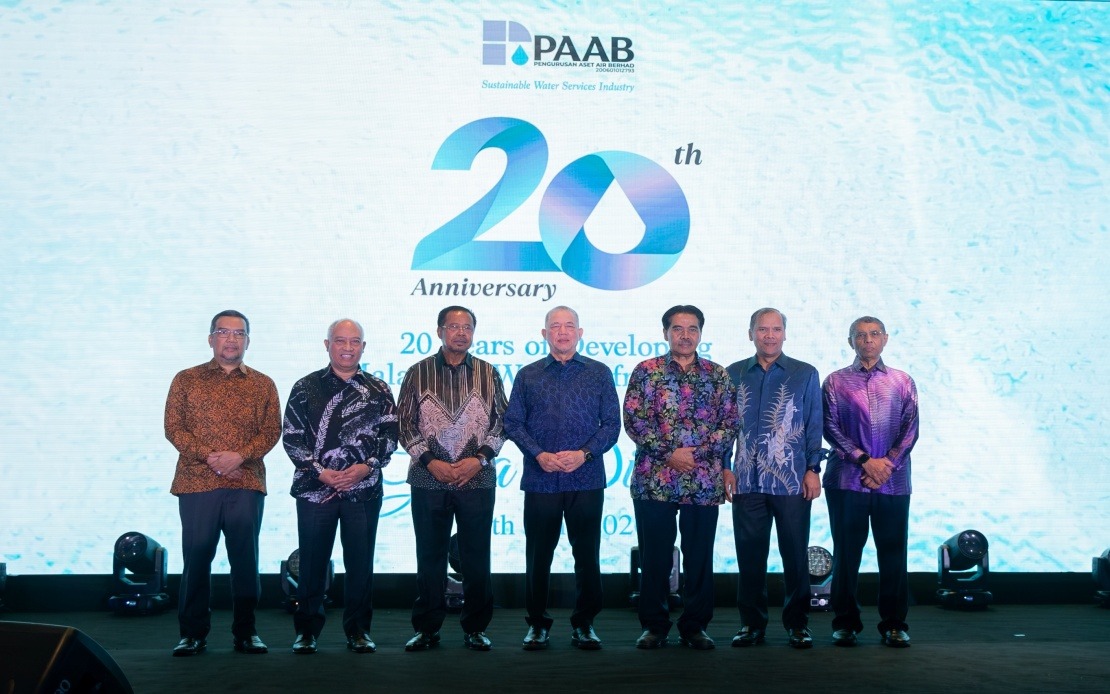
Pengurusan Aset Air Berhad (PAAB) is celebrating two decades of steering Malaysia's water sector transformation, a milestone that underscores the country's sustained commitment to modernising its critical utilities infrastructure. Since its establishment on May 5, 2006, the wholly government-owned entity has emerged as a central pillar in the nation's push to secure reliable water supply, having channelled RM23.04 billion into refinancing water industry debts and deployed another RM23.84 billion toward infrastructure expansion, bringing cumulative financing and investment to RM46.88 billion.
The scale of PAAB's capital deployment reveals the magnitude of work required to overhaul a water sector that serves over 33 million Malaysians across diverse urban and rural landscapes. By December 2025, ten states had enrolled in the National Water Services Industry Restructuring Plan, a phased blueprint extending to 2050 that aims to achieve full cost recovery and operational sustainability. This multi-decade roadmap reflects recognition that water infrastructure renewal cannot be rushed; rather, it demands deliberate sequencing through migration, stabilisation, consolidation, and full cost recovery phases.
Tangible outputs from two decades of restructuring paint a picture of substantial infrastructure advancement across the nation. As of late 2025, PAAB and its partner operators have brought 21 water treatment plants online, collectively capable of processing 2,085 million litres daily—a figure that illustrates both the ambition and complexity of serving Malaysia's diverse geographies and consumption patterns. Complementing treatment capacity, 42 storage facilities now hold 783 million litres, buffering supply against demand fluctuations and seasonal variations. Additionally, 3,263 kilometres of pipeline infrastructure have been upgraded or newly laid, replacing ageing networks that historically bled water through leakage before reaching end-users.
Yet despite these achievements, Malaysia's water sector grapples with a challenge that threatens to undermine all progress made to date: non-revenue water (NRW) loss stands at approximately 40 per cent nationwide. This figure—among the highest globally—means that for every litre treated and pumped into distribution systems, two-fifths vanishes through leakage, theft, metering errors, and administrative lapses before customers receive it. Deputy Prime Minister Datuk Seri Fadillah Yusof, speaking at PAAB's anniversary dinner on June 25, framed this inefficiency as a crisis demanding immediate intervention rather than reliance on protracted 2050 targets. His comments, delivered with evident frustration, highlight mounting political pressure within government to demonstrate tangible NRW reductions within the current electoral cycle.
Fadillah's intervention carries particular weight given his role as Energy Transition and Water Transformation Minister, positioning him as custodian of water security at a moment when Malaysia's economic trajectory hinges on stable utilities. The Deputy Prime Minister specifically cited data centre developments as exemplars of sectors requiring guaranteed water and electricity supply; the global competition for hosting facilities ensures that nations failing to deliver reliable infrastructure cede competitive advantage to rivals. This framing situates water management within broader digital economy ambitions, linking municipal utilities to foreign direct investment targets and technological leadership.
The financing architecture PAAB oversees illustrates how government has gradually assumed responsibility for water sector debt and capital requirements that would otherwise burden private concessionaires or state water authorities lacking fiscal headroom. By absorbing RM23.04 billion in historical industry liabilities, PAAB has effectively purchased breathing room for operators to invest in service improvements rather than merely servicing debt obligations. This debt restructuring proved necessary because prior iterations of water privatisation left utilities burdened with legacy obligations, constraining their capacity to fund modernisation. The agency's subsequent capital deployment, totalling RM23.84 billion through December 2025, reflects deliberate efforts to convert this fiscal reprieve into brick-and-mortar infrastructure.
Breaking down capital expenditure reveals work distribution across project lifecycles: RM8.33 billion has been spent on completed projects already handed to operators, RM1.84 billion finances ongoing construction, and RM13.67 billion funds schemes still in design and planning phases. This distribution suggests a development pipeline extending years into the future, with design-stage projects representing long-term commitments that will shape water availability through the 2030s and beyond. For Malaysian readers, this implies sustained government investment momentum regardless of electoral cycles, though execution speed remains vulnerable to bureaucratic inefficiencies and inter-agency coordination lapses.
PAAB chairman Datuk Seri Jaseni Maidinsa articulated the organisation's mandate as implementation of the National Water Services Industry Restructuring Plan through the Full Cost Recovery Roadmap, a framework requiring operators to eventually charge tariffs reflecting true operational costs. This economic reorientation marks a philosophical shift from treating water as a welfare commodity toward positioning it as a managed resource requiring rational pricing. The four-phase approach—Migration (2008–2020), Stabilisation (2021–2030), Consolidation (2031–2040), and Full Cost Recovery (2041–2050)—represents gradualism designed to avoid social backlash that abrupt price increases might trigger. For consumers, particularly lower-income households, this implies slowly rising water bills as tariffs move toward cost-reflective levels.
The milestone itself, marked by an anniversary dinner attended by senior government figures including National Water Services Commission chairman Datuk Abdul Kadir Mohd Din and Chief Executive Officer Datuk Ahmad Faizal Abdul Rahman, signalled official recognition of PAAB's institutional contribution. Yet the event's tenor suggested less celebration than concern about persistent sectoral challenges, particularly NRW rates that consume enormous quantities of expensively treated water before delivery. Fadillah's repeated emphasis that "ten years is still not enough to resolve non-revenue water" underscored frustration that despite billions invested, fundamental inefficiency persists.
For Southeast Asian observers, Malaysia's water restructuring trajectory offers instructive lessons about both possibilities and limitations of state-led infrastructure transformation. Neighbouring countries including Indonesia, Thailand, and the Philippines grapple with similar NRW challenges and ageing distribution networks, yet Malaysia's institutionalisation of PAAB—combining debt restructuring, capital deployment, and long-term planning frameworks—provides a model, albeit imperfect, for systematically addressing utilities crises. PAAB's two-decade existence has produced real infrastructure gains while simultaneously exposing how durable problems like leakage require solutions beyond capital investment alone.
Looking ahead, PAAB's role will likely intensify as Malaysia confronts competing pressures: climate-driven water stress, population growth concentrating in water-scarce regions, industrial expansion demanding reliable supply, and electoral expectations for improved service quality. The organisation's success in forthcoming years will be measured not merely by investment volumes—a metric easily manipulated—but by whether NRW retreats toward international best practice levels of 15-20 per cent, whether treatment reliability improves sufficiently to support high-growth sectors like semiconductors and data centres, and whether tariff increases remain politically tolerable as operators transition toward full cost recovery. PAAB's next two decades will determine whether Malaysia achieves water security befitting a regional economic leader or continues managing chronic shortage amid infrastructure abundance.

