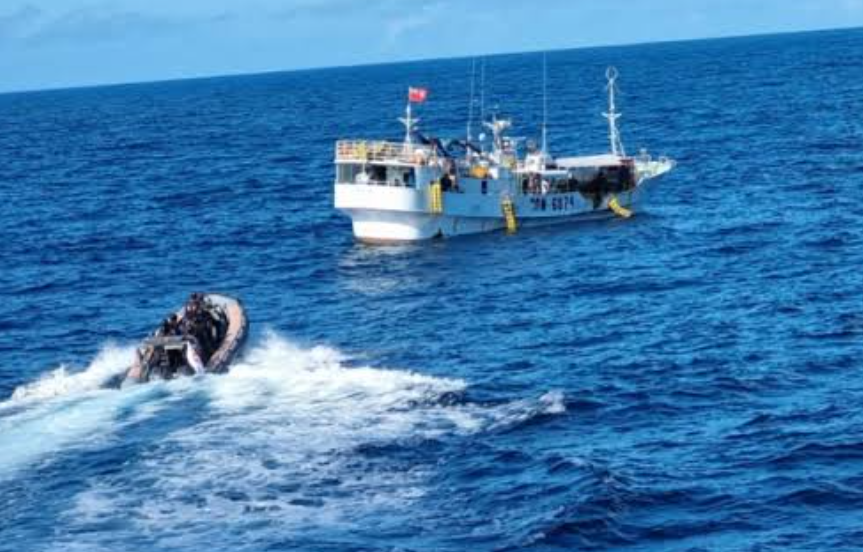
Pacific island authorities have stepped up enforcement actions against foreign fishing fleets operating illegally in their waters, with a major coordinated operation this month resulting in the detention of several Chinese and Indonesian vessels accused of breaching fishing regulations. The Pacific Islands Forum Fisheries Agency confirmed that four boats were apprehended by authorities across Kiribati, Palau and Papua New Guinea during August, marking the latest chapter in an intensifying struggle by small island states to control access to their marine resources and protect their economic interests.
The enforcement drive reflects growing concerns among Pacific nations about the scale of foreign fishing operations within their exclusive economic zones. An ambitious two-week surveillance campaign code-named Operation Island Chief, which concluded on August 14, saw more than 100 vessels intercepted across an area spanning 28 million square kilometres of ocean. The operation involved 11 island nations working in concert, supported by an Australian military aircraft conducting aerial reconnaissance and joint patrols with a United States Coast Guard vessel alongside local maritime police forces. Beyond the four formal detentions, authorities identified a further 16 vessels flagged as requiring investigation, though the FFA has declined to release identifying details about these ships.
The strategic importance of these enforcement actions cannot be understated for Southeast Asian readers and regional observers. The Pacific tuna fishery represents an economic lifeline for many island nations, with the region accounting for approximately half of the world's total tuna catch. Yet this vast wealth largely bypasses local communities and governments. Pacific Island countries process or handle only 15 per cent of tuna caught in their own waters, with the remaining 85 per cent being exported by distant-water fishing fleets operated primarily by Asian nations. The financial arrangements highlight the asymmetrical relationship between resource-rich but economically vulnerable island states and technologically advanced fishing nations. Annual revenue from licensing fees alone reaches US$500 million, while export earnings generated from tuna commerce total approximately US$1.2 billion for Pacific governments collectively. These figures underscore why fishing rights have become such a contentious political issue across the region.
The livelihoods of roughly one-third of all Pacific Island households depend directly or indirectly on fishing activities, creating powerful domestic political pressure on governments to demonstrate they are protecting national interests. Most tuna harvested in Pacific waters is caught by large commercial vessels operating under licensing agreements negotiated between foreign fishing companies and island governments. These long-distance fleets, primarily from China, Taiwan, South Korea and Japan, pay access fees to operate within the exclusive economic zones of small island states. However, the arrangements often leave island nations with minimal control over fishing practices and limited visibility into actual catch volumes, creating opportunities for illegal and unreported fishing to occur with relative impunity.
The detention of Chinese vessels represents a particularly delicate diplomatic matter within the region. Chinese companies operate the most extensive long-distance fishing fleets in the Pacific and have established numerous joint venture partnerships with island governments, providing significant economic and political influence. Publicly naming Chinese fishing boats suspected of illegal activity risks antagonising a major economic partner and complicating bilateral relationships, which explains why maritime authorities in several jurisdictions have been reluctant to provide detailed information about the operation. This diplomatic sensitivity was evident in the lack of responses to information requests from Palau and Papua New Guinea authorities, while Kiribati's maritime police also declined to comment on specifics of the enforcement action.
The incident involving a Chinese vessel detained by Tuvalu authorities last month illustrates the practical challenges of enforcing regulations. The boat was apprehended while transmitting false location data, a technique used to obscure illegal fishing activities from monitoring systems. After 24 days in detention, the vessel was released following payment of a fine, suggesting that penalties remain insufficient to deter violations. Peter Hammarstedt, captain of the conservation vessel Sea Shepherd, which assisted Tuvalu police during that operation, highlighted the ongoing struggle between enforcement authorities and fishing operators determined to circumvent regulations. Tuvalu's willingness to crack down on Chinese vessels may reflect its diplomatic ties with Taiwan rather than mainland China, creating an additional layer of geopolitical complexity in regional fisheries governance.
Historical enforcement data reveals the scale of violations by Chinese fishing operations. Between 2008 and 2026, the Western and Central Pacific Fisheries Commission issued 278 penalty notices to Chinese vessels, the second-highest tally globally after Taiwan with 319 infringements. This statistical picture suggests that violations are endemic rather than exceptional, and that current penalties and enforcement mechanisms have failed to achieve meaningful deterrence. The upcoming annual gathering of 18 Pacific Island leaders scheduled for late August in Palau provides an opportunity to discuss new strategies for strengthening fishing rights protection and increasing government revenues from the sector.
Climate change adds another urgent dimension to these fisheries governance challenges. Rising ocean temperatures are already affecting fish migration patterns and stock distributions across the Pacific region, threatening the long-term sustainability of catches that Pacific economies have come to depend upon. As fish stocks potentially migrate or decline, competition over remaining resources will intensify, making effective regulation and enforcement even more critical. Island governments recognise that without stronger controls over foreign fishing operations and better data about catch volumes, they will be unable to implement adaptive management strategies necessary for maintaining stocks under changing environmental conditions.
The broader context for these enforcement actions reflects a fundamental shift in how Pacific Island nations are asserting sovereignty over their marine resources. For decades, these countries operated at a significant disadvantage in negotiations with distant-water fishing nations, lacking the technical capacity and political leverage to enforce their own regulations effectively. The coordinated Operation Island Chief represents a more assertive approach, pooling resources and technical expertise across national boundaries to achieve greater enforcement coverage and deterrent effect. The participation of Australian and American military assets demonstrates how traditional security partnerships are increasingly extending into maritime law enforcement and fisheries management domains, suggesting a broader strategic pivot toward countering illegal activities in the Pacific region.
For Malaysia and other Southeast Asian nations with fishing interests in the Pacific, these enforcement trends carry important implications. As regional fishing companies face stricter regulations and higher compliance costs in Pacific waters, there may be pressure to shift operations toward less regulated areas or to engage in more systematic partnerships with local authorities. The enforcement crackdown also signals that Pacific Island nations are becoming more assertive in protecting their marine resources, suggesting that future fishing access negotiations may involve higher license fees and stricter operational requirements. This could reshape the economics of long-distance tuna fishing fleets operating across the region and influence investment decisions by fishing companies throughout Asia.

