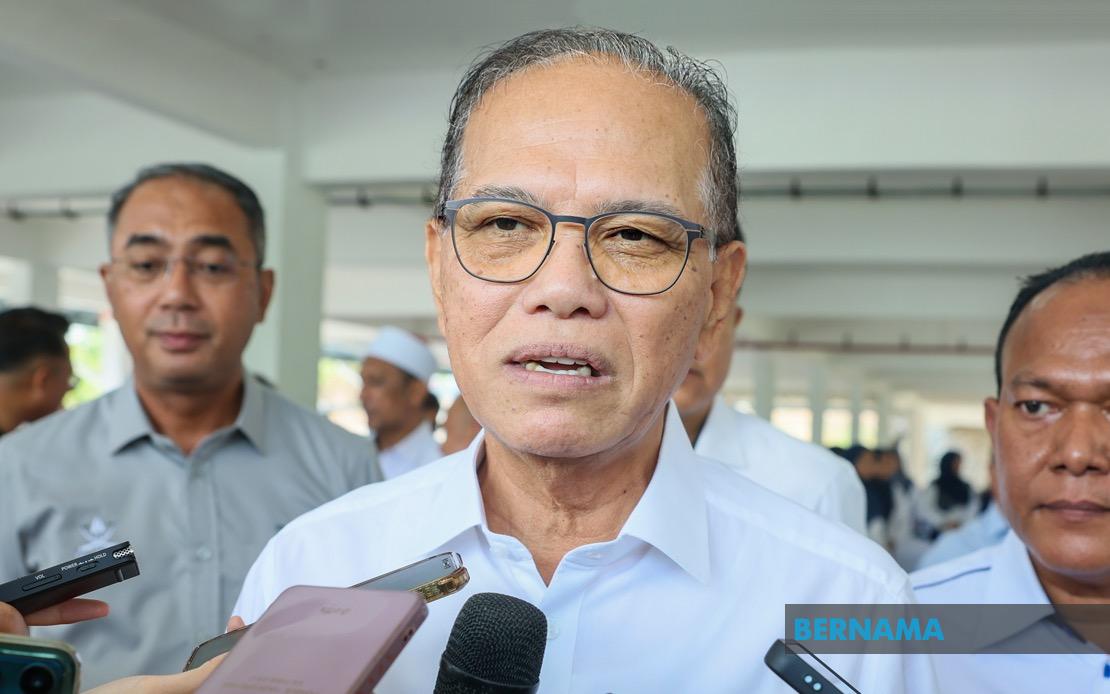
Pahang is intensifying its push to establish itself as a competitive force in Malaysia's national sports arena through a substantial RM3.5 million investment announced by Menteri Besar Datuk Seri Wan Rosdy Wan Ismail. The funding package, unveiled during the closing ceremony of the Pahang 1st Netball League Championship at the state's Sports Complex in Kuantan on July 5, represents a deliberate strategic shift toward developing world-class athletes while simultaneously building deeper talent pipelines at community level.
The allocation breaks down into three distinct tranches, with football commanding the largest share at RM2 million, followed by netball at RM1 million and sepak takraw at RM500,000. This distribution reflects both the popularity of these sports within Pahang and the state government's assessment of where investment could yield the most immediate returns in terms of championship performances. The selection is particularly noteworthy given that netball and sepak takraw represent traditional Malaysian sporting strengths, suggesting the state is doubling down on disciplines where regional competitive advantage already exists.
Wan Rosdy's framing of the initiative extends beyond mere financial commitment, emphasizing that the state government intends to operate with genuine seriousness rather than superficial gestures. He articulated a vision where Pahang transitions from a secondary player in national sports to a peer of long-established powerhouses that have accumulated championship credentials over decades. This ambition reflects broader regional competition among Malaysian states, where sporting achievement serves as a proxy for administrative competence and development.
Crucially, the initiative targets both elite athlete development and grassroots cultivation simultaneously. By strengthening infrastructure and support systems at community level, Pahang aims to create a funnel through which young talent can be systematically identified, assessed and developed. This two-tier approach acknowledges that producing national champions requires not merely funding elite programmes but building robust foundational systems that can continuously supply promising recruits to higher levels of competition.
The emphasis on unity, cooperation and discipline represents another dimension of the state's strategic thinking. Pahang's government recognizes that sports programming extends beyond medals and trophies, functioning as a social cohesion mechanism that transcends demographic boundaries. In a Malaysian context where communal harmony remains a policy priority, framing sports development as a vehicle for fostering cross-community engagement adds legitimacy to the initiative beyond its purely athletic dimensions.
Netball emerges as a particularly favored discipline, with the government already committing to increase the sport's allocation by an additional RM500,000 in the following financial year, bringing the total to RM1.5 million. This escalation signals confidence in netball's development trajectory and suggests that the Pahang 1st Netball League Championship may have demonstrated sufficient organizational quality and competitive depth to justify expanded investment. The decision to increase funding ahead of schedule indicates responsive governance rather than rigid budget adherence.
The Pahang 1st Netball League Championship itself provided the announcement's backdrop, with 42 teams competing for supremacy. Semambu's championship victory and RM10,000 prize purse underscore the competitive intensity the state is cultivating. The scale of participation suggests netball has achieved meaningful grassroots penetration in Pahang, creating a foundation upon which the additional investment can build.
For Malaysian readers and observers, Pahang's initiative merits attention as a case study in how state governments can leverage financial resources to influence national sporting hierarchies. The spending level, while substantial, remains modest compared to infrastructure investments in other sectors, yet the state government clearly regards it as significant enough to warrant announcement alongside high-profile sporting events. This suggests a political calculation that sports development resonates with constituents and reflects positively on administrative effectiveness.
The initiative also reflects broader Southeast Asian trends toward state-sponsored athletic development as a means of enhancing international prestige. Pahang is positioning itself within regional competition, whether explicitly against other Malaysian states or implicitly within broader ASEAN sporting comparisons. Success in these three disciplines would elevate the state's profile across Malaysian and Southeast Asian sporting calendars.
Implementation will prove critical. The announcement of RM3.5 million carries weight only if execution matches ambition. Questions regarding how funds will be allocated between coaching infrastructure, athlete stipends, facility improvements and competition support will determine whether this represents transformative investment or marginal enhancement. The state government's demonstrated seriousness will be tested through the quality of programme design and administrative oversight.
Sustainability constitutes another consideration. The commitment through the next financial year suggests multi-year planning, yet long-term success requires institutional consistency regardless of administrative or political transitions. Building competitive capacity in football, netball and sepak takraw demands sustained commitment extending well beyond initial funding cycles.
For athletes and sports administrators within Pahang, the allocation provides tangible validation of state-level support. Increased resources should facilitate better coaching, improved training facilities and enhanced competitive opportunities. The announcement also signals that other sports seeking state support have a reference point demonstrating that government investment in athletics is not merely theoretical but operationalized through concrete budget allocations.

