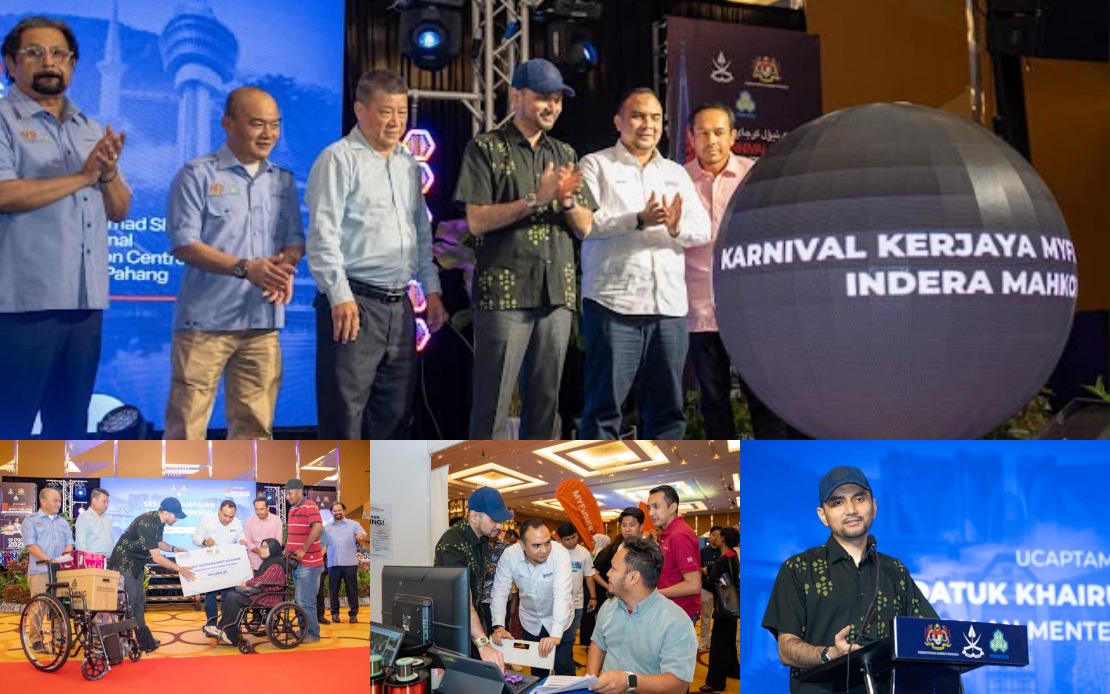
Pahang has emerged as the employment leader across Malaysia's east coast, posting a labour force participation rate of 65.3 per cent in the first quarter of 2026 alongside an impressively low unemployment rate of 1.9 per cent. The state's strong performance reflects the success of coordinated government initiatives aimed at connecting job seekers with employment opportunities across multiple sectors. The figures represent meaningful progress in the state's economic participation, particularly as Pahang works to diversify its economy beyond traditional industries.
Deputy Human Resources Minister Datuk Khairul Firdaus Akbar Khan attributed the positive outcomes to a suite of targeted programmes designed to expand employment access across Pahang's workforce. At the forefront of these efforts is the MYFutureJobs programme, administered by the Social Security Organisation PERKESO, which has become instrumental in bridging the gap between employers seeking talent and workers pursuing career opportunities. The minister emphasised that these initiatives represent an ongoing governmental commitment to maintaining Malaysia's competitive unemployment rates while creating sustainable pathways into the workforce, particularly for younger and less experienced workers who stand to gain substantially from structured entry points.
The tangible impact of these employment initiatives becomes evident when examining the track record since 2023. Through July 24, 2026, a total of 26,877 job seekers across Pahang successfully secured employment via the MYFutureJobs platform, demonstrating that structured intervention in the labour market yields demonstrable results. This figure encompasses individuals transitioning from unemployment, underemployment, or career changes, representing significant household economic gains and reduced reliance on government support systems.
PERKESO's infrastructure for job matching has expanded substantially, with the organisation conducting 1,277 interview programmes and career carnivals throughout Pahang during the same period. These events serve dual purposes: they facilitate immediate connections between employers and candidates whilst simultaneously building job-seeking confidence and professional skills among participants. The MYFutureJobs portal itself has listed more than 10,000 job vacancies across Pahang, whilst attracting 11,857 registered job seekers in 2026 alone, indicating growing awareness and utilisation of the digital employment platform among the state's population.
Beyond job placement, the government recognises that sustainable employment requires continuous workforce development. Deputy Minister Khairul Firdaus stressed that the ministry's role extends beyond simply offering employment opportunities; it encompasses comprehensive training programmes designed to equip workers with skills aligned to current industry demands. This forward-thinking approach acknowledges that Malaysia's economy is undergoing structural transformation, particularly as manufacturing sectors evolve and service industries expand. Workers who engage in upskilling programmes enhance their long-term earning potential and career mobility within the rapidly changing economic landscape.
The Indera Mahkota MyFutureJobs Career Carnival 2026, held in Kuantan, exemplified the scale at which these initiatives operate, bringing together 30 employers offering 6,000 job vacancies across diverse industries including manufacturing, services, technology, and logistics. Such concentrated employment events create rare opportunities for intensive job matching whilst generating momentum around career opportunities in the region. For jobseekers, particularly those in smaller towns and rural areas, these carnivals provide access to employers and career information that might otherwise require travel to major urban centres.
The Prime Minister's political secretary Datuk Ahmad Farhan Fauzi used the carnival platform to launch the Pahang-level Sahabat MADANI initiative, marking an expansion of the government's community engagement strategy. Sahabat MADANI operates as more than a volunteer programme; it functions as a grassroots movement emphasising volunteerism, social responsibility, and community cohesion. By integrating employment initiatives with broader community development objectives, the government attempts to address labour market challenges whilst simultaneously strengthening social bonds and collective responsibility amongst Malaysian youth.
The Sahabat MADANI framework specifically targets underserved populations, directing employment and development services towards rural and geographically isolated communities that often lack convenient access to job information or training resources. This geographic inclusion strategy recognises that unemployment and underemployment rates often appear lower in aggregate statistics whilst masking significant regional disparities. By establishing volunteer networks at the grassroots level, the initiative creates distributed capacity to identify labour market barriers and employment gaps that centralised policymaking might overlook.
Ahmad Farhan articulated Sahabat MADANI as a bridge mechanism connecting government institutions with local communities, positioning volunteers as both service providers and information channels feeding community insights upward to policymakers. The initiative had achieved its initial target of recruiting 2,000 members in Pahang, though the government signalled intentions to expand this volunteer force significantly beyond the baseline target. This expansion approach suggests confidence in the model's effectiveness whilst acknowledging that employment challenges and community development needs extend beyond what existing government capacity can address unilaterally.
The integration of MYFutureJobs employment services with Sahabat MADANI volunteerism creates structural synergies that amplify reach and effectiveness. Volunteers positioned within communities possess contextual knowledge about local labour markets, demographic characteristics, and barriers to employment that distant government offices cannot easily access. Simultaneously, trained volunteers can facilitate information dissemination about available job programmes, training opportunities, and career pathways with credibility derived from local embeddedness rather than top-down government messaging.
For Malaysian observers and policymakers across other states and regions, Pahang's employment performance offers both benchmark data and a tested model for replication. The state's success reflects sustained institutional commitment, substantial resource allocation to job matching infrastructure, and integration of employment initiatives with broader community development objectives. The 65.3 per cent labour force participation rate and 1.9 per cent unemployment rate position Pahang favourably against comparable economies and demonstrate that coordinated governmental effort can meaningfully improve employment outcomes.
Looking forward, the government's emphasis on continuous workforce development through training programmes addresses recognised risks that job placement without skills development creates precarious, low-wage employment vulnerable to technological disruption and economic cycles. By coupling employment access with upskilling initiatives, policymakers attempt to generate sustainable career advancement rather than temporary placements. This approach aligns with Malaysia's broader economic transformation objectives, positioning the workforce for higher-value employment in evolving sectors requiring technical competence and adaptive capacity.

