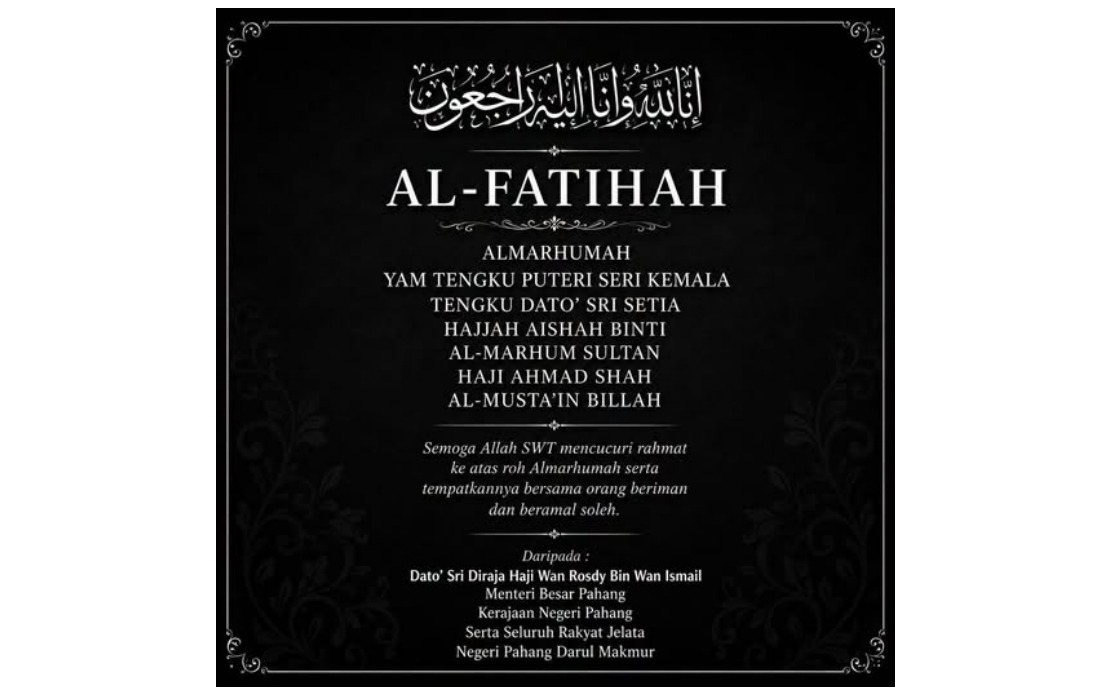
Pahang Menteri Besar Datuk Seri Wan Rosdy Wan Ismail has formally conveyed the Pahang State Government's condolences following the death of Tengku Puteri Seri Kemala Tengku Datuk Seri Aishah Almarhum Sultan Ahmad Shah, the elder sister of the Sultan of Pahang. The senior royal passed away at a Kuala Lumpur hospital at 9.15 pm on August 26, marking a significant moment of mourning for the state's ruling family and the broader Pahang community.
In a statement shared through social media, Wan Rosdy acknowledged the profound impact of the loss, particularly for Al-Sultan Abdullah Ri'ayatuddin Al-Mustafa Billah Shah and Tengku Ampuan Pahang Tunku Azizah Aminah Maimunah Iskandariah. The Menteri Besar's remarks underscore the deep personal and institutional significance of the royal family's patriarch in the state's political and ceremonial life. Such losses within ruling families inevitably reverberate through state institutions, affecting both ceremonial duties and the emotional tenor of governance during periods of mourning.
The Menteri Besar's formal expression of condolences represents the constitutional role of state government leadership in acknowledging major developments within the royal household. This practice, deeply rooted in Malaysia's constitutional monarchy framework, reinforces the ceremonial and symbolic bonds between the executive government and the institution of royalty. By articulating the state's collective grief on behalf of Pahang's populace, Wan Rosdy fulfilled his role as chief administrator during a period of personal loss for the sovereign.
Tengku Puteri Seri Kemala's funeral arrangements proceeded swiftly according to Islamic practice and royal protocol. Her mortal remains were transported to the Pahang Royal Mausoleum in Pekan, where interment took place on August 27. The Pekan mausoleum serves as the final resting place for members of Pahang's royal lineage, and the swift completion of funeral rites reflected both religious observance and long-established procedures governing royal mourning ceremonies in the state.
For Malaysian observers of constitutional affairs, the passing of senior royal family members carries implications extending beyond individual grief. Pahang, as one of Malaysia's constitutional monarchies, maintains intricate protocols governing state functions during periods of royal mourning. Such transitions, though routinely managed, require coordinated attention from government machinery to ensure continuity of state operations while according appropriate respect to the deceased and bereaved family members.
The broader context of royal mortality in Malaysia highlights the aging demographics of various state ruling families. As senior members pass away, questions of succession, regency arrangements, and the evolving roles of younger family members frequently emerge. Though Tengku Puteri Seri Kemala's passing involves established succession arrangements, it nonetheless reinforces awareness of generational transitions within Malaysia's monarchical institutions.
Wan Rosdy's invocation of Islamic prayers for the deceased—requesting Allah's mercy, forgiveness, and acceptance of righteous deeds—reflects the predominant religious dimension of Malaysian state governance. Such formulations have become standard in official communications concerning death, particularly within royal and governmental contexts. This integration of Islamic spiritual language with constitutional governance represents a distinctive feature of Malaysian political practice, where Islamic principles and monarchical traditions intersect.
For Pahang specifically, royal family events carry particular weight given the state's historical significance in Malaysia's constitutional development. As one of the founding sultanates in the Federation of Malaya and subsequently Malaysia, Pahang's royal institution maintains considerable ceremonial and symbolic importance. Deaths within the senior branch of the royal family thus assume broader cultural and historical resonance beyond immediate family circumstances.
The coordination between state government and royal household during such periods demonstrates the functional interdependence of Malaysia's constitutional arrangements. Although the Sultan remains the supreme head of state, the Menteri Besar and state government apparatus play crucial supporting roles in managing state affairs and ensuring appropriate ceremonial acknowledgment of royal developments. This shared governance model, while occasionally complex, has proven resilient across decades of Malaysian political experience.
The timing and manner of official condolence statements also carry subtle political implications. By promptly and formally acknowledging the loss through a public statement, Wan Rosdy demonstrated respect for royal protocol while simultaneously reinforcing the government's institutional connectivity to the palace. Such gestures, though ceremonial in appearance, serve important functions in maintaining the political equilibrium essential to Malaysia's constitutional monarchy system.
Looking forward, the bereavement of Pahang's ruling family represents another in the ongoing succession of such events that periodically touch Malaysia's royal institutions. The state's institutional resilience and the established protocols governing such circumstances suggest continuity in administrative and ceremonial functions despite the personal loss. Nevertheless, each such transition provides opportunity for reflection on the enduring role of monarchy within contemporary Malaysian governance and society.

