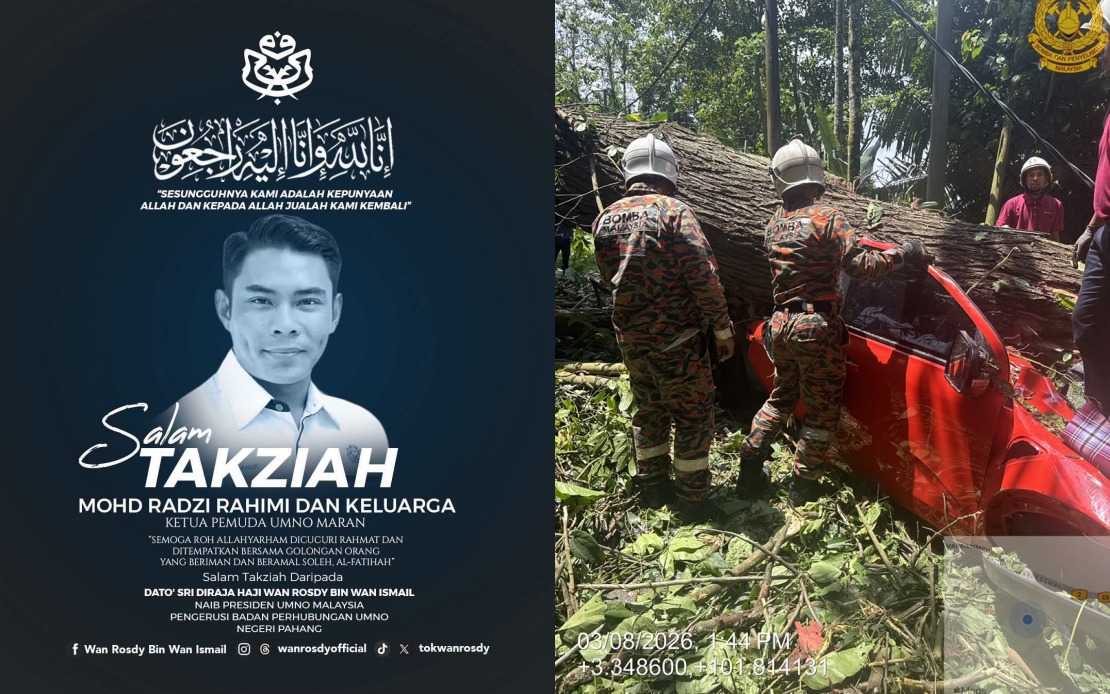
A prominent youth leader in Pahang has been remembered as a passionate advocate for grassroots engagement following his unexpected death in a tree-falling accident near Bentong on the afternoon of August 3. Datuk Seri Wan Rosdy Wan Ismail, who chairs the Pahang UMNO Liaison Committee and serves as Menteri Besar, delivered the tribute through a Facebook post, characterising the late Mohd Radzi Rahimi, popularly known as Edy Radzi, as someone whose professional life centred squarely on serving the public interest and responding to community needs.
The tragedy unfolded along the old Kuala Lumpur-Bentong road in the vicinity of Janda Baik when a substantial tree collapsed onto a four-wheel-drive vehicle carrying multiple passengers. The incident claimed four lives immediately and left one child with injuries. Besides Radzi, those killed in the collision included Nuriani Mohammad Jafri, her son Muhammad Rizz Hazim, and Nuriani's brother Mohammad Nizam. The circumstances surrounding the tree's failure remain part of the ongoing narrative surrounding the tragedy, with weather conditions and structural factors potentially contributing to the collapse.
Radzi had risen to serve as chief of Maran UMNO Youth, a position that places him within the party's structured youth apparatus responsible for mobilising younger members and advocating for policies affecting younger demographics across Pahang. His appointment within the party machinery reflected confidence from senior leadership in his ability to represent youth interests and bridge communication between party elders and younger members. As a divisional youth leader, he would have been engaged in organising community programmes, political education initiatives, and voter engagement campaigns throughout the Maran constituency.
Wan Rosdy's acknowledgement of the loss emphasised the ripple effect such a death creates across multiple institutional layers. The Menteri Besar noted that Radzi's passing constituted a significant blow not only to his immediate family members but equally to the formal party structures he represented: the Maran UMNO division itself, the broader Pahang UMNO Youth movement, and the overarching Pahang UMNO Liaison Committee framework. This delineation underscores how such deaths disrupt both personal family networks and the political organisational infrastructure that sustained his professional identity.
The statement released by Wan Rosdy conveyed formal condolences to the bereaved families and invoked religious language appropriate to Muslim funeral customs in Malaysia, praying that the families would receive divine strength and patience to endure their grief. Such expressions, rooted in Islamic tradition, represent the standard respectful framework through which Malaysian political leaders acknowledge loss within their communities. The prayers for the deceased similarly followed established conventions, requesting divine forgiveness and eternal peace for those who had passed.
UMNO Youth chief Datuk Dr Muhammad Akmal Saleh extended a separate expression of condolence, widening the circle of official acknowledgment beyond the state level to the national youth leadership structure. His statement similarly employed religious language, requesting that Allah grant forgiveness to the deceased and accept their righteous deeds. Such national-level recognition emphasises that Radzi's death resonated across UMNO's hierarchical structure and was not treated merely as a local incident but as a loss affecting the broader organisation's youth portfolio.
The accident itself raises questions about infrastructure safety along secondary routes connecting major population centres in Selangor and Pahang. The old Kuala Lumpur-Bentong road, while serving as an established thoroughfare for the region, traverses terrain where vegetation management and tree health monitoring become critical public safety considerations. That a fallen tree could collide with vehicles travelling this route suggests either exceptional weather conditions or potentially inadequate preventive maintenance of roadside hazards—an issue relevant to Malaysian highway safety protocols more broadly.
Radzi's death occurs within the context of UMNO's ongoing consolidation of its grassroots leadership following the party's return to prominence in Malaysian federal politics. Youth leadership positions carry particular significance in ensuring the party maintains engagement with younger voters and builds institutional capacity for future electoral cycles. The loss of an active divisional youth chief interrupts these continuity efforts and creates immediate questions about succession planning within Maran UMNO Youth structures.
For Pahang specifically, where UMNO maintains significant electoral dominance, the incident underscores the personal toll that political engagement can exact on individuals balancing constituency service with private family life. Radzi's dedication to community service, highlighted by Wan Rosdy, presumably involved extensive travel, constituency events, and political obligations—activities that place politicians and party workers on roads frequently and at varied times. The accident thus intersects broader questions about occupational hazards facing elected representatives and party officials throughout Malaysia.
The presence of a child among the injured in the accident adds another dimension to the tragedy, suggesting that family members or dependents were accompanying at least some of those in the vehicle. This detail introduces additional considerations about how accidents of this nature affect not only the immediate victims but their associated networks and dependents. For the political community in Pahang, the incident represents both a human tragedy and a reminder of the unexpected vulnerabilities inherent in public service work.
The condolences extended by senior UMNO figures reflect institutional protocols for acknowledging member deaths but also suggest the genuine regard in which Radzi was held within party circles. Descriptions of his commitment and community-centred approach suggest he had cultivated relationships and impressed colleagues through his work ethic and constituency engagement. Such positive characterisations, while inevitably part of memorial acknowledgments, typically reflect accumulated observations from colleagues working alongside the deceased.

