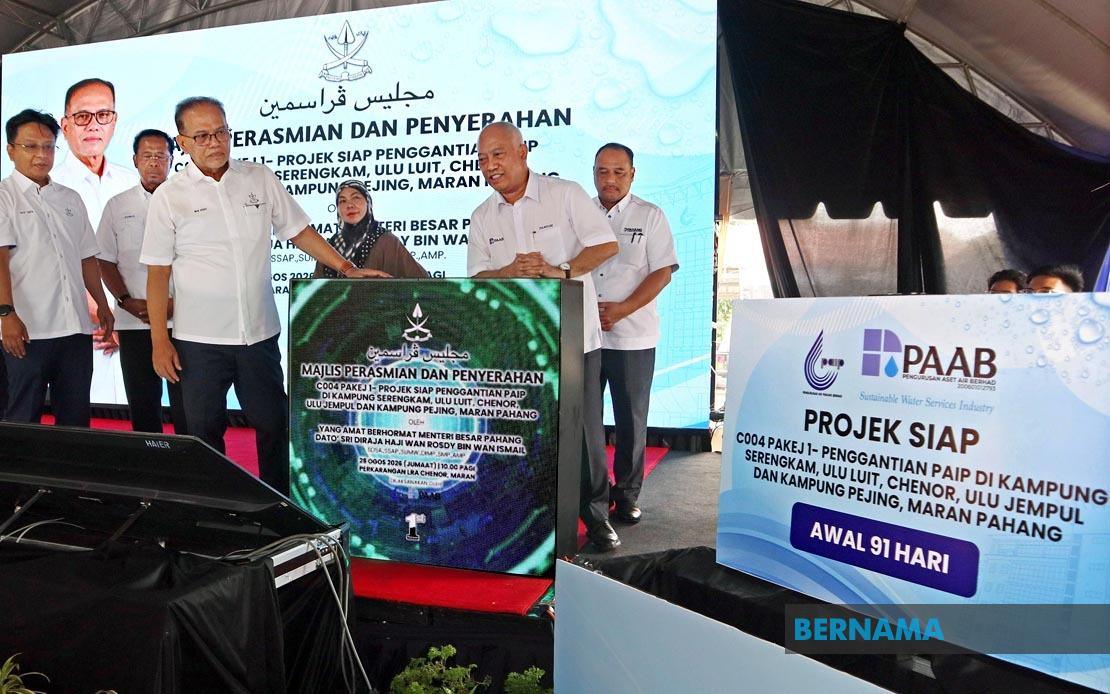
The Pahang state government is moving forward with a systematic approach to resolve the recurring problem of shallow water levels in Sungai Pahang, a challenge that has increasingly impacted economic activities and daily life for riverside communities. Menteri Besar Datuk Seri Wan Rosdy Wan Ismail disclosed the state's commitment to addressing the issue when speaking at the Chenor Water Treatment Plant in Maran, where he presided over the completion of a significant pipe replacement initiative. The shallow river conditions have particularly affected Kampung Pesagi and several other designated localities, prompting the administration to seek lasting remedies rather than temporary fixes.
Wan Rosdy emphasised that the state government views this situation with considerable urgency, given its direct implications for the economic stability and quality of life of affected residents. Rather than rushing into solutions, however, the Menteri Besar indicated that the administration is gathering comprehensive data from district authorities and other relevant agencies to fully understand the hydrological and environmental factors contributing to the problem. This methodical approach reflects growing recognition across Malaysian state governments that river management issues often require multifaceted solutions grounded in scientific assessment rather than reactive interventions.
The Menteri Besar outlined a tiered strategy encompassing short-term interventions, medium-term adjustments, and long-term structural solutions. He indicated that once the compiled reports reach the state executive council meetings, these materials will undergo rigorous review, analysis, and refinement before the government commits to specific courses of action. This deliberative process, while potentially frustrating to communities experiencing immediate hardship, reflects contemporary best practices in environmental management and infrastructure planning. The depth of preliminary investigation signals that authorities recognise the need to avoid unintended consequences that poorly conceived solutions might trigger elsewhere in the river system or among communities further downstream.
Parallel to the Sungai Pahang initiative, the Pahang administration has accelerated its broader water infrastructure modernisation programme, demonstrating a commitment to resolving supply-related challenges across multiple districts. The pipe replacement project inaugurated at Maran represents a significant investment in upgrading ageing water distribution networks that have historically contributed to service interruptions and quality issues. Four districts within the state have already achieved water supply resolution rates exceeding 90 per cent, with Maran positioned to join this cohort in the coming months. This parallel infrastructure upgrading effort underscores the state government's recognition that water challenges operate at multiple levels, from river management to urban delivery systems.
Beyond immediate water concerns, Pahang is positioning itself to attract substantial investment through complementary infrastructure development projects. The Tenaga Nasional Berhad initiative to construct a 500 kilovolt Transmission Main Intake Substation in Kampung Awah represents a RM350 million commitment designed to enhance the state's energy infrastructure resilience. Such projects carry significant economic implications for Pahang, as enhanced grid capacity and reliability typically encourage manufacturing operations and data centre investments that depend on stable electricity supplies. The substation's expected completion by 2030 aligns with broader national energy transition objectives while strengthening the East Coast region's capacity to serve growing industrial demand.
The electrical infrastructure expansion is explicitly framed as a foundation for economic diversification and employment generation across Pahang. Officials anticipate that improved power infrastructure will enhance the state's competitive positioning when multinational corporations evaluate potential investment sites in Malaysia. This investment linkage reflects contemporary economic development thinking, where quality infrastructure serves as a primary determinant of investor confidence. For a state like Pahang, which has historically relied heavily on primary industries and traditional manufacturing, this diversification represents a strategic pivot toward higher-value economic activities.
The interconnected East Coast energy network being developed through the TNB project creates transmission pathways linking strategic locations across the region, establishing greater grid stability and redundancy. This systemic resilience proves increasingly critical as Malaysia pursues renewable energy targets and integrates variable generation sources into its electricity system. The transmission infrastructure improvements enable more efficient power distribution patterns across the East Coast, potentially reducing systemic losses and creating conditions for more stable electricity pricing for commercial and industrial consumers. For Pahang specifically, such improvements enhance the state's ability to support manufacturing sectors that are sensitive to power supply consistency and cost.
Wan Rosdy's comments reflect a broader regional perspective on infrastructure as an economic catalyst. The simultaneous pursuit of water management solutions and energy infrastructure development reveals a government strategy grounded in understanding that modern economic competitiveness depends on foundational service reliability. States competing for investment and skilled workforce retention must demonstrate consistent commitment to maintaining and upgrading essential services. Pahang's multi-front approach signals recognition that tackling individual problems in isolation often produces suboptimal results, whereas coordinated infrastructure development creates complementary benefits.
The Sungai Pahang initiative also carries implications beyond Pahang's borders, as the river system impacts communities and economic activities throughout its watershed and downstream regions. Comprehensive management of the river requires coordination across multiple stakeholder interests, potentially involving federal agencies overseeing water resources and environmental impact. The state government's commitment to detailed studies before implementation provides opportunity for appropriate consultation with affected communities and inter-state coordination mechanisms. Such collaborative approaches have become increasingly standard in Malaysian water management, reflecting recognition that river systems operate as integrated environmental units transcending administrative boundaries.
For Malaysian readers monitoring state-level governance and infrastructure development, the Pahang initiative exemplifies contemporary approaches to addressing infrastructure challenges in a sustainable manner. Rather than embracing crisis-driven decision-making, the state administration's emphasis on comprehensive assessment and multi-phase implementation suggests institutional maturation in how governments approach complex environmental and infrastructure problems. The integration of water management with parallel investments in energy infrastructure demonstrates strategic thinking about how different systems interact to support broader economic and social objectives.
Looking forward, the success of these initiatives will likely influence how other Malaysian states approach comparable challenges. The Pahang model emphasises data-driven decision-making, stakeholder consultation, and recognition that infrastructure investments must serve multiple policy objectives simultaneously. Whether the eventual solutions to Sungai Pahang's shallow water problem prove effective will provide valuable lessons for regional water management practitioners. The timeframe extending to 2030 for completion of the TNB project reflects the long-term perspective required when addressing systemic infrastructure challenges, a horizon increasingly characteristic of strategic planning across Malaysian state administrations.

