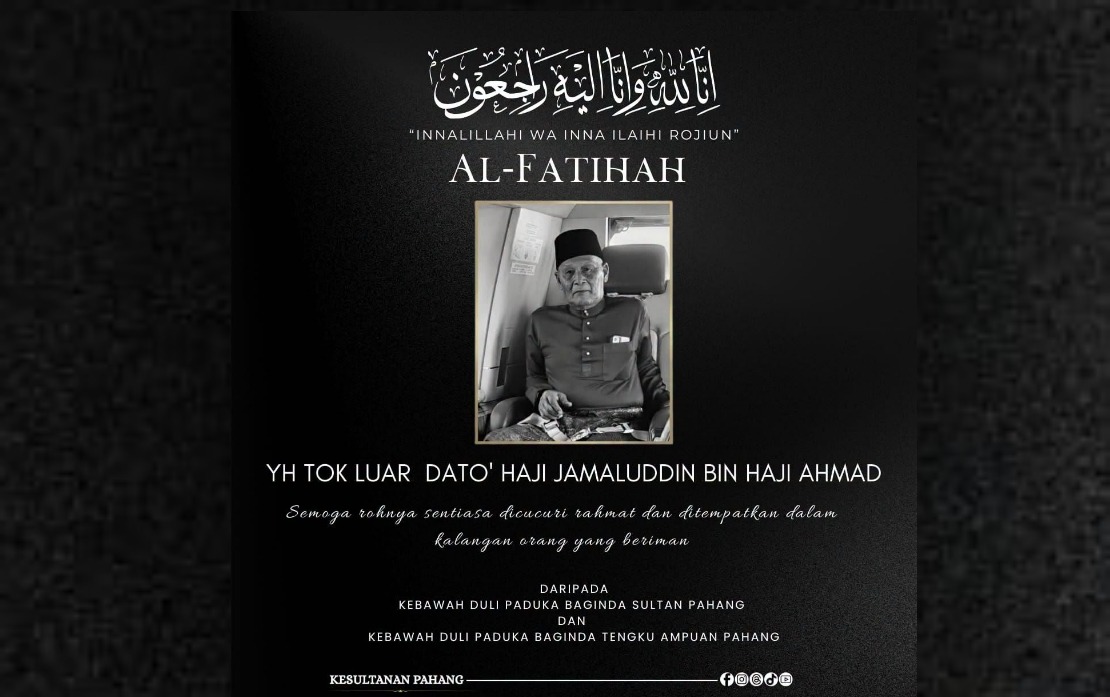
The Sultan of Pahang Al-Sultan Abdullah Ri'ayatuddin Al-Mustafa Billah Shah and Tengku Ampuan of Pahang Tunku Azizah Aminah Maimunah Iskandariah have offered their deepest sympathies following the death of Tok Luar Datuk Jamaluddin Ahmad on June 28. The senior figure, who maintained close ties to the Pahang royal institution, passed away at Tengku Ampuan Afzan Hospital in Kuantan at 6.48 am.
Through an official announcement posted on the Kesultanan Pahang Facebook page, the royal couple articulated their profound sorrow at Jamaluddin's passing. Their statement highlighted his longstanding commitment as a devoted supporter of the Pahang Sultanate, underscoring the significant role he had played in various royal matters throughout his lifetime. This public acknowledgement reflects the customary protocol observed by the Pahang palace when acknowledging the loss of prominent figures within the sultanate's circle.
In keeping with Islamic tradition and royal custom, the Sultan and Tengku Ampuan invoked blessings upon the departed soul. The royal statement specifically requested that Allah SWT shower mercy upon Jamaluddin's spirit, grant forgiveness for his transgressions, accept his righteous deeds, and position him among the faithful and virtuous servants of the Almighty. Such spiritual supplications form an essential component of Islamic mourning practices across Malaysian society, reflecting the integration of religious observance within state ceremonial contexts.
The palace's message extended sympathetic wishes to Jamaluddin's bereaved family members during this period of grief. The Sultan and Tengku Ampuan conveyed hopes that the family would receive the necessary emotional fortitude, inner resilience, and emotional steadiness required to navigate the challenging days ahead. This compassionate acknowledgement of family suffering demonstrates the palace's recognition of the personal impact such losses have on immediate relatives and dependents.
The passing of prominent supporters of royal institutions often serves as a moment of reflection within Pahang's administrative and ceremonial circles. Tok Luar Datuk Jamaluddin Ahmad's death marks the loss of someone who had evidently cultivated a meaningful relationship with the sultanate over an extended period. Such figures frequently serve as bridges between the palace and broader community networks, facilitating communication and reinforcing institutional continuity across generations.
The official palace statement concluded with the Islamic prayer "Al-Fatihah," the opening chapter of the Quran traditionally recited as a spiritual offering for the deceased. By incorporating this element, the royal household reinforced the Islamic spiritual framework that underpins Malaysia's constitutional monarchy and demonstrated institutional commitment to Islamic values alongside secular governance responsibilities.
Tengku Ampuan Afzan Hospital, where Jamaluddin spent his final hours, functions as a principal medical facility serving Kuantan and surrounding regions. The hospital's role in this instance underscores the broader healthcare infrastructure supporting Pahang's population and the medical care extended during end-of-life circumstances. The timing of his death in the early morning hours is consistent with typical hospital protocols and medical documentation practices.
The condolence message from the Sultan and Tengku Ampuan carries particular significance within Pahang's political and social context. Royal expressions of sympathy serve not merely as personal grievances but as formal state acknowledgements that reinforce institutional continuity and the palace's engagement with significant figures within its sphere of influence. Such gestures contribute to the broader fabric of ceremonial governance and state representation.
For Malaysian readers, this announcement reflects the ongoing role that constitutional monarchies play in social and ceremonial aspects of governance. The Pahang Sultan and Tengku Ampuan's willingness to publicly acknowledge losses within their support network demonstrates the personal dimensions of royal responsibility that extend beyond formal legislative and executive functions. This integration of personal compassion with institutional duty characterizes much of the monarchy's contemporary role in Malaysian society.
The death of individuals closely associated with royal institutions often prompts broader conversations about succession planning, institutional memory, and the transfer of knowledge within established networks. Tok Luar Datuk Jamaluddin Ahmad's passing represents a potential transition point within these informal but significant administrative and advisory relationships that have historically sustained the sultanate's operations and community engagement.

