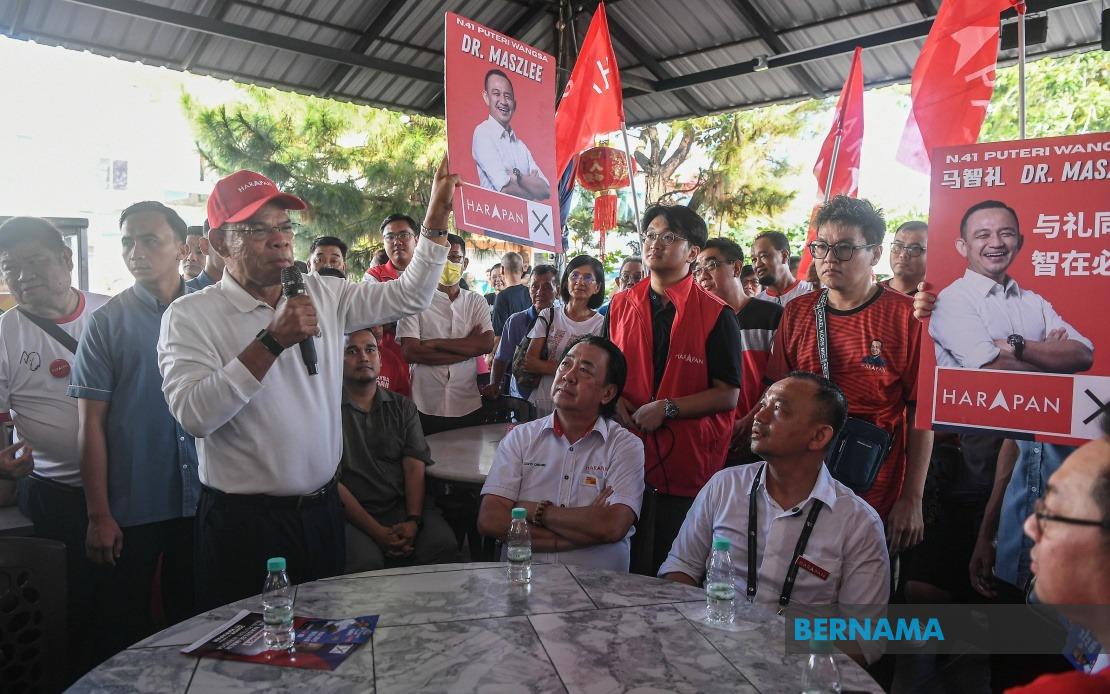
Pakatan Harapan is capitalising on what its leadership views as a successful ground campaign in Johor, with party strategists attributing the coalition's increasing support to a disciplined, data-driven approach to targeting specific constituencies. PH secretary-general Datuk Seri Saifuddin Nasution Ismail outlined the mechanics of this strategy during a campaign event in Johor Bahru on July 5, revealing that the coalition has classified all 56 contested state seats into priority tiers based on real-time assessments of voter sentiment and local dynamics.
The tiering system represents a departure from blanket campaign approaches, allowing PH to concentrate resources where they are most likely to yield electoral gains. Saifuddin Nasution explained that constituencies vary dramatically in their political profiles and voter composition, making a one-size-fits-all campaign inefficient and potentially counterproductive. By segmenting seats into clusters with different priority ratings, PH can deploy campaign personnel, messaging, and candidate appearances strategically rather than dispersing effort uniformly across the state.
This granular approach mirrors techniques increasingly common in modern election campaigns across Southeast Asia, where data analytics and microtargeteting have become standard among sophisticated political operations. For Malaysian readers, the disclosure reveals how far electoral strategy has evolved beyond traditional rallies and door-knocking, incorporating detailed geographical and demographic analysis to forecast outcomes at the constituency level.
Beyond internal campaign mechanics, PH's leadership has identified moves by rival parties as inadvertently strengthening the coalition's electoral position. The Islamic Party of Malaysia (PAS) chose to contest only 11 of the 56 seats while explicitly directing supporters to back Barisan Nasional (BN) candidates in remaining constituencies. This decision, Saifuddin Nasution suggested, has fractured the opposition vote in ways that benefit PH. By withdrawing from 45 seats and publicly endorsing BN, PAS created confusion among voters who might otherwise have been undecided or aligned with a broader anti-BN front.
In contrast, PH has adopted a more transparent posture, announcing its seat allocation clearly across its component parties and presenting what officials describe as a realistic, implementable manifesto. PKR is fielding 20 candidates, Amanah 19, and DAP 17, accounting for all 56 seats without gaps or redundancy. This comprehensive coverage and straightforward communication represents a deliberate messaging strategy designed to project unity and clarity to voters fatigued by coalition fragmentation.
A notable moment came when Datuk Dr Mohd Puad Zarkashi, a former UMNO Supreme Council member, appeared at joint talks with Prime Minister Datuk Seri Anwar Ibrahim in Felda Ulu Tiram. PH officials viewed this as symbolically significant, demonstrating that even traditional UMNO figures are open to dialogue with the government coalition. Such crossovers, whether symbolic or substantive, signal to voters that political realignments are occurring and that change is feasible.
PH's campaign narrative emphasises competence and deliverability, particularly through candidate quality. Saifuddin Nasution highlighted Puteri Wangsa candidate Dr Maszlee Malik as exemplifying the calibre of individuals the coalition is fielding, suggesting that PH candidates bring professional credentials and policy expertise. This framing attempts to elevate the campaign above purely partisan appeals, positioning PH as capable of effective governance should voters grant the coalition a state mandate.
The stakes are substantial for PH, which currently lacks control of Johor state government. A strong showing in this election would strengthen the coalition's foothold in Malaysia's southern powerhouse and potentially shift the balance of power in a state historically dominated by UMNO and Barisan Nasional. The 172 candidates contesting the 56 seats indicate a three-cornered or multi-cornered contest in numerous constituencies, heightening the premium on strategic vote management and mobilisation.
For Southeast Asian observers, the Johor election illustrates how Malaysian politics continues to evolve in complexity. Coalition politics, once dominated by fixed arrangements, now feature fluid alignments where parties negotiate, sometimes fracture, and occasionally shift alliances between elections. PAS's decision to cooperate selectively with BN while maintaining formal distance reflects the pragmatic opportunism characterising Malaysia's current political environment.
The election itself is scheduled for July 11, with early voting on July 7, meaning PH's campaign window to consolidate support and refine messaging is compressed. The coalition's confidence in its strategy rests on the assumption that voter sentiment on the ground aligns with internal polling and that the priority-seat classification correctly identifies winnable constituencies. If PH's assessment proves accurate, the targeted approach may yield a respectable haul of seats; if miscalibrated, the strategy could leave the coalition spread too thinly across difficult terrain.
Saifuddin Nasution's public articulation of campaign mechanics, while standard political communication, also serves to manage expectations. By explicitly framing PH's prospects in terms of strategic sophistication and opposition errors rather than predicting a landslide, PH leadership hedges against disappointment while positioning any gains as validation of superior campaign craft. This rhetorical positioning has become commonplace in Malaysian politics, where nuance and careful language often matter as much as outcomes themselves.

