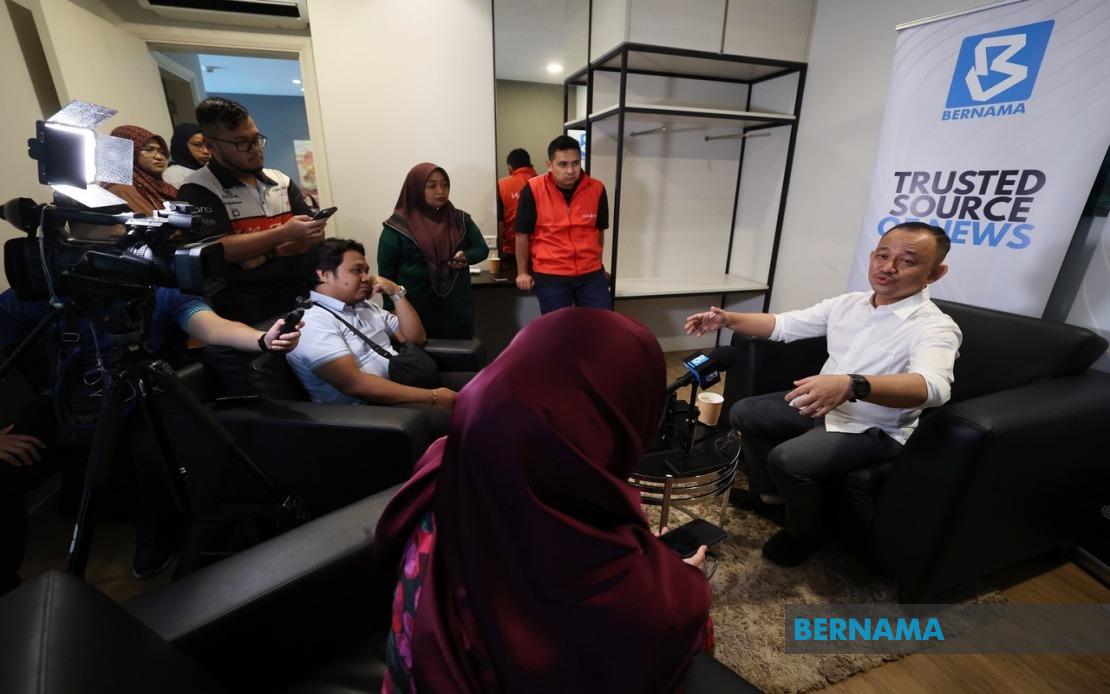
Pakatan Harapan has made clear that should the coalition secure victory in the Johor state election, the appointment of the next Menteri Besar will rest entirely with the Sultan of Johor, exercising his authority under the state constitution. The declaration came from Maszlee Malik, PH's candidate for the Puteri Wangsa seat, who emphasised that his coalition respects the constitutional framework governing such appointments and views the matter as exclusively within the Palace's domain.
Maszlee's statement addresses mounting speculation on social media that has positioned him as a potential contender for the Menteri Besar position should PH form government. Rather than engaging with such conjecture, the PH candidate steered the conversation toward his coalition's broader electoral strategy and policy commitments. His remarks underscore an important constitutional principle that often gets obscured in Malaysian electoral discourse: the role of the monarchy in appointing chief executives, particularly in states where this remains a genuine prerogative rather than a ceremonial function.
This stance reflects a deliberate choice by PH to avoid the factional positioning that has historically plagued Malaysian politics when parties attempt to influence royal appointments. By publicly ceding this decision to the Sultan, the coalition signals both constitutional respect and pragmatic politics—avoiding internal disputes that could weaken its electoral prospects. The timing of this clarification, coming ahead of the July 11 polling date, suggests PH leadership recognises that internal jostling over the Menteri Besar role could distract from its message to Johor voters.
Maszlee emphasised that PH has deliberately avoided internal discussions about the Menteri Besar portfolio, choosing instead to concentrate on what he described as the coalition's primary objective: delivering quality governance through coordinated teamwork. This approach represents a departure from the personality-driven politics that has often dominated Malaysian state elections, where leadership contests frequently overshadow substantive policy debates. By framing the election around collective performance rather than individual ambition, PH appears to be calculating that voters are more interested in governance outcomes than in speculation about future appointments.
The coalition has fielded candidates across all 56 contested seats in Johor, and Maszlee invoked the metaphor of an "Avengers" team to describe this slate, suggesting that PH's strength lies in the collective calibre of its nominees rather than in any single prominent figure. This messaging strategy may prove particularly relevant in Johor, where the Sultan maintains genuine authority over executive appointments and where state politics has traditionally been more hierarchical and institution-conscious than in other Malaysian states. The emphasis on teamwork also reflects lessons PH absorbed from its 2018 federal victory and subsequent 2023 electoral repositioning, where coalition stability became as important as charismatic leadership.
Johor holds particular significance in Malaysian politics given its large voter base, its economic weight, and its history as a politically competitive state. The 16th Johor state election will be closely watched as a barometer of public sentiment, especially regarding the performance of the current administration and the credibility of opposition alternatives. For PH, a victory would substantially strengthen its hand in national politics and could reshape the balance of power within federal arrangements. However, such calculations remain secondary to the coalition's immediate focus on convincing Johor voters that it offers a superior vision for development and service delivery.
The constitutional provisions governing Menteri Besar appointments vary significantly across Malaysian states. In Johor, the Sultan retains meaningful discretion, unlike states where the appointment has become largely procedural. This genuine prerogative creates a different political dynamic from states where the chief minister position is effectively determined by legislative arithmetic alone. By explicitly acknowledging this reality, Maszlee positioned PH as a coalition comfortable with constitutional monarchy and respectful of state-level institutions—a positioning that may resonate with Johor voters who value stability and proper governance frameworks.
Maszlee's refusal to engage with Menteri Besar speculation also serves an internal coalition function. In PH's multiparty structure, competing claims to high office have occasionally generated tension between component parties. By removing the Menteri Besar question from internal political bargaining and placing it firmly within the Sultan's domain, PH coalition leadership can sidestep arguments about portfolio allocation that might otherwise complicate campaign coordination. This allows party leaders to focus on mobilising their respective voter bases without friction over future power-sharing arrangements.
The early voting scheduled for July 7, with general polling on July 11, means PH has limited time to communicate its electoral platform before Johor voters cast their ballots. The coalition's emphasis on governance capability and institutional respect represents a calculated appeal to voters concerned about stability and competent administration. Whether this message resonates will depend partly on how effectively PH candidates can contrast their proposed policies with the incumbent administration's record, and partly on whether the coalition can convince voters that a change in government will genuinely improve service delivery and economic opportunity.
PH's public deference to the Sultan of Johor's appointment prerogative also carries implications for Southeast Asian observers watching how Malaysian political actors negotiate between electoral competition and constitutional monarchy. The coalition's framing demonstrates that respecting institutional limits need not imply weakness or lack of ambition; rather, it reflects a matured understanding that durable political change depends on maintaining confidence in constitutional frameworks. As Malaysian politics continues to evolve, the interplay between democratic contestation and monarchical authority will remain a defining feature of electoral campaigns, particularly in states where sultans retain genuine executive powers.

