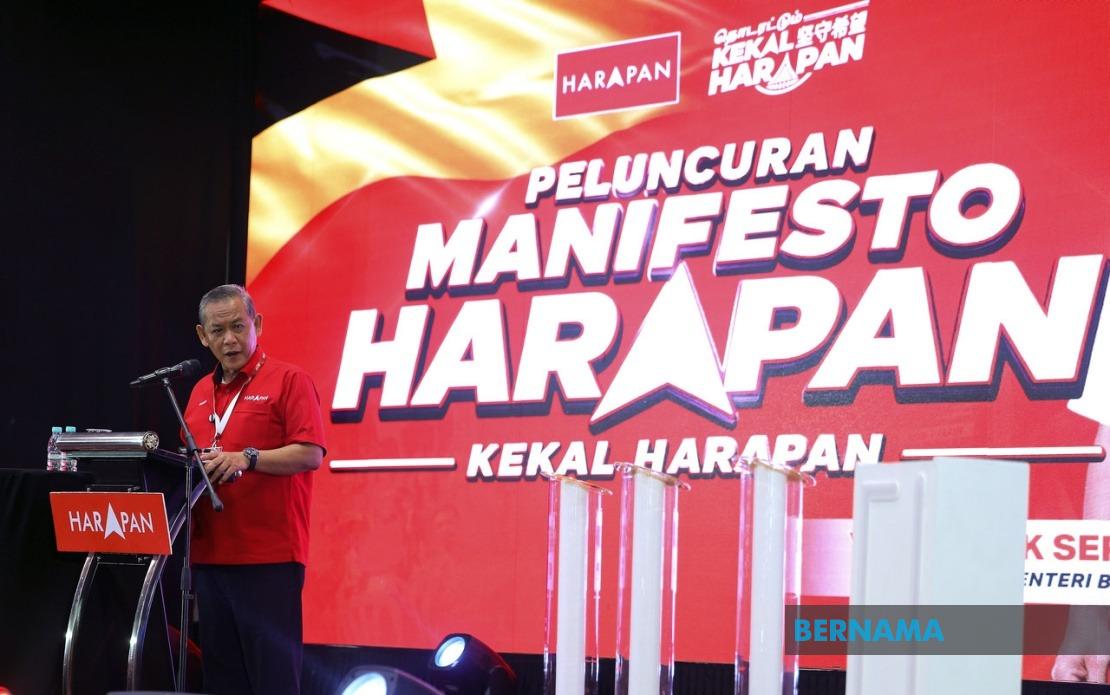
Pakatan Harapan has set out an ambitious electoral platform for the forthcoming 16th Negeri Sembilan state election, rolling out a manifesto centred on the theme 'Negeri Sembilan Kekal Harapan' (Negeri Sembilan Stays With Harapan). The coalition's vision, unveiled in Seremban by Menteri Besar Datuk Seri Aminuddin Harun, who also chairs Negeri Sembilan PH, positions governance reform and economic opportunity as twin pillars of its re-election bid.
The manifesto rests on ten distinct policy areas that the coalition says reflect the priorities of ordinary Negeri Sembilan voters. Chief among these is a commitment to deliver stable, corruption-free administration that places citizens' needs at the forefront of decision-making. This pledge comes as Malaysian voters nationwide have grown increasingly attuned to issues of governance quality and accountability following years of political turbulence across federal and state levels.
Economic growth features prominently in PH's strategy, with a specific undertaking to create 30,000 high-income employment opportunities across the state. The coalition argues that generating quality jobs rather than subsistence-level positions is essential to raising living standards and retaining young talent in Negeri Sembilan. This employment target reflects broader concerns in Malaysia about wage stagnation and the flight of skilled workers to more prosperous urban centres or overseas.
The manifesto also foregrounds the People's Wellbeing Scheme, known locally as Skim Sejahtera Rakyat or SSR, pledging to fortify and expand this safety net programme. Enhanced social support mechanisms are particularly relevant in a state where rural communities and lower-income groups have historically faced economic vulnerability. By making SSR central to its platform, PH signals recognition of persistent income inequality and the need for targeted assistance.
Housing affordability emerges as another cornerstone, with PH committing to construct 20,000 reasonably priced homes. This pledge addresses a chronic pain point for Malaysian households, particularly younger families and first-time buyers struggling with soaring property costs relative to median incomes. Accompanying this housing push is a broader undertaking to resolve longstanding land disputes that have complicated ownership and development across Negeri Sembilan.
Educational access and quality rounds out PH's social agenda, with the manifesto guaranteeing that all residents will enjoy equitable schooling opportunities. The coalition frames education not merely as a statutory obligation but as a foundation for breaking cycles of poverty and enabling social mobility—a particularly salient message in constituencies where school infrastructure and teaching resources remain inadequate.
The manifesto ventures into sectoral development as well, designating tourism and cultural heritage as priority growth areas. Negeri Sembilan's positioning as a gateway between Kuala Lumpur and the northern states, coupled with its natural attractions and historical significance, presents untapped potential. By championing tourism, PH hopes to diversify the state's economic base and create secondary employment in hospitality and creative industries.
Agricultural modernisation and food security constitute an additional pillar. As Malaysia confronts global supply chain disruptions and seeks to reduce dependence on imported foodstuffs, strengthening local farming capacity has become strategically important. PH's pledge to upgrade agricultural practices resonates with both rural producers and urban consumers concerned about food price volatility and nutritional security.
The coalition also commits to advancing critical infrastructure and expanding access to quality healthcare services. These pledges acknowledge that Negeri Sembilan, while relatively developed compared to some Malaysian states, still faces infrastructure gaps in certain districts and healthcare accessibility challenges in outlying areas. Modernised transport networks and well-equipped medical facilities are framed as essential to retaining residents and attracting investment.
Youth, women, and family empowerment form a distinct policy area within the manifesto. PH undertakes to create institutional support structures and targeted programmes benefiting these demographics, reflecting demographic realities and evolving social consciousness around inclusivity. Enhanced childcare provision, entrepreneurship schemes for women, and youth skills training feature implicitly within this commitment.
Interfaith harmony and national unity round out the policy framework. In a state with significant Indian Muslim, Malay Muslim, and other faith communities, PH's emphasis on religious and cultural cohesion speaks to the imperative of maintaining social peace and preventing polarising rhetoric. The commitment signals the coalition's intent to prioritise shared Malaysian identity over sectarian divisions.
Felda plantation development also receives explicit attention in the manifesto, reflecting the political and economic significance of smallholder agriculture in Negeri Sembilan. Many voters hold Felda land and depend on scheme benefits; therefore, pledging to revitalise Felda operations addresses a constituency critical to electoral fortunes in several constituencies.
Cyclically, PH's manifesto attempts to thread together economic dynamism, social protection, infrastructure modernisation, and governance integrity into a coherent electoral narrative. Whether voters find this platform persuasive will partly depend on perceptions of the coalition's track record in delivering on prior commitments and its credibility on tackling corruption and administrative inefficiency—concerns that have shadowed Malaysian politics for years.

