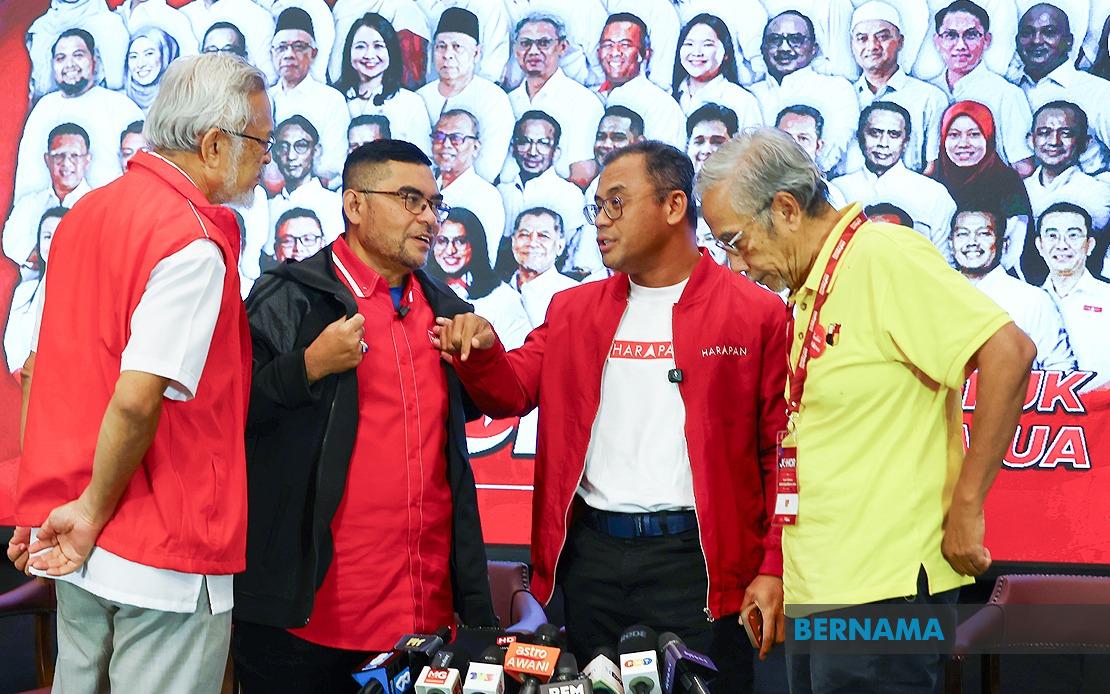
Pakatan Harapan is preparing to undertake a detailed examination of the factors that shaped the Johor state election outcome, using the findings to fortify its electoral machinery and campaign strategy before contesting the Negeri Sembilan state election. The coalition's focus on understanding voting pattern shifts and assessing its performance among younger voters signals a data-driven approach to revitalising its competitiveness in the coming state contests.
Amirudin Shari, the Selangor Menteri Besar and PKR's Election Co-director, articulated this position at a press conference held at the Pakatan Harapan Operations Centre in Johor Bahru on the evening of the Johor polls. He emphasised that the coalition would not rush to conclusions about the implications of the Johor results, noting that several state seats remained unconfirmed at that juncture. His cautious stance reflected the coalition's desire to obtain accurate and final figures across all polling stations before conducting its review.
The Johor election delivered a significant setback for Pakatan Harapan, with Barisan Nasional securing 29 of the 56 state seats—a comfortable majority exceeding 50 per cent of the contested seats according to Election Commission chairman Datuk Seri Ramlan Harun. For the opposition coalition, which had harboured hopes of expanding its footprint in the southern state, the outcome underscored the challenges it faces in displacing the long-entrenched ruling coalition from several key strongholds. The result also serves as a sobering reminder of the electoral dynamics at play in peninsular Malaysia, where traditional voting patterns and demographic factors continue to favour Barisan Nasional in certain regions.
Amirudin indicated that Pakatan Harapan would initiate a week-long review process to dissect the mechanics of the Johor election. This comprehensive examination is expected to encompass voter behaviour across different demographic segments, the effectiveness of campaign messaging, and the performance of individual candidates. By investing time in understanding what resonated—and what did not—with voters in Johor, the coalition aims to avoid repeating missteps in Negeri Sembilan, where the political landscape presents both opportunities and risks.
The coalition's next immediate challenge centres on Negeri Sembilan, a state where Pakatan Harapan currently holds the reins of government under Menteri Besar Datuk Seri Aminuddin Harun. Unlike Johor, where Baristan Nasional's dominance remains entrenched, Negeri Sembilan represents terrain where the opposition coalition believes it can consolidate and defend its control. Amirudin expressed confidence that the coalition would retain the state administration, citing the track record of the incumbent Menteri Besar and the performance of the state government in delivering for residents.
The coalition's strategy for Negeri Sembilan hinges substantially on the appeal and credibility of Aminuddin Harun, whose administration has reportedly delivered tangible results in the state. By framing the election as a referendum on the state government's achievements rather than broader federal political dynamics, Pakatan Harapan seeks to insulate itself from potential backlash arising from national-level political developments. This localised approach reflects a recognition that state elections can differ markedly from federal contests in terms of voter priorities and decision-making calculus.
Candidate selection represents another critical element of the coalition's Negeri Sembilan preparation. Amirudin announced that discussions to finalise the slate of candidates would commence the day following his press conference, with the full list of Pakatan Harapan candidates scheduled for announcement on July 14. This timeline suggests a structured and deliberate process aimed at ensuring that nominated candidates not only align with coalition values but also possess credibility and resonance within their respective constituencies. The involvement of representatives from multiple coalition partners, including Amanah officials present at the press conference, underscores the collaborative nature of candidate vetting.
Meanwhile, Amirudin moved to reassure observers that electoral contests at the state level would not precipitate instability at the federal level. He underscored the commitment of all component parties within the federal coalition to maintain governmental cohesion through the remainder of the current parliamentary term. Notably, he cited Barisan Nasional's parallel commitment to federal stability, suggesting a degree of pragmatic understanding amongst competing political entities that wholesale disruption of central governance serves no party's long-term interests.
The broader political context reveals a sophisticated calculation by Pakatan Harapan leaders: although the Johor result represented a disappointment, the coalition must demonstrate resilience and strategic adaptability to maintain credibility with its base and with swing voters. By publicly committing to a thorough post-election review and by projecting confidence in its ability to retain Negeri Sembilan, the coalition seeks to frame the Johor outcome as a temporary setback rather than a harbinger of electoral collapse. This narrative positioning becomes especially important in sustaining morale amongst party activists and donors as the coalition gears itself for successive state contests.
For Malaysian political observers, the unfolding sequence of state elections serves as a revealing barometer of shifting voter sentiment across the federation. The Johor result suggests that Barisan Nasional retains considerable organisational and grassroots strength, particularly in states where it has governed for extended periods. Conversely, Pakatan Harapan's determination to mount a vigorous defence of Negeri Sembilan indicates that the opposition coalition is not retreating from electoral competition but rather recalibrating its tactics and focusing resources on winnable terrain. The coalition's emphasis on understanding voter behaviour and refining candidate selection also hints at institutional learning within Pakatan Harapan, suggesting that the organisation is adapting to electoral realities rather than persisting with approaches that have demonstrably underperformed.
Looking beyond the immediate contests, the state election cycle occurring throughout 2023 will significantly influence the trajectory of Malaysian politics leading towards the next federal election. Both Barisan Nasional and Pakatan Harapan have vested interests in converting state-level victories into momentum for federal campaigns. For Southeast Asia's third-largest economy, the stability of governance—both at state and federal levels—carries implications for policy continuity, investor confidence, and regional strategic positioning. Amirudin's explicit reassurances about federal stability should therefore be understood not merely as political rhetoric but as recognition of the interconnectedness between state electoral outcomes and the broader health of Malaysia's political system.

