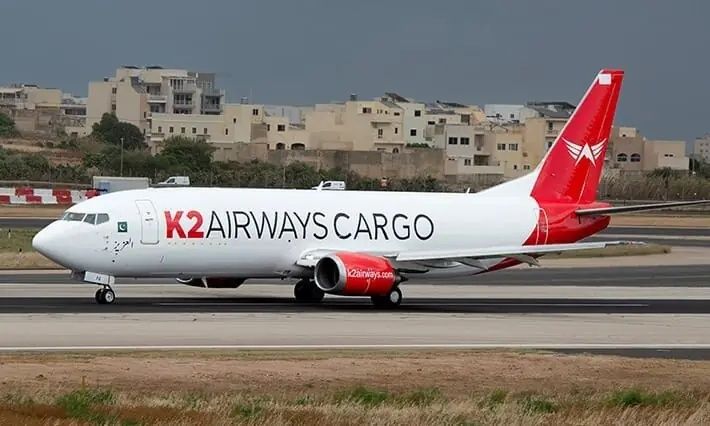
Pakistan mobilized its naval forces, merchant vessels, and military aircraft Wednesday in a desperate search for a K2 Airways Boeing 737-400 cargo plane that vanished off its southern coast en route from Sharjah to Karachi. Prime Minister Shehbaz Sharif acknowledged the aircraft had crashed into the Arabian Sea, carrying five crew members whose fate remained unknown as rescue teams raced against time in the Arabian waters.
The aircraft's final moments painted a disturbing picture of mechanical distress. According to the Pakistan Airports Authority, radar operators detected the plane entering a rapid descent at 21:21 local time on Tuesday evening, roughly 155 nautical miles west of Karachi, after the pilot had reported a navigational system malfunction. Communication with the cockpit severed abruptly during this critical phase, leaving investigators with fragmented data and unanswered questions about what transpired in those final minutes.
Flight tracking data provided additional clues to the unfolding tragedy. Flightradar24, the aviation monitoring service, recorded troubling variations in the aircraft's altitude profile: initial descent, followed by a brief climb, then a sudden and catastrophic plunge. This erratic pattern suggested the pilots may have attempted to regain control after encountering serious technical difficulties, though the severity and nature of the malfunction remained unclear as authorities began preliminary investigations.
K2 Airways, the operator, is a private Pakistani cargo carrier offering both scheduled and charter services across South Asia and beyond. The aircraft itself, though relatively modern in appearance, carried considerable history. Manufactured in 1999, it had previously served as a passenger plane for Russia's Aeroflot and Indonesia's Garuda Indonesia before being reconfigured for cargo operations in 2012. The age of the aircraft and its conversion history would likely feature prominently in the accident investigation.
Prime Minister Sharif's statement reflected the gravity of the situation, expressing profound sorrow over what he termed a tragic incident. He directed Pakistan's civil aviation authorities, navy, and air force to deploy maximum resources toward locating the wreckage and recovering the crew members. The coordinated response underscored the high priority authorities attached to the operation, with military assets mobilized alongside civilian search resources in what would become a round-the-clock effort.
The search and rescue coordination revealed the scale of Pakistan's response capability. Navy vessels worked in tandem with commercial shipping operating in the Arabian Sea, while military aircraft provided aerial reconnaissance and coordination from above. The involvement of merchant vessels suggested authorities were drawing on private sector shipping companies to expand search coverage across the vast and challenging waters where the plane disappeared.
This incident arrives at a particularly sensitive moment for Pakistan's aviation sector. The country has endured a troubled recent history with aircraft accidents, experiencing several catastrophic crashes within the past decade, notably including the 2020 Pakistan International Airlines disaster near Karachi that killed 97 people. That tragedy had exposed systemic weaknesses in aviation safety and maintenance standards, damaging international confidence in Pakistani carriers.
International scrutiny of Pakistan's aviation practices had been severe. The European Union imposed a four-year ban on Pakistan's national carrier from operating in its airspace, citing safety and licensing deficiencies that reflected broader concerns about regulatory oversight. Although the EU lifted its ban in 2024 after Pakistan addressed certain safety measures, the move was conditional and demonstrated the persistent international skepticism about Pakistani aviation standards. This latest accident could reignite those concerns and prompt renewed scrutiny of private cargo operators like K2 Airways.
For Malaysia and Southeast Asian aviation authorities, the incident offers a sobering reminder of the interconnected nature of regional air transport. Pakistani carriers, particularly cargo operators, frequently transit Southeast Asian airspace and use regional airports. The technical and operational standards of all carriers operating in shared spaces have implications for regional safety. Malaysian aviation regulators monitor developments in neighboring countries' aviation sectors, and incidents like this often trigger reviews of regulatory coordination and safety information-sharing protocols.
The investigation's findings will likely carry implications beyond Pakistan. Cargo aviation, which has expanded significantly across South Asia driven by e-commerce growth, operates with less public visibility than passenger services. Yet accidents involving cargo planes can reveal systemic issues affecting the entire regional air transport system. Malaysian stakeholders in aviation, including operators, regulators, and airports, will monitor how Pakistan investigates the technical and operational factors that led to this crash.
As search operations continued, the broader question of safety culture in South Asian aviation remained pressing. Regulatory frameworks, maintenance standards, pilot training, and aircraft aging all factor into accident causation. Pakistan has attempted to strengthen its civil aviation authority and implement international standards, but incidents like this suggest challenges remain in execution and enforcement. The investigation findings could provide valuable lessons not only for Pakistan but for the entire region grappling with balancing rapid aviation sector expansion against safety requirements.
The families of the five crew members faced an agonizing wait as rescue efforts unfolded. Beyond the immediate human tragedy, this incident underscored why rigorous international aviation standards and consistent regulatory enforcement matter profoundly. For Pakistan, the challenge lies in sustaining the improvements begun after previous accidents. For the broader Southeast Asian region, it reinforces the importance of coordinated oversight and information-sharing to ensure safety across shared airspaces.

